The frames of the cushions and backs, hinged together, are made of strong metal frames. Wire springs are attached to the frames. To avoid squeaking, the ends of the springs are covered with a layer of polyethylene. Soft padding made of foamed polyurethane foam is installed on the frames of the cushions and backs. The upholstery is made of artificial leather on a knitted base (there may be options made of cloth) with a synthetic wool backing, which after dielectric welding produces clear decorative reliefs.
The seat slides (Fig. 199) consist of guides 3 and sliders, which are stamped from sheet steel. The slider moves along the guide on two rollers 8. The slider's displacements to the sides and upwards are eliminated by two pairs of steel balls 7, located in the channels between the walls of the slider and the guide with a tension of up to 0.3 mm.
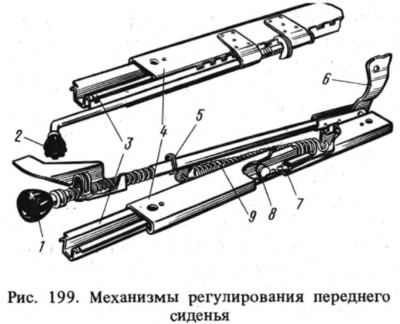
The seat is fixed in the desired position by a latch, which, under the action of a spring, enters one of the grooves of the comb-shaped retainer welded to the guide rail of the runners. The latch is released by handle 2 when it is pressed downwards.
The backrest tilt adjustment mechanism consists of a rod pivotally connected to the backrest amplifier 6, a screw 1 with a plastic handle, a lock? and a spring 9. The annular notches of the screw 1 in the front part engage with the teeth of the lock. When the screw handle is raised up (coarse adjustment of the backrest tilt) the screw disconnects from the teeth of the lock, spring 9 moves the backrest forward or the driver presses it back. When the handle is turned (fine adjustment) the screw is held in place by a lock, and the rear threaded end of the screw moves the seat back via a rod. To prevent the screw from being completely unscrewed, there is a groove on the threaded end of the screw into which a cotter pin 5 is inserted.
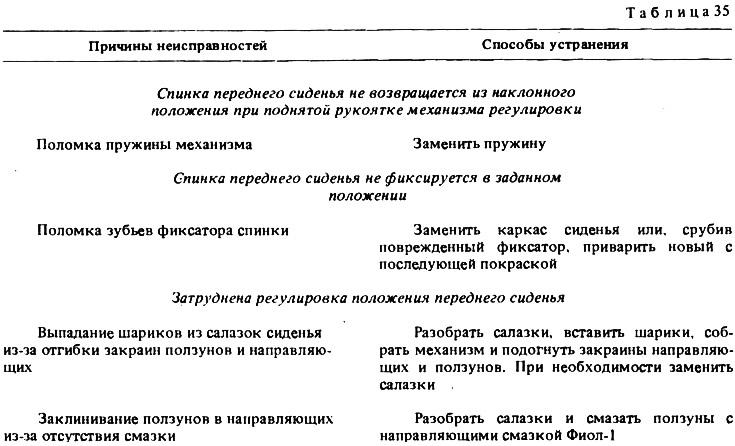
Possible malfunctions of the control mechanism, their causes and methods of elimination are given in Table 35.