




Open large image in new tab »
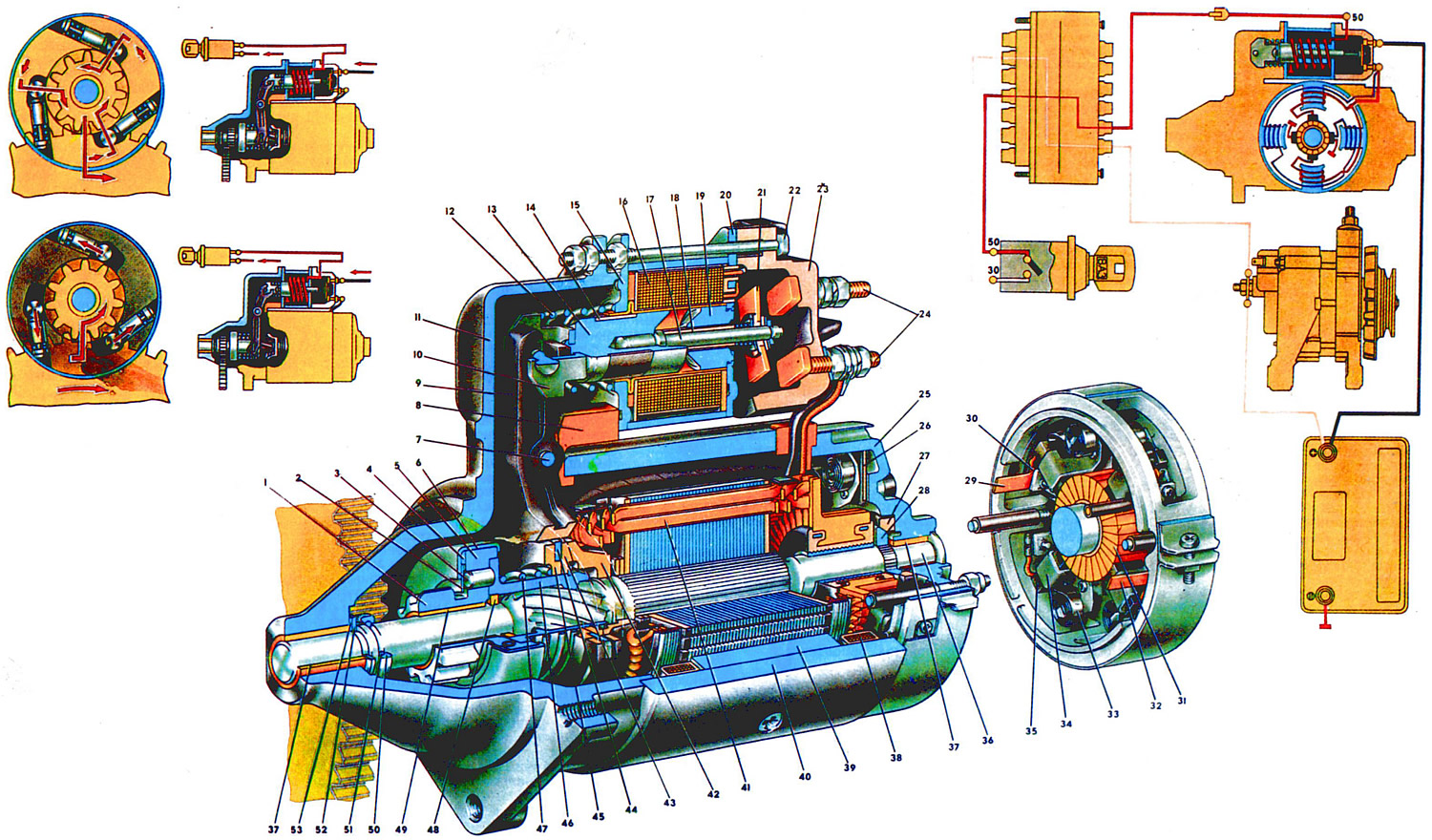
Fig. 30: 1. Drive gear. 2. Overrunning clutch thrust half ring. 3. Overrunning clutch roller. 4. Overrunning clutch centering ring. 5. Overrunning clutch outer ring. 6. Overrunning clutch casing. 7. Drive lever axle. 8. Starter cover sealing plug. 9. Starter drive lever. 10. Relay armature rod. 11. Starter cover on the drive side. 12. Relay armature return spring. 13. Relay armature. 14. Sliding sleeve. 15. Relay front flange. 16. Solenoid relay winding. 17. Armature rod. 18. Armature rod sliding sleeve. 19. Relay core. 20. Relay core flange. 21. Contact plate. 22. Relay tie bolt. 23. Relay cover. 24. Relay contact bolts. 25. Starter cover on the commutator side. 26. Inner insulating plate of the positive brush holder. 27. Cover brake disc. 28. Armature shaft brake disc. 29. Stator winding shunt coil terminal. 30. Starter brush terminal. 31. Commutator. 32. Stator winding series coil terminal. 33. Brush spring. 34. Brush holder. 35. Starter brush. 36. Armature shaft. 37. Starter cover bushing. 38. Stator winding shunt coil. 39. Stator pole. 40. Starter housing. 41. Armature winding. 42. Pinion disengagement travel limiter. 43. Pinion travel limiting disk. 44. Drive ring. 45. Centering disk. 46. Overrunning clutch hub. 47. Buffer spring. 48. Overrunning clutch hub insert. 49. Drive pinion sleeve. 50. Pinion travel limiting ring. 51. Retaining ring. 52. Armature shaft thrust washer. 53. Axial free play adjusting washer. 54. Guide rod. 55. Plunger 56. Auxiliary starter relay. 57. Mounting block. 58. Ignition switch. 59. Starter. 60. Generator. 61. Battery. I - Overrunning clutch operation diagram II - Starter connection diagram.
Technical specifications:
- Nominal voltage, V — 12
- Nominal power, kW — 1.3
- Direction of rotation (from the gear side) - right
- Starter weight, kg — 8.5
To start the engine, most cars produced use the ST-221 starter with electromagnetic engagement of the drive gear, with a roller overrunning clutch and remote control. It is installed on the right side of the engine and is fastened with a flange to the clutch housing with three bolts.
Since 1986, some cars produced have been equipped with the 35.3708 starter. It is distinguished by the use of an end collector and by the fact that it has three series and one shunt coil in the stator winding.
The ST-221 starter is a four-brush, four-pole DC electric motor with mixed excitation and consists of a housing 40 with excitation windings, an anchor with a drive, two covers 11 and 25 and a traction relay. The covers and the starter housing are pulled together by two studs that are screwed into the cover 11 and insulated with plastic tubes to prevent short circuits with the terminals of the series coils of the stator winding.
The body is made of a steel strip rolled into a ring and welded end-to-end and has four steel poles 39 secured with screws. The winding coils are placed on the poles. The body together with the poles and the winding forms the starter stator.
Two series coils are connected to each other in parallel, and to the armature winding - in series. Since the main current consumed by the starter and dependent on the braking torque on the armature shaft passes through them (the greater the torque, the greater the current), then the coil winding consists of copper tape. The turns of the coils are insulated from each other with electrically insulating cardboard.
The shunt coils are connected to each other in series and to the armature winding in parallel. A relatively small current flows through them, depending mainly on the voltage of the storage battery. Therefore, the shunt coils are wound with copper wire in enamel insulation. All stator coils are wound with cotton tape and impregnated with varnish.
The starter anchor consists of a shaft 36, a core with a winding 41 and a collector 31. The anchor shaft rotates in two porous metal-ceramic bushings 37, pressed into the starter covers and impregnated with oil. The axial free play of the anchor shaft is adjusted by selecting washers 53 and should be within 0.07-6.7 mm.
The anchor core is assembled from 1 mm thick electrical steel plates pressed onto the middle part of the shaft, which has a longitudinal knurling. Along the edges of the core, there are plates made of electrical insulating cardboard. The core has manholes of a half-forgotten shape, into which the anchor wave winding made of copper tape is laid. In each slot there are two winding conductors, insulated from the core and between themselves by electrical insulating cardboard. The edges of the winding coming out of the core slots are pulled together by bandages, which protect the winding conductors from bending by centrifugal force at a high rotation frequency of the anchor. The bandages are made of copper wire wound on a cardboard lining. Some starters have a bandage only on the drive side and are made of nylon fiber. The ends of the winding are soldered to the plates of the collector 31, pressed onto the shaft.
The collector consists of a plastic base reinforced with two steel rings, on which copper plates of the collector lamellae are installed, isolated from each other. In some starters, the plastic base of the collector can be with a steel hub-sleeve.
In the cover 25, cast from an aluminum alloy, four steel brush holders 34 with copper-graphite brushes are riveted. Two brush holders are insulated from the cover by plastic plates, internal 26 and external. These are the brush holders of the positive brushes. The terminals of the series coils are connected to them, the other two brush holders are riveted directly to the cover 25 and, therefore, are connected to the ground. These are the brush holders of the negative brushes. The terminal of the shunt coils is connected to one of these brush holders. The brushes are pressed to the collector by spiral springs with a force of up to 10 N (1 kgf).
The starter drive is mounted on the front end of the armature shaft, consisting of a roller overrunning clutch and gear 1. The purpose of the overrunning clutch is to transmit torque from the starter armature shaft to the flywheel ring when starting the engine, and after starting, when operating in the overrunning mode, to prevent torque from being transmitted from the flywheel to the armature. Otherwise, the armature winding may be ejected from the core slots due to the "runaway" of the excessively high rotation frequency of the armature by the flywheel of the running engine.
The coupling consists of a hub 46, an outer ring 5 with rollers 3 and an inner ring combined with a gear 1 of the drive. A plastic centering disk with a steel leash ring 44 and a plastic limiting disk 45 are mounted on the coupling hub 46, pressed by a spring to the locking ring on the hub. The hub has internal screw splines on one side and can rotate and move along the screw splines of the anchor shaft. On the other side, an oil-impregnated metal-ceramic insert 48 is pressed into the hub, sliding along the smooth part of the anchor shaft. The outer ring 5 of the overrunning clutch is fastened to the hub with three rivets. It contains three rollers 3 with plungers 55, springs and guide rods 54. These parts are kept from falling out by a steel casing 6. On starters of later releases, the cylindrical plungers are replaced by L-shaped plate pushers. The grooves in which the rollers 3 are located have a variable width. The rollers are pressed by springs into the narrow part of the groove, in which they are wedged between the outer 5 and inner rings of the clutch when transmitting rotation from the starter to the flywheel ring and transmit rotation from the outer ring to the inner ring, i.e. from the shaft to the gear. After starting the engine, the gear, and therefore the inner ring, will rotate faster (i.e. to overtake the outside) and the rollers will be thrown into the wide part of the groove, where they will rotate freely without jamming and the torque will not be transmitted by the clutch.
The casing 6 also secures two thrust half rings 4, which enter the annular groove of the gear 1. The gear has a brass bushing with graphite inclusions and can move freely along the smooth end of the armature shaft and rotate on it.
Cover 11 of the starter on the drive side is cast from cast iron, since the starter is attached to the clutch housing by the cover flange and it experiences the greatest loads. To ensure correct engagement of the starter gear with the flywheel ring gear, cover 11 has a centering belt that enters the hole in the clutch housing. A traction relay is fixed to the cover.
the electromagnetic traction relay of the starter serves to engage gear 1 with the flywheel ring gear and to close the power supply circuit of the anchor and stator windings. Two windings are wound on a frame made of a brass tube and two cardboard cheeks: a holding (wound on the outside) and retracting (wound inside). Both windings are wound in one direction. The beginnings of the windings are soldered to the plug "50". The end of the holding winding is welded to the flange 20, i.e. connected to the "ground", and the end of the pull-in winding is connected to the lower contact bolt 24. On starters produced before 1981 there was only one winding.
Steel flanges 15 and 20 together with the yoke form the magnetic system of the relay. Core 19 is welded to flange 20. On one side of anchor 13 of the relay, rod 10 is riveted for coupling with lever 9, and on the other side, rod 17 is rolled, passing through an opening in the core and having a spring-loaded copper contact plate 21 at the end. In order to improve the sliding of the anchor and to eliminate jamming, a sleeve made of polyamide plastic is put on anchor rod 17. When the relay is turned on, contact plate 21 closes two fixed contacts made in the form of copper bolts 24, secured with nuts on plastic cover 23. The stator winding terminals are connected to the lower contact bolt, and the wire from the storage battery is connected to the upper one. The relay flanges are pulled together with cover 23 by three bolts. The relay is attached to the starter cover with the same bolts.
The traction force from the relay is transmitted to the starter drive via a plastic lever 9, secured to the axis 7 in the cover 11. The ears of the drive ring 44 enter the grooves of the lever fork.
The starter is activated by an auxiliary relay 56 type Ri-534 or 113.3747-10, installed in the engine compartment on the right mudguard. Until 1906, this relay was not used and voltage was supplied to the windings of the traction relay directly from the ignition switch. Then the plug "50" of the starter was connected with a red wire (shown in the picture) with a mounting block. This wire is not installed with an auxiliary relay.
When the key is turned to position II ("Starter"), contacts "30" and "50" of ignition switch 58 close and current begins to flow through the winding of auxiliary relay 56, closing along the path: "plus" of the storage battery terminal - "30" of the generator - mounting block 57 - contacts "30" and "50" of ignition switch 58 mounting block winding of auxiliary relay 56 - ground.
The contacts of the auxiliary relay close and current flows through them to the windings of the traction relay along the path: "plus" of the storage battery - terminal "30" of the generator - contacts "87" and "30" of the auxiliary relay - plug "50" of the starter. Here the current path is divided into two parallel branches. One passes through the holding winding (on the diagram on the left) traction relay and to ground, and the second - through the pull-in winding (on the diagram on the right), through the stator and armature windings also to ground.
When moving, the anchor of the traction relay moves the overrunning clutch with the gear through the lever 9. The hub of the overrunning clutch, turning on the screw splines of the shaft 36 of the starter anchor, also turns the gear 1, which facilitates its engagement with the flywheel ring. In addition, the chamfers on the side edges of the teeth of the gear and the flywheel ring, as well as the buffer spring, transmitting the force from the lever 9 to the hub 46 of the clutch, facilitate the engagement of the gear and soften the impact of the gear on the flywheel ring.
When the contact bolts are closed, the pull-in winding (on the diagram on the right) the relay is de-energized, since both its ends are connected to the "plus" of the battery. But since the relay anchor is already pulled in, then to hold it in this position, a relatively small magnetic flux is required, which is created by the holding winding (on the diagram on the left).
After the traction relay contacts are closed, current begins to flow through the stator and armature windings. As a result of the interaction of the magnetic fields created by the current, the starter armature begins to rotate. The armature rotation is transmitted through the screw splines to the hub 46 and the outer ring 5 of the starter overrunning clutch. Since the clutch rollers 3 are displaced by springs into the narrow part of the groove of the outer ring, and the gear is braked by the flywheel ring, the rollers are wedged between the outer and inner rings of the overrunning clutch and the torque from the armature shaft is transmitted through the clutch and gear to the flywheel ring. At the same time, as a result of the braking of the gear and the rotation of the armature, the clutch hub 46 is unscrewed from the splines of the armature shaft and the gear is sent to the stop in ring 50, completely engaging with the flywheel.
After the key is returned to position I ("Ignition"), auxiliary relay 56 is switched off. Its contacts open and the power supply circuit of the starter traction relay through the auxiliary relay is interrupted. Now the current goes along the following path: "plus" of the storage battery - closed contacts of the traction relay - ground that pulls in and then holds the windings of the traction relay. The relay anchor is pressed back to its original position by springs and the relay contacts open, disconnecting the power supply of the anchor windings and the starter stator.
At the same time, the anchor of the traction relay with the lever 9 moves the overrunning clutch back to the initial position and removes the gear from engagement with the flywheel ring. The return spring 12 through the lever, disk 43 and limiter 42 presses on the anchor towards the cover 25. The brake disk 28 of the anchor shaft rests against the brake disk 27 of the cover, and the anchor quickly stops rotating.