




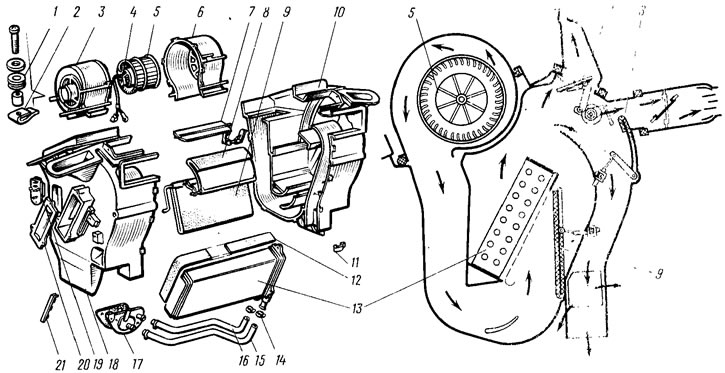
Figure 170. Heater parts: 1 - elastic bushing; 2 - spring nut; 3 - left fan shroud; 4 - electric fan; 5 - impeller; 6 - right fan shroud; 7 - century glass heating flap; 8 - foot heating flap; 9 - heater control flap; 10 - right heater casing; 11 - heater casing mounting bracket; 12 - gasket; 13 - radiator; 14 - clamp; 15 - supply hose; 16 - drain hose; 17 - crane; 18 - left heater casing; 19 - resistor; 20 - sealing cover; 21 - heater control flap bracket
The heater is secured from the passenger compartment side with four nuts to bolts welded to the air intake box by the right 10 and left 18 casings, connected to each other by brackets 11. An electric fan is mounted on top of the heater, consisting of the right 6 and left 3 fan casings and an electric motor 4 with an impeller 5. A resistor 19 is secured to the left casing 18.
Radiator 13 is inserted into the heater casing, secured with three screws to the right casing 10 and sealed with gasket 12. Hoses 15 and 16 connect the radiator to tap 17, which is connected to the cooling system and sealed on the front shield with a gasket. The circulation of liquid through radiator 13 is carried out by the engine cooling system pump.
The air supplied by the electric fan to the heater housing can enter the passenger compartment, bypassing the heater radiator, or completely pass through the radiator, or mix with some of the air that has passed through the radiator. Control is performed by damper 5 (figure 171) heater control, the lever of which is connected by rod 19 to lever 18. Air can be directed into the passenger compartment through air duct 2 (figure 172) to the windshield heating and through the side nozzles 3, as well as through the central nozzle 4 into the body interior, and through the air duct 6 of the internal ventilation to the passengers' feet. The windshield heating is regulated by the lever 14 (see figure 171), connected by a rod to the levers 11 of the damper 10. The lever 16 of the damper 13 regulates the air flow to the passengers' feet. The heater control lever 18 is simultaneously connected by a rod 1 to the lever of the heater valve 2.
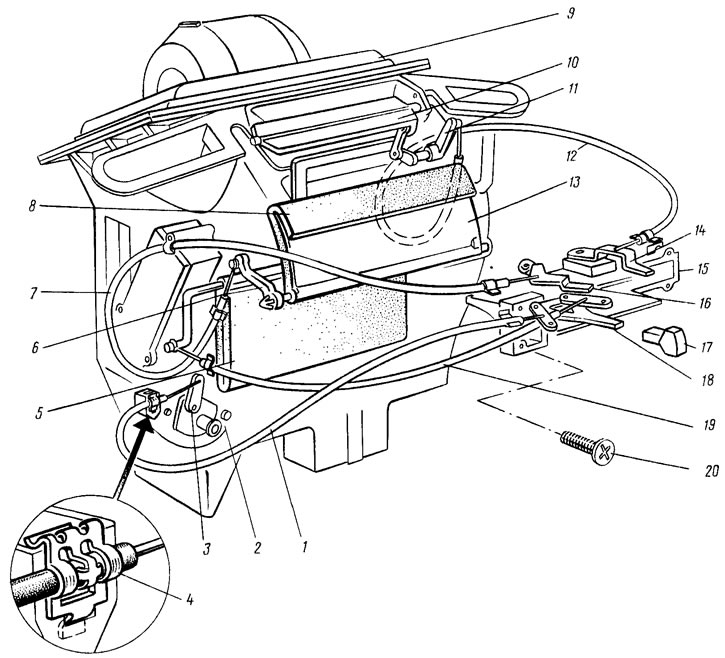
Figure 171. Heater control: 1 - crane control rod; 2 - crane; 3 - crane lever: 4 - rod casing mounting bracket; 5 - heater control flap; 6 - footwell heating flap drive lever; 7 - footwell heating flap pull; 8 - footwell heating flap seal; 9 - heater housings; 10 - Windshield heating flap; 11 - windscreen heating flap drive levers; 12 - Windshield wiper flap rod; 13 - foot warmer flap; 14 - Windscreen heating flap control lever; 15 - control lever bracket; 16 - footwell heating flap control lever; 17 - control lever handle; 18 - heater control lever; 19 - heater control flap drive rod; 20 - lever bracket mounting screws
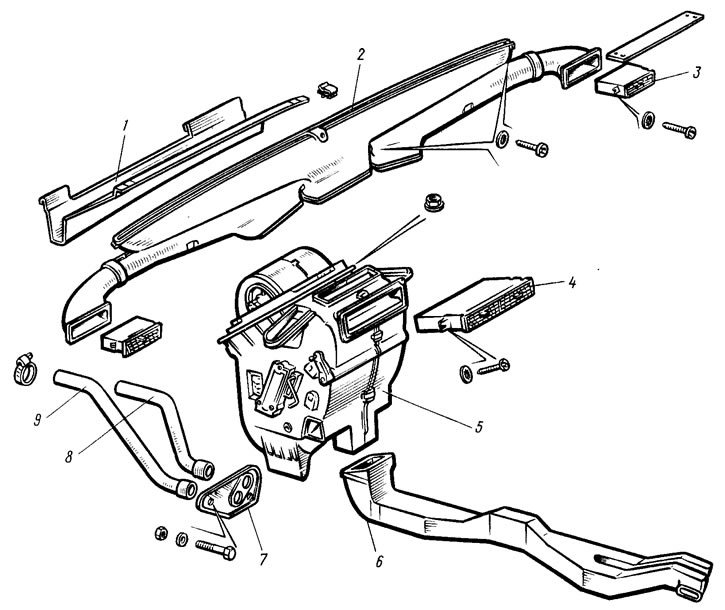
Figure 172. Heater with air ducts and ventilation nozzles: 1 - water-deflecting shield; 2 - windshield heating air duct assembled with side window air ducts; 3 - side nozzle; 4 - central ventilation nozzles; 5 - heater assembly; 6 - internal ventilation air duct; 7 - heater tap pipe seal; 8 - rear outlet hose; 9 - rear supply hose
By moving lever 18 to the right, the valve and damper 5 are opened, directing air through the heater radiator.
By turning the guide blades of the side and central nozzles, the direction of the air flow in the cabin is changed.
At an ambient temperature of minus 20°C, the heater provides an average temperature in the cabin at maximum heating mode of plus 20°C, and in the footwell area - plus 25°C.