




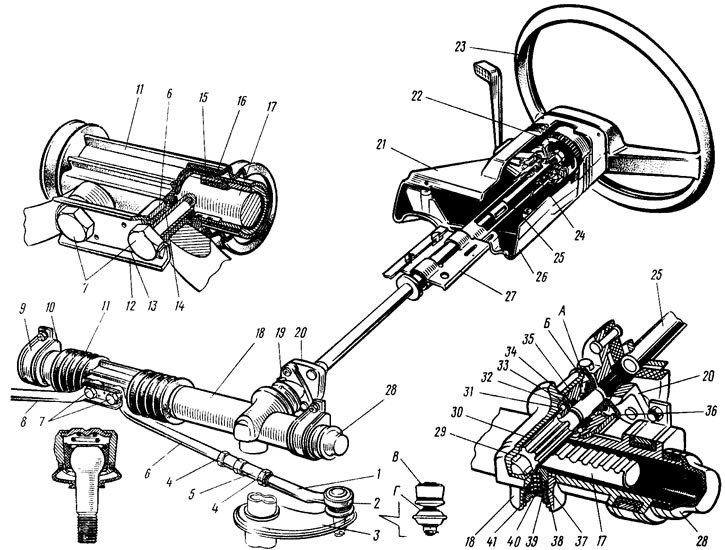
Figure 101. Steering
The steering consists of a rack-and-pinion steering mechanism and a steering drive. In the tides of the crankcase 18 (figure 101) the steering gear has a drive pinion 30 (4) mounted on roller 29 (18)* and ball 31 (19) bearings and is engaged with rack 17 (3). The rack is pressed against the pinion by spring 40 through metal-ceramic stop 39 (17), which is sealed in the housing by rubber ring 37 (15). The spring rests against nut 41 (16) with locking ring 38, which creates resistance to unscrewing the nut. The other end of the rack rests on sleeve 16 (11) with two sealing rings 15. The ball bearing of the pinion on the shaft is locked by ring 32, and is pressed against the housing seat by nut 35 (22) with sealing ring 34 (21). The nut is locked in the housing with a washer and covered with a boot 36 (23). mounted on the drive pinion shaft. A protective washer 33 is installed between the locking 32 and sealing 34 rings. Marks A and B are made on the steering gear housing and on the boot for correct assembly of the steering gear. A protective cap 28 (1) is put on the steering gear housing on the left side, and a pipe with a longitudinal groove is pressed on the right. Bolts 7 (7) for fastening rods 6 and 8 of the steering gear to the rack pass through the groove of the pipe and the holes in the protective cover 11 (12). The bolts pass through rubber-metal hinges 14 (9). pressed into the heads of the rod ends and the connecting plate 12 (8). The bolts are fixed with a lock plate 13.
* The corresponding positions in Figure 103 are indicated in brackets.
The rack travel is limited in one direction by a ring (14) pressed onto the rack, and in the other direction by a bushing (6) of the tie rod's metal-to-metal hinge 14. In this case, both the ring and the bushing rest against the steering gear housing.
The steering shaft is connected to the drive gear 30 (4) by an elastic coupling 20. The upper part of the shaft rests on a radial ball bearing 24. At the upper end of the shaft, the steering wheel 23 is secured with a nut on splines through a damping element 22.
The steering gear consists of two horizontal rods 6 and 8 and pivot arms 3 of the telescopic struts of the front suspension. The length of each rod is changed by a tubular rod 5, which is screwed onto the rod ends and locked with nuts 4. The head of the rod end 1 contains the parts of the ball joint 2: insert, pin and spring. Pivot arms 4 are welded to the front suspension struts.
Possible steering malfunctions, their causes and methods of elimination are given in table 13.