




The steering wheel is mounted on the splines of the upper shaft of the steering column and secured with a self-locking nut.
The steering column consists of the upper and intermediate steering shafts connected by a cardan joint and a bracket for their attachment. The upper steering shaft rotates in two bearings pressed into the bracket tube. An ignition switch with an anti-theft device is installed on the bracket tube.
The pipe has the ability to move in the longitudinal and vertical direction relative to the bracket itself, after which it is fixed in the selected position with a tie bolt, on which
an adjusting sleeve with a lever is installed. By lowering the lever, you can change the height of the steering wheel. By raising the lever, the wheel is fixed in the selected position. The front end of the steering column bracket is attached to the body using bolts with breakaway heads and special locking plates. The bolts are tightened until the heads break off. This prevents them from unscrewing and replacing the steering column together with the ignition switch in an attempt to steal the car. The steering column's injury safety is ensured by special locking plates. In the event of a frontal impact, the plates are deformed and stop holding the front part of the steering column bracket, allowing it to drop down. In this case, the steering column is moved to a vertical position, and the steering wheel moves away from the driver.
The intermediate steering shaft is connected to the steering gear via a rubber flexible coupling, which allows for slight misalignment of the drive shaft and the lower shaft of the steering column.
The steering gear is a rack-and-pinion type, consisting of a housing, a drive pinion and a steering rack, which are in a toothed engagement. The steering gear is attached to the engine shield using two rubber supports, two clamps and four bolts with nuts. When turning the steering wheel, the rotation is transmitted through the upper and intermediate shafts of the steering column to the drive pinion, which, turning, moves the rack.
The steering rods consist of the steering rods themselves, the ends and the threaded inserts that connect the steering rods and the ends. The ends of the steering rods have ball pins installed.
One end through the silent block (rubber-metal hinge) the steering rods are attached to the steering rack of the steering mechanism, and the tips, using ball pins, to the pivot arms of the shock absorber struts of the front suspension. When the steering rack moves, the rods turn the struts of the front suspension, on which the drive wheels are mounted.
The length of the steering rods can be adjusted by rotating the threaded inserts, thereby changing the toe-in of the front wheels.
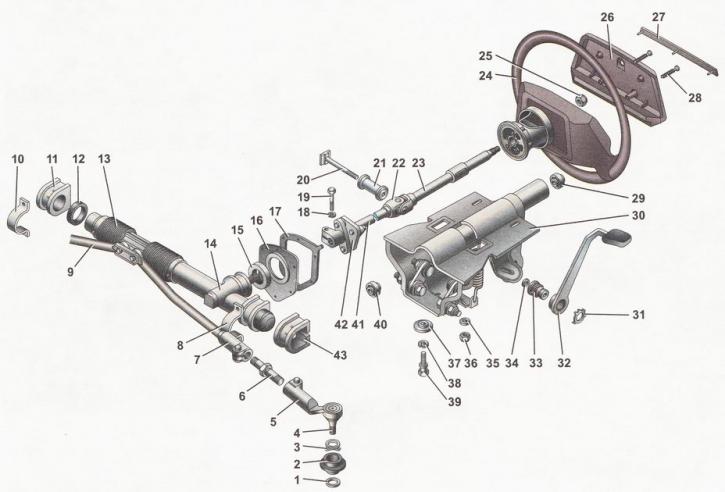
Steering device diagram: 1 - sealing ring; 2 - Tie rod end protective cover; 3 - spring ring; 4 - ball pin; 5 - steering rod end; 6 - threaded insert; 7 - left steering rod; 8, 10 - steering gear mounting brackets; 9 - right steering rod; 11 - right support of the steering gear; 12 - spacer ring; 13 - Steering gear protective cover; 14 - steering mechanism; 15 - seal; 16 - thrust plate; 17 - gasket; 18 - spring washer; 19 - bolt; 20 - tie bolt; 21 - spacer sleeve; 22 - cardan joint; 23 - upper steering shaft; 24 - steering wheel; 25 - steering wheel mounting nut; 26 - steering wheel trim; 27 - decorative overlay; 28 - self-tapping screw, 29, 40 - bearings; 30 - Upper steering shaft mounting bracket; 31 - retaining ring; 32 - steering column adjustment lever; 33 - adjusting sleeve; 34, 35 - washers; 36 - self-locking nut; 37 - fixing plate; 38 - spring washer, 39 - special bolt with breakaway head; 41 - intermediate steering shaft; 42 - rubber elastic coupling; 43 - left support of steering gear