




Caution! Loosen and tighten the wheel mounting bolts only with the vehicle on the ground. Bolt tightening torque 65-95 N·m (6.5-9.5 kgf·m).
Caution! Do not use gasoline, diesel fuel or any other mineral solvents to clean brakes.
Attention! The minimum permissible thickness of the linings is 1.5 mm. If you have any doubts that the thickness of the friction lining is within the permissible limits or its surface is oily or there is a suspicion that the friction lining is not firmly connected to the base, be sure to remove, check and, if necessary, replace the pads. The linings should not have deep grooves or chips.
Attention! When installing old pads, replacing the inner and outer pads with each other, as well as between the left and right wheels, is not allowed. This may lead to uneven braking.
Attention! The surface of the friction linings should not be oily, have deep scratches and chips. The lining should be firmly connected to the base of the pad. If, during the next check, the thickness of the linings approaches the minimum permissible, then such pads are still functional, but their service life will soon end. Choose for yourself whether to immediately replace the pads or constantly monitor their thickness.
The text is taken from the online resource: www.VazBook.ru
Caution! Brake pad sets must be replaced simultaneously on both sides of the vehicle.
Attention! Press the piston into the cylinder carefully so that it does not warp. To do this, install both worn brake pads (it is better if only the base remains from the inner one) and the bracket housing into place. Carefully move the piston with a large screwdriver or crowbar, pressing on the inner shoe and resting on the brake disc.
Attention! If the brake fluid level in the reservoir is at or near the "MAX" mark, pump out some of the fluid from the reservoir. Otherwise, it will spill over the edge when installing new pads.
1. Apply the parking brake and chock the rear wheels. Raise the front of the car and place it on supports. Remove the wheel.
2. Wash with warm water and detergent and dry the brake mechanism.
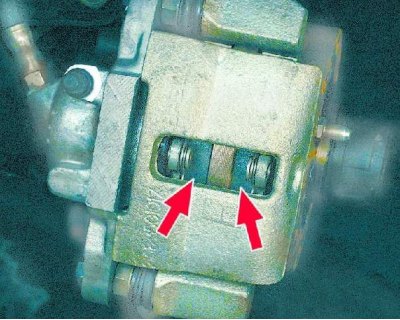
3. Visually check the condition of the brake pads through the hole in the brake caliper housing.
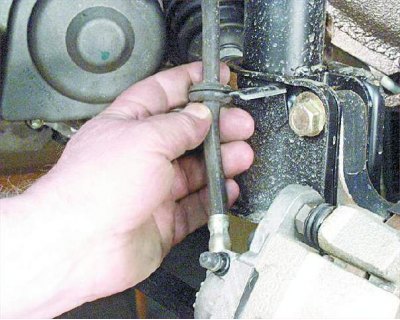
4. Remove the rubber seal together with the hose from the bracket.
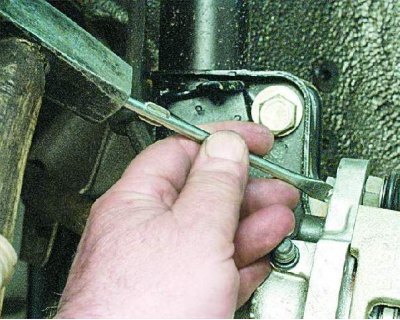
5. Use a screwdriver to bend back the tab of the lock washer on the upper guide pin mounting bolt.
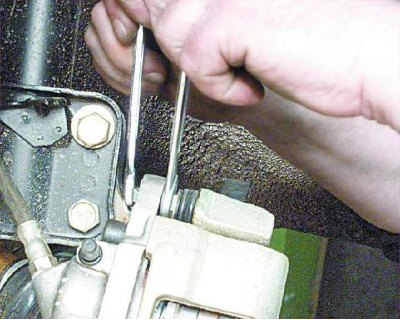
6. Loosen the upper guide pin mounting bolt, holding it with a hex key.
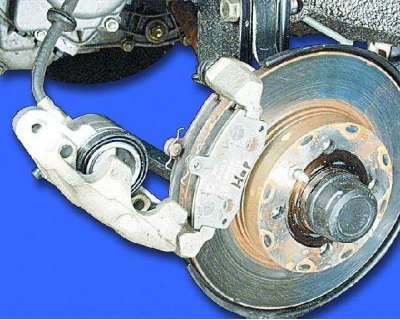
7. Rotate the bracket body downwards around the axis of the lower pin.
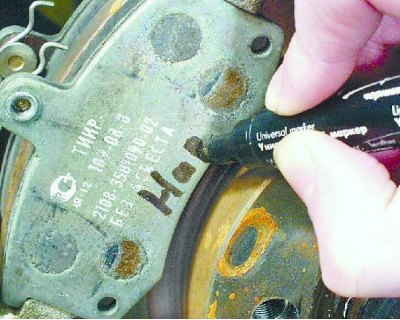
8. Mark the brake pads if you plan to reinstall them.
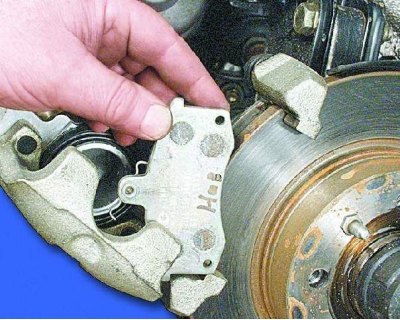
9. Remove the brake pads.
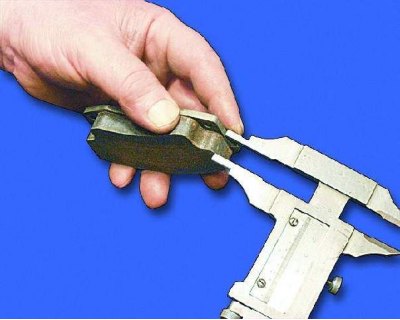
10. Check the thickness and condition of the brake pad friction linings.
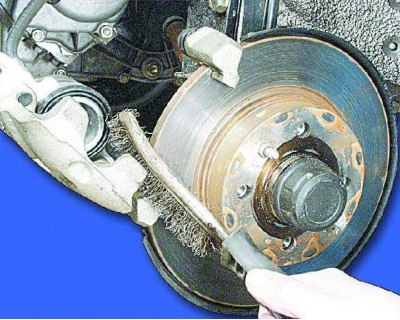
11. Clean any dirt and rust from the brake parts, especially the brake pad seats.
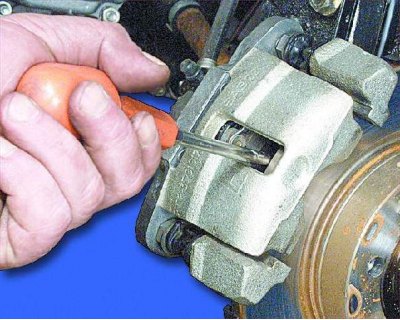
12. If you are installing new brake pads, press the piston into the cylinder.
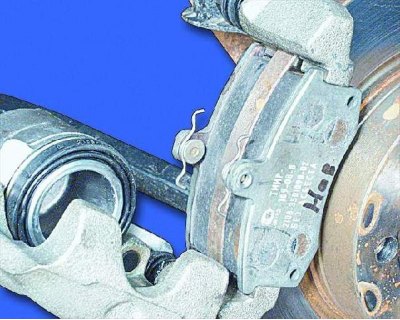
13. Install new brake pads. Make sure that the pressure springs are parallel to the top edge of the brake pads. The old pads must be installed in accordance with the previously made markings.
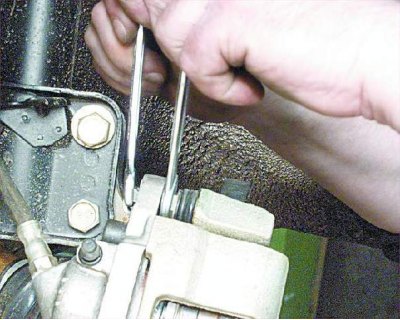
14. Turn the bracket body and tighten the upper guide pin mounting bolt to a torque of 31-38 N·m (3.1-3.8 kgf·m), while holding it with a hex key.
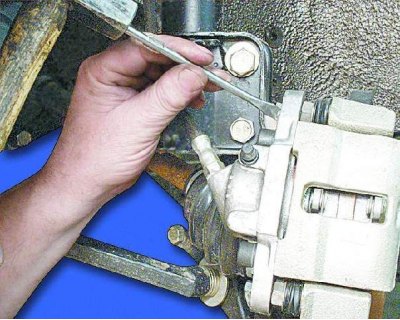
15. Bend the tab of the lock washer with a screwdriver.
16. Install the wheel and lower the car to the ground. Then press the brake pedal several times to set the piston to the working position. Check the brake fluid level in the reservoir and top up to the norm if necessary.