




Contents: Removal ↓ Installation ↓ Disassembly and assembly ↓ Checking the details ↓ Checking the brake disc runout ↓ Replacing brake pads ↓
Before you begin repairing the brake mechanisms, wash them with warm water and detergents and dry them with a stream of compressed air. The use of gasoline, diesel fuel, trichloroethylene or any other mineral solvents when cleaning the brakes is unacceptable, as it damages the cylinder seals.
Removal
Raise the front of the car, place it on stands and remove the wheel. Unscrew the nipple, disconnect the flexible hose from the line, plug the holes in the hose and steel tube to prevent leakage of brake fluid. After removing cotter pin 14 (see fig. 200), and then fingers 8 with springs 10 (see fig. 201), remove springs 15 (see fig. 200) and brake pads 16. Mark the pads so that they can be installed in their original places during assembly. Having bent the locking plates, unscrew the two bolts 9 with which the caliper is attached to the bracket, and remove the caliper.
You can remove the brake mechanism (without brake disc) assembled with the brake wells, for which disconnect the hose and unscrew the caliper mounting bolts 9.
Installation
Performed in reverse order. After that, restore the fluid level in the tank, bleed the brake drive.
Disassembly and assembly
Disconnect tube 5 (see fig. 201) and remove the dust caps 2 from the cylinders. Then, by forcing a stream of compressed air through the brake fluid inlet, push the pistons 1 out of the cylinders on the caliper 4 and remove the sealing rings 3 from the cylinders.
During long-term operation of the car, corrosion of the working cylinders occurs. In this case, as well as in case of wear or damage to the working surfaces of the cylinder or piston, replace the cylinder as an assembly. To do this, after performing the above operations, clamp the caliper in a vice, press the clamps and knock the cylinder out of the caliper grooves with a rubber hammer. Then install a new cylinder in the grooves.
Assemble the brake mechanism in the reverse order. At the same time, lubricate the sealing rings, pistons and cylinder mirror with brake fluid.
Checking the details
Check all parts by washing them with warm water and detergent and drying them with a jet of compressed air. If the piston or cylinder mirror shows signs of wear or seizure, replace the cylinder complete with pistons. In all cases where the piston is removed from the cylinder, it is recommended to replace the sealing ring in the cylinder grooves and the dust cap.
Checking the brake disc runout
Check the axial runout of the brake disc 1 (Fig. 202) without removing it from the car. The maximum permissible runout according to the indicator 2 is 0.15 mm. The indicator is installed using the magnetic support 3. If the runout is greater, machine the disc using the mandrel 67.7141.9500. Then grind it, but the final thickness of the disc should not be less than 9.5 mm. If there is damage or very deep scratches, as well as if the wear exceeds 0.5 mm on each side, replace the disc with a new one.
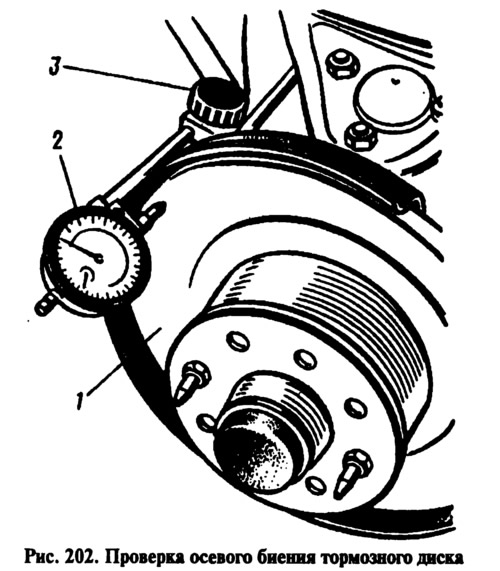
Replace the disk only together with the front wheel hub, since its final processing is carried out together with the hub. Its removal and installation with the brake disk are described in the section "Chassis".
Replacing brake pads
Replace the pads with new ones if the thickness of the linings has decreased to 1.5 mm. To replace the pads, remove the cotter pins 14 (see fig. 200) and pins 8 with springs. Then remove shoes 16 and springs 15. Carefully, so as not to damage the dust caps and prevent fluid from splashing out of the hydraulic drive reservoir, press the pistons into the cylinders. Install new shoes, then pins, springs and cotter pins, having previously applied a thin layer of some consistent lubricant to the surface of the pins.
[Information copied from the portal VAZBOOK.ru]