

It is very important to determine in time that a wheel puncture has occurred. While driving, pay attention to the behavior of the car: if it began to accelerate poorly, the effort on the steering wheel increased when maneuvering, or the directional stability worsened, be sure to check the pressure in the wheels.
The easiest way to repair a wheel is to go to your nearest tire shop, where the repair will be done quickly, professionally, and usually at a very affordable price.
Attention! Don't try to get to "tire fitting" on a completely flat tire: it is enough to drive a few tens of meters in this way, and the tire will have to be thrown away.
You need to replace the damaged wheel with a spare. This rather simple operation does require some skill.
In case of a tire puncture, turn on the alarm, brake the car smoothly to a speed of 2–3 km/h and, in first gear, try to carefully move to the edge of the carriageway and stop as far to the right as possible at the curb, and if possible, outside the carriageway. If road conditions allow and this does not contradict the requirements of the Rules of the Road, in case of a puncture of any wheel on the right side of the car, pull over to the right side of the road, in case of a puncture on the left - to the left. Avoid stopping the car in places where the road is poorly visible - in sharp turns, on descents and ascents, bridges, tunnels. If the car is left on the roadway, first of all, ensure your own safety and the safety of other road users! Turn on the hazard warning lights and set the warning triangle.
Wheel replacement
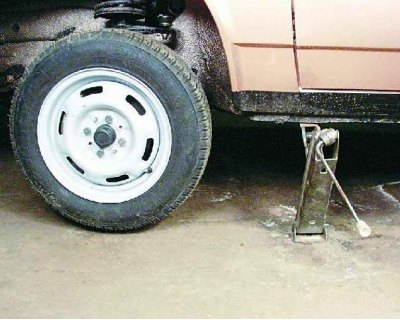
1. Engage first gear and parking brake.
Place a jack under the vehicle next to the tire to be changed. If the vehicle is on soft ground, place a wide, firm support under the bottom support of the jack (a board with a size of at least 300x300x20 mm, a flat stone, etc.).
2. In order not to get dirty when changing a wheel, put on gloves and overalls, if your car has them.
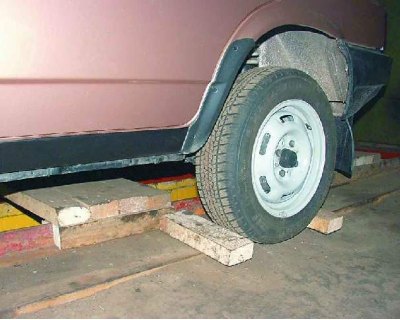
3. On the opposite side, the car must be fixed by placing wheel chocks under the front and rear wheels so that the raised car cannot move forward or backward.
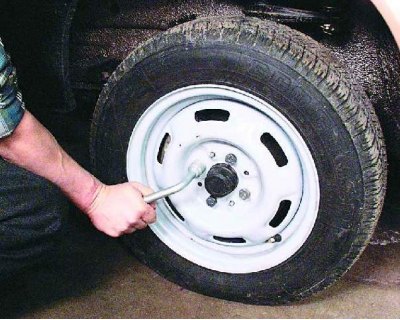
4. Using a jack, slightly raise the vehicle, but so that the wheel that needs to be replaced does not come off the road. Remove the decorative cap (if he is) and use a wheelbrace to loosen the four wheel bolts. Charming ladies are advised to purchase a special balloon wrench with a telescopic handle to facilitate this operation.
Tip: To make it easier to unscrew the wheel bolts, you can use your foot instead of your hands, stepping on the handle of the wheel wrench from above.
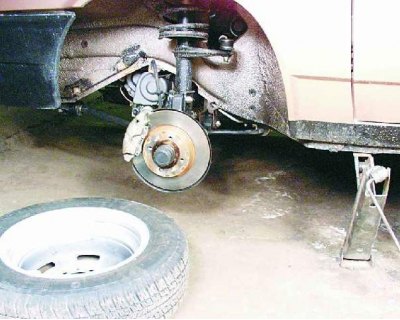
5. Raise the car with a jack until the wheel is off the road, then completely unscrew the bolts and remove the wheel.
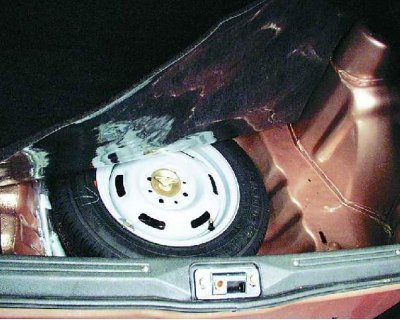
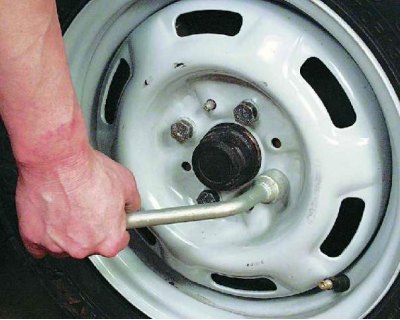
6. Install the spare wheel in place of the removed one, tighten the mounting bolts, lower the car and finally tighten the bolts. Wheel bolts are tightened crosswise. To avoid damage to the wheel rim, do not attempt to "hold out" wheel bolts by pressing the wrench handle with your foot.
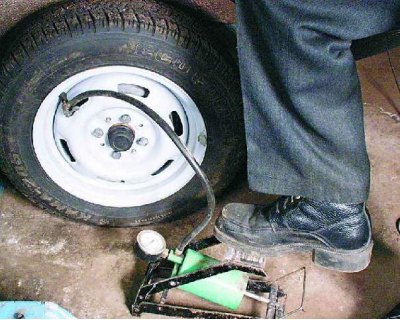
7. Be sure to check the air pressure in the tire of the installed wheel before you continue driving.
Adviсe
As a rule, tubeless tires are installed on front-wheel drive cars of the Volga Automobile Plant. If you are not a professional, we advise you not to try to fit a tire yourself. One damage to the sidewall and you have to buy a new tire or insert a tube.
In a hopeless situation, you can use a special first aid kit for repairing tubeless tires without stripping or a tire sealant. They must be used in accordance with the attached instructions.
Why is a tubeless tire better than a tubed one?
Firstly, a tubeless one descends very slowly during a puncture, you can drive for weeks with a nail in the wheel until you get tired of pumping it up.
Secondly, when steel cord wires come out of a tubeless tire with a very significant mileage, it can still be used as "spare wheels". It is useless to insert a camera into such a tire - it will pierce already during the first inflation.