




The owner faces practically one question: what to choose as a source of the music signal, a compact disc (CD) or a tape cassette? After comparing the main parameters of a tape recorder and a CD player (the frequency band of a tape recorder is 40-16,000 Hz, and of a player - 20-20,000 Hz, the noise factor is -40 and -90 dB, respectively), it becomes clear that CD players provide a qualitatively new level of reproduction of musical compositions.
If a couple of years ago the car CD player (CD receiver) cost about 500 dollars, now a good device can be bought for 300 and even 150 dollars. Moreover, the reliability and vibration resistance of the products has increased. It is safe to say that if you do not use unbalanced discs with mechanical damage, let the air in the cabin warm up before listening in the winter, and do wet cleaning more often, there will be no problems with the CD receiver.
If you have a certain budget reserve ($250), the best option would be to buy a changer, a multi-disc CD player. This is a separate unit larger than the radio, which is connected to it by a special cable through which the music signal and control commands are transmitted. Changers come in 6-, 10- and 12-disc versions. Six-disc changers fit perfectly in the glove compartment of the "ten", moreover, this place is optimal for them in terms of protection and proximity to the car heater. By purchasing a changer, you kill not two, but several birds with one stone. Firstly, there is no need to give up listening to cassettes, it is enough to buy a radio that can control the changer (with rare exceptions, these must be products from the same company). Secondly, you won't have to be distracted from driving to change the disc. Thirdly, changers provide better playback quality. And finally, they are more reliable in operation.
Which company's products should you choose when buying? There are now a huge number of new companies that are striving to conquer the domestic market. These are NRG, UDO, Prology, and we will proudly mention our Ural, etc. The devices of these manufacturers are very affordable, and if you want to stop at a regular radio, you should definitely pay attention to them, but as for laser players, it would be more correct to choose more proven brands. Among Europeans, these are Philips, Blaupunkt, Grundig. And Japanese companies are known to everyone. The most common and deservedly beloved are the products of JVS, Kenwood, Pioneer, Klarion, and for lovers of advanced things - Alpme, Nakamichi.
Front (frontal) acoustics
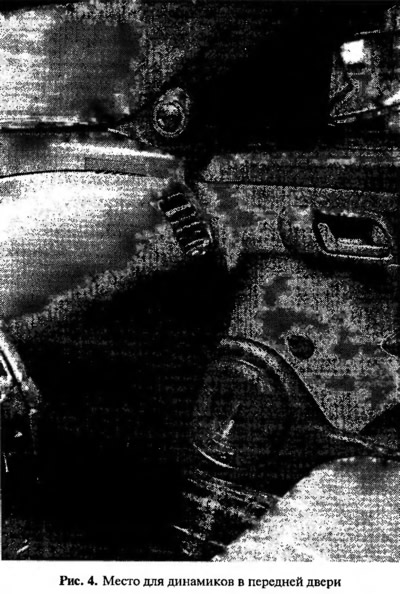
The front speakers have very important tasks of creating the right sound field in the car. They are responsible for tonal accuracy and spectral balance, and form the sound stage. Experience shows that, in relation to the VAZ-2110, the most successful in these tasks is a two-component acoustics with a low-frequency (LF) head (woofer) diameter of 16 cm. We have already noted that the doors have a seat for a 13-centimeter speaker. But these speakers do not provide the necessary depth and relief of the bass. The way out of this situation is simple - you need to increase the seating hole and calmly place the required speaker under the standard plastic grille. At the same time, to achieve truly high-quality sound, the door is carefully treated with noise-insulating materials of either our (Vizomat) or imported (VB-5) production.
High-frequency speaker of two-component acoustics (tweeter) it is fixed with the help of inclined adapters, which should be included in the delivery set, on the party prize or on the side pillars of the windshield. There can be two orientation options: directed at the listener or at the windshield, in this case the reflected signal reaches the listener's ears. In the first case, a correct from the tonality point of view, but somewhat narrowed sound stage is achieved, in the second - an expanded and deep sound stage, but with a slightly disturbed tonal accuracy and spectral balance. Which option to prefer, the owner of the car should ultimately decide, so ask the installers not to rigidly fix the tweeters, listen to both options and decide which one to give preference to.
There are usually no problems with installing crossover filters that separate the full audio signal into high-frequency and low-frequency components.
Experience has shown that the required sound quality in the "ten" can be provided by speakers in the price range of 130-180 dollars. These are products of such companies as MB Quart, Morel, Infmiri, Hertz, JBL, DLS. If you need more specific advice, please take Phoenix Gold QX6.
In conclusion, it is necessary to say that a reputable company that installs audio equipment will definitely offer to make beautiful adapters and pockets similar to those shown in Fig. 4. In this case, the speakers work in the best conditions for themselves, and the acoustic design pleases the eye and ennobles the interior of the car.
Receivers
Since the widespread distribution of digital technologies, manufacturers of automotive electronics have developed a certain gentleman's set of service functions and technical parameters of a car receiver, and now they change little. The following functions are considered standard: the presence of long and medium wave ranges (they are of little interest to anyone now), the presence of two FM ranges, the panel should have six buttons that correspond to the selected stations, in each range the possibility of automatic and manual settings.
In the equipment of noteworthy companies, the receiving part differs slightly and does not serve as a criterion for choosing a product. The only thing to be wary of is the possibility of taking a radio with the American FM broadcasting standard. But the general rule here is that we should take electronics released for Europe.
The RDS system has not received any significant distribution in our country, but again, it is definitely present in European technology.
Antennas
The absence of any places on the VAZ-2110 car body for mounting pin antennas, as well as the fact that all sorts of retractable designs did not justify themselves due to unreliability, made the active antenna of the German company Bosh, which is glued to the windshield, beyond competition. It costs 15-17 dollars, is easy to install, has excellent reception, its only drawback is that it will have to be replaced if for some reason you need to replace the windshield; So, we have considered the possibility of installing an inexpensive but good-sounding audio system in a VAZ-2110 car. For many people, this will be enough for many years, while some will want to upgrade it, add, for example, a video part, increase the power by installing separate amplifiers, young people will certainly want to have a subwoofer-speaker in an acoustic design in their car, designed to reproduce the lowest frequency range of the sound range. But these issues require a separate discussion.
Rear acoustics
If the front speakers in a car are responsible for creating a sound stage, localizing musical images, and are responsible for the tonal accuracy and spectral balance of the system, then the rear acoustics are assigned a seemingly modest role, expressed in the contemptuous word - subsonics. But if you dig deeper, things are not so simple.
Let's say you're listening to a violin concerto while sitting in a conservatory hall, most of the sound waves come to you from the front, without any distortion, but some are reflected from the walls, ceiling, chandeliers and other objects, and although the intensity of the reflected sounds is much lower than the intensity of the direct ones, it is the echoes that create the feeling of a rich sound space or environment in which the musical waves are propagating. Without a reverberation picture, the natural perception of music is disrupted, and the rear speakers are responsible for it.
Since they are designed to imitate a reflected signal, their characteristics must be an order of magnitude worse than the front speakers. Even at the dawn of Caraudio, oval speakers measuring 6x9 inches began to be installed in the rear shelf of cars, and they have not yet found a worthy replacement. There is another point here. The diffuser area of ovals is 25% larger than the area of centimeter midbass speakers, so they provide good bass support.
For the system we are creating, the optimal ones are coaxial speakers in the price range of $50-80. There is no point in buying more expensive ones, and cheap ones can be a fly in the ointment that will spoil our barrel of honey. This price category includes products from Pioneer and Kenwood, and at the same time Boston and Alpine, so the choice is very diverse.