




- open the door with your right hand,
- place your left leg parallel to the body of the car and transfer your body weight onto it,
- with your left hand, lean on the opening of the open door window or on the inside door handle,
- place your right foot as far to the right as possible under the steering wheel,
- take a seat on the seat,
- close the door tightly with your left hand.
Note: Some drivers, especially women, get into a car head first, with their right hand on the seat back and their left hand on the top of the steering wheel. In this case, their head often hits the inside rearview mirror. This is not very comfortable.
Correct driver positioning in the cabin ensures the least fatigue, ease of use of instrument controls and good visibility. Once in the car, you need to sit comfortably, adjust the seats so that your feet can easily be placed on the pedals, lean on the back, and your hands on the steering wheel should be slightly bent at the elbows.
The adjustment of the seat and backrest to the figure consists in the fact that, using the adjustment handles, the seat moves forward and backward while simultaneously setting the backrest tilt. The backrest tilt allows you to distribute the body weight on the seat and backrest, relax the rib muscles to the greatest extent, and provides comfortable bending of the legs at the knee.
After adjusting the seat, do this exercise: without holding the steering wheel, lift your feet off the pedals. If you maintain balance in this position, then everything is fine, and if you are pulled forward, you will have to move the backrest back.
The comfort of landing is also determined by the inclusion of third gear. If the back does not come off the seat, then everything is fine. The legs should press the pedals to the floor, remaining in a semi-bent position.
If after you start moving you start to fidget in the seat and change your body position, then the seat and backrest are adjusted incorrectly.
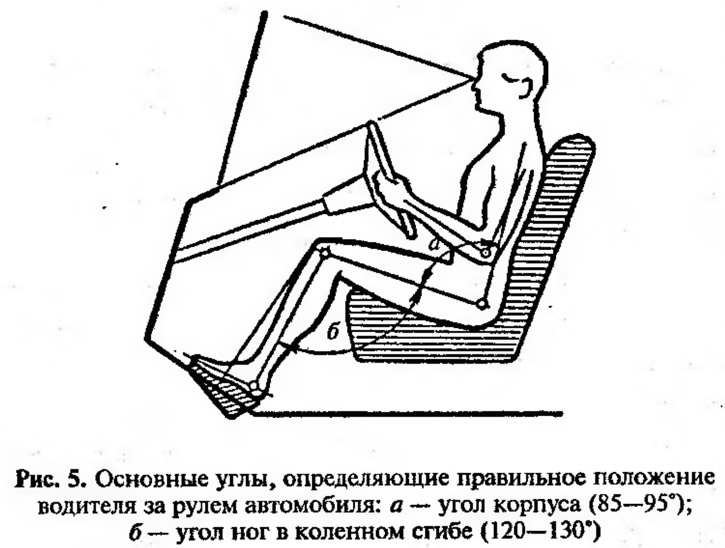
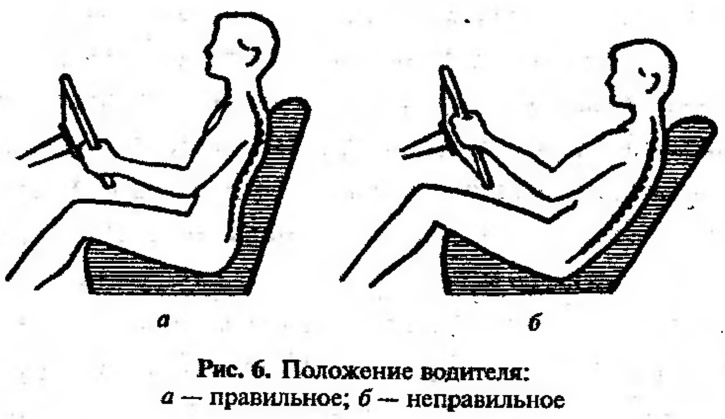
Fig. 5 shows the main angles that determine the correct position of the driver. Fig. 6 shows the correct and incorrect position of the driver behind the wheel.
If you mainly drive alone and do not alternate with other drivers, you should finally adjust the seat so that it is comfortable for you. Especially since a seat that is too far forward will unpleasantly press on your leg under the knee, while a seat that is too short will not provide sufficient support. Because of this, your legs quickly get tired, go numb, and lose the necessary sensitivity and mobility. The same applies to arms that are too long or bent. If your back hurts after a long drive, check whether the pain is caused by an incorrect seat back angle.
Of course, if you want to drive easily and comfortably, do not spare any money or effort on re-equipping the seats. The main thing is not to convince yourself that you drive little and short distances, when comfort is not so important. Poor visibility from the driver's seat, untimely pressing of the pedal or touching the steering wheel on your knees can have equally irreparable consequences both on short and long routes.
Driving a car always carries the risk of an accident and represents a special degree of risk. Moreover, an accident may occur not due to the driver's own fault, but due to the fault of other road users or due to bad weather conditions.
For example, a car moving at 40 km/h cannot physically stop at a distance of less than 10 m, and the passengers and the driver continue to move, slide off their seats and can hit the steering column or windshield, with the most dangerous place being the one next to the driver. The passenger is not prepared for sudden braking, and the driver presses the brakes, preparing to brake.
When a car hits a stationary obstacle at this speed, those sitting in the car are thrown forward with a force 12 times greater than their own weight, and if the speed is greater, naturally the force will be greater.
To prevent the consequences of such impacts, seat belts are used in the car. They protect the passenger from hitting the front wall of the body, and the driver from hitting the steering wheel.
Seat belts must meet special requirements. When struck, the belt must stretch to a certain length, thus increasing the braking distance of drivers and passengers.
Accident statistics show that with seat belts fastened, you have a 2-3 times greater chance of surviving a collision and a 5 times greater chance of surviving a rollover.
Of course, belts may not help if the speed is more than 100 km/h or the belt is not adjusted correctly. The seat belt should not only be in working position, but also adjusted.
Let's look at Fig. 7. The belt is brought into working position with the left hand by pulling it out of the socket and passing the special tongue (1) on the belt to the right hand. The tongue moves freely along the belt in order to adjust the necessary length for your height and volume. The tongue is inserted into a special lock (2) on the right side of the driver's seat and on the left side of the passenger's seat. The latch should fix the position of the belt. This belt simultaneously presses the hips to the seat, and the chest and shoulders to the back of the seat. By pressing the button (3) of the lock, the belt is automatically released.
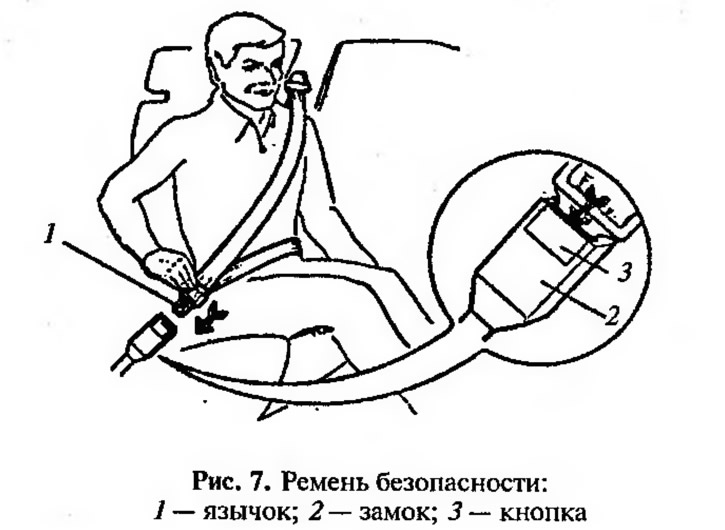
The belt should be adjusted so that, when the driver assumes the correct position, he or she feels a tight fit of the belt, while the palm of the driver's right hand and the left hand of the passenger at chest level should pass under the fastened belt with tension.
After adjusting the belts, you need to check how convenient it is to use the switch on the instrument panel and the gearshift lever. Does it restrict movement? Be patient for a little while. You will get used to it and will not even notice the belt.
The seat belt is necessary not only for the driver and the passenger sitting next to him, but also for passengers sitting in the back seats. However, these belts are prohibited for use on children under 12 years of age. Children's heads are relatively heavy, and their cervical vertebrae are weak. Therefore, when using these belts, during an impact, the child's head is thrown forward and a spinal fracture occurs, so children under 12 years of age can only be transported in the front seat in special seats.
The headrest is designed to prevent spinal injury in the event of a sudden and sharp impact from behind. The driver feels pain in the cervical vertebrae. This happens because the headrest was not adjusted after purchasing the car, and even worse, if it was removed at all. The headrest can be adjusted both vertically and by tilting. The headrest should be positioned so that its hard part is at eye level and located as close to the back of the head as possible and comfortable. A properly adjusted headrest can save your life.
It is necessary to adjust the rearview mirror correctly. Rearview mirrors significantly contribute to improving traffic safety and are absolutely necessary in today's heavy traffic conditions.
The car must have a rear-view mirror inside the cabin, through which the driver sees the road behind the car, and one or two external rear-view mirrors, through which the driver sees the road on the left and right sides of the car. The internal mirror is adjusted by rotating the mirror housing itself. The external mirrors are adjusted by special levers on the car door inside the cabin. Luxury cars are equipped with a special switch, with which you can also adjust the position of the external mirrors.
The mirror should be installed as shown in Fig. 8, so that the driver can see the space behind the car without turning his head. When adjusting the mirror, you need to hold it in such a way as not to touch its surface, otherwise fingerprints will remain on it, and they distort and blur the image, and also distract your attention from the road. The interior mirror is flat, and therefore does not distort the image from behind. Some drivers install convex mirrors, they reduce the image, such mirrors should not be used, since they distort the picture of the road and change the proportions of the sizes of objects visible in them, this makes it difficult to determine the distance to the car from behind, and therefore their speed, but they have one advantage - they increase visibility. Interior mirrors usually have a switch lever that allows you to switch the mirror from the normal to the anti-glare position, this position at night allows you to avoid blinding.
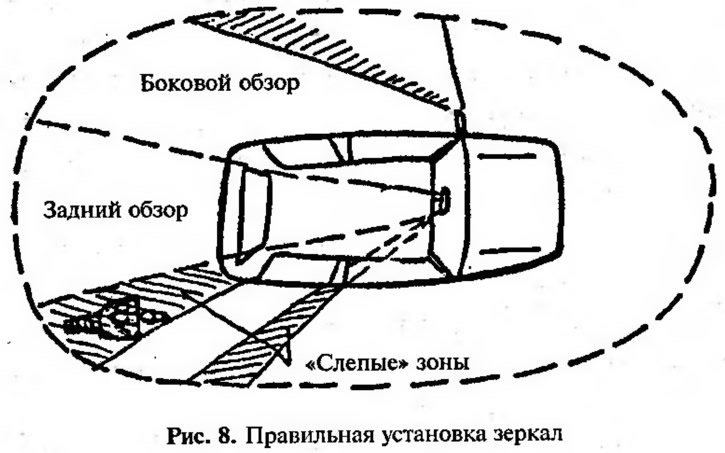
Exterior mirrors are mostly convex. The most important thing when adjusting is that the mirrors cover as much of the road surface as possible from the side and rear.
No matter how you turn the mirrors, there will still be blind spots. You can't completely trust the mirrors, because any road user can end up in a blind spot. Therefore, when monitoring the road surface, you also need to turn your head.
When adjusting the interior mirror with one exterior mirror, it must be adjusted so that the right rear door window and most of the rear window are visible in its right corner. With two exterior mirrors - so that the rear window of the car is visible. In the left exterior mirror, the rear left wing of the car should be visible in the right corner.
Regular use of mirrors and monitoring of the actual traffic situation around the car is a necessary element of safe driving.
After you have adjusted the position of the mirrors, find the "blind spots". These are located directly behind and on both sides of the car. A quick glance at these areas is enough to make sure they are safe. This should be done before changing lanes and before performing maneuvers. Try not to guess the "blind spots" in other cars and do not stay in them for a long time.
You need to look in the rearview mirror in front of:
- the beginning of the movement;
- restructuring;
- turn right, left or make a U-turn;
- overtaking, passing or going round;
- reversing;
- stopping or opening doors;
- braking;
- approaching a dangerous area.