




Contents: Oil for "tens" should wash, clean…↓ What oil and how to choose it for…↓ When to change oil ↓ Why is it necessary to regularly…↓
The lubrication system is designed to lubricate rubbing parts, remove friction products, protect engine parts from corrosion and cool these parts. The lubrication system consists of an oil pump, an oil filter and the required amount of good oil. The measuring ruler - the dipstick, which can tell a lot about the work of his "friend" - is also of great importance for the driver.
The "tens" oil pump has the index 2112. It differs from the 2108 oil pump by its original aluminum cover, which contains a boss and a hole for attaching the crankshaft position sensor. The gears and cast iron body are the same as in the 21083 engine.
The oil filter absorbs both wear particles of rubbing parts and combustion products of the working mixture, supplementing them with elements of its own combustion. Oil filters 2108 are suitable for "tens". You can't look inside the oil filter, but the quality of filtration is essential. This will be discussed below. Therefore, we can offer a filter from the German company SCT-SM-101.
You need to check the oil level regularly, less often if the oil consumption is small, and more often if it is large. When checking, pay attention to the color of the oil. The letters and marks on the measuring ruler should be well oiled through the oil. The oil level should be between the "max" and "min" marks. In summer, the level can be kept above the middle: when there is a large amount of oil, the engine cools better. In winter, on the contrary, the oil level should be closer to "lip", which accelerates warming up.
There are many reasons for the rapid deterioration of oil quality and the increase in its consumption. But the main reason is the speed at which the driver drives, the number of accelerations and braking.
Oil for "tens" should wash, clean and lubricate well in winter and summer
The first and most important rule for owners of "tens" is that your "friend" does not like bad oil. And here's why. In a serviceable, normal engine, a small part of the oil gets into the cylinder and burns there. And especially in low-grade (i.e. cheap) the oil contains a large amount of impurities, mainly phosphorus, which, with the exhaust gases, get onto the surface of the oxygen sensor and destroy zirconium dioxide; the sensor readings will be abnormal. These impurities also negatively affect the performance of the neutralizer. Therefore, owners of tens, especially those with oxygen sensors and a neutralizer, should forget about cheap oils. It is better to change the oil immediately after purchasing a car. It is not worth waiting for 2000 kilometers to the first maintenance. Bad oil or a not very clean oil pan can affect the operation of these devices after 100 kilometers.
Nowadays, the choice of oils is huge, and the modern technical level of automobile technology requires the use of new generation lubricants capable of ensuring the highest performance of your "friend". The quality level of motor oil has a significant impact on the service life of the engine and fuel consumption, especially multi-valve with injection. Unfortunately, many drivers cannot choose the right oil for their car and do not have sufficient knowledge to determine what kind of oil is in their canister.
What oil and how to choose it for "tens"
Modern domestic oils can easily compare with foreign analogues. They are currently marked, as well as according to international standards, SAE and API. First of all, oils should be selected according to the level of their performance properties, these oils are designated in accordance with the API system by two letters. The first letter S means: for 4-stroke gasoline engines. If the first letter is C, then for diesel engines. The second letter can be from A to Z (nine letters), indicates the quality class. The further the letter in the Latin alphabet from its beginning, the higher the quality. You need quality oil for your "friend". Quality groups SG, SH, SJ are recommended for VAZ-2110 and VAZ-2112 engines. Foreign oils of class SG are now less common. They focus on the production of oils of quality SH, SJ of the API standard.
Domestic mineral oils, related to the SG category, can also be related to the highest quality group. These oils include domestic oils "Lukoil-Standard", "Spectrol" and others. Mineral oils with synthetic additives (semi-synthetic) quality categories SG, SJ have more additives, the degree of purification is higher. These oils include "Lukoil-Lux", "Esso-Ultra", "Lukoil-Super" and others.
Synthetic oil of quality category SJ has a significantly expanded temperature range, it cleans channels better and retains cleaning properties longer. These include "Lukoil-Synthetic", "Mobil 1" and others.
These new generation high performance oils contain base oils (in semi-synthetic or fully synthetic) replaced by high-quality synthetic base oils. The chemical and physical properties of synthetic oil are more uniform than those of mineral oil. This uniformity provides excellent lubrication at low temperatures and excellent protection in all operating modes, including extreme ones. Therefore, regardless of whether you start your car on a cold winter morning or rush at high speed along a country highway, semi-synthetic, or even better, synthetic, will provide you with the reliability you want to count on when purchasing these oils.
Another criterion for choosing oil is its viscosity. It is necessary to proceed from the requirements of the engine and the ambient temperature. Viscosity is the main property of oil and one of the main indicators when choosing oil. Increasing viscosity stabilizes the pressure in the lubrication system. Oil will flow in the right amount to the rubbing parts and will be retained (the most important) between them. The higher the viscosity, the stronger the oil film. In addition, oil consumption for burning is reduced. And we have already said that for "tens", especially with a neutralizer, oil burning is harmful. For example, medium viscosity oil is almost not consumed when driving in the urban cycle. But engine operation on a country road at high speeds (at high speed) will lead to high oil consumption. Fans of fast driving need to have oil of class 50 or even 60, which have the highest viscosity, up to 26 centistokes at a temperature of 100°C. But an increase in viscosity leads to an increase in fuel consumption.
Just as mineral oil can have a viscosity class of 50, so can synthetic oil - class 60. The latter has the highest viscosity.
The international classification SAE corresponds to the viscosity-temperature properties of oils. It divides oils into winter, summer and all-season. For example, winter SAE 10W, summer SAE 40, all-season SAE 15W-40. The numbers indicate the viscosity class. The letter W is the first letter in the word Winter.
Experience of operating the family of "tenth" models says that in terms of viscosity, it is best to use 5W-30 oil during the break-in period. In the future, you can use all-season oils 10W-40 or 5W-40. Choose mineral, semi-synthetic or synthetic yourself, their differences have been discussed.
Temperature range of motor oils according to SAE classification
The original source is published on the website: www.vazbook.ru
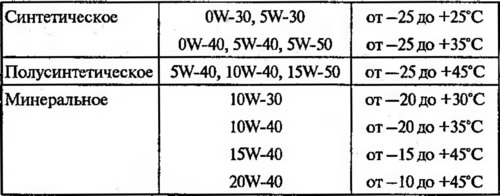
The main motor oils that the plant recommends for the engine lubrication system are 2110, 2111 and 2112:
- "Lukoil Lux" SJ 5W-40, J0W-40, 15W-40
- "Lukoil Super" SG 5W-30, 5W-40, 10W-40, 15W-40
- "ESSO ULTRA" SJ/SH10W-40
- "SHELL HELUXSUPER" SG 10W-40
A complete list of motor oils recommended by the plant for the "ten" is available in the operating manual.
When to change oil
We have already discussed the need for the first oil change immediately after purchase. After the break-in period, i.e. after 2,000 kilometers, the oil needs to be changed a second time. Then, maintenance requirements require that the oil be changed every 10,000 kilometers. One of the advantages of good synthetic oil is that it lasts longer and can be changed less often.
Please note that when the engine is running, some cars emit blue smoke from the exhaust pipe and oil consumption is increased, which means the engine is running on both gasoline and oil. It burns off a lot, this depends on both the oil itself and the car's malfunction and driving style. The measuring ruler shows that the oil is heavily contaminated and diluted with fuel, since the piston group is heavily worn. Therefore, there is a need to replace the oil ahead of schedule with a more viscous one.
Oil condition sensors have been developed and are used in imported cars. These sensors send a signal to the instrument panel. As the oil properties deteriorate, impurities are present, etc., the lights come on or, conversely, the number of lights decreases. This is a signal that the oil needs to be changed. Some cars have indicators that show how many kilometers are left before the oil is changed.
Our cars don't have such sensors yet, so monitor the condition and consumption of the oil yourself.
Why is it necessary to regularly flush the lubrication system and fuel system?
We have considered the issue of how the operation of the lubrication system affects the engine performance. And simply replacing one oil with another will hardly improve these performance indicators unless the lubrication system is flushed.
After flushing the lubrication system with special oils, compression increases and thermal valve clearances are restored. This normalizes engine operation, improves the process of mixing the components of the working mixture and purging the cylinders. The service life of the parts of the gas distribution and crank mechanisms increases.
During fuel system flushing, resinous deposits are removed from the injectors, normalizing the operation of the injectors, which leads to more complete combustion of the fuel, eliminating detonation and reducing the toxicity of exhaust gases, increasing the service life of the engine, especially with a fuel injection system.
Before changing the oil and oil filter, flush the lubrication system, and better yet, the injection system.