




- about the throttle position;
- the speed of its movement;
- crankshaft speed;
- air temperature and, if necessary, turns on the electric heater;
- coolant temperature;
- analyzes the vacuum in the throttle space through the working mixture pressure sensor;
- monitors the operation of the idle speed controller and, having received information about the speed of movement, switches it off;
- receives information about engine speed;
- monitors with an oxygen sensor (if there is one) for the percentage of oxygen in the exhaust manifold.
It receives this information every 7 ms and, in accordance with its program stored in the computer memory, calculates the duration of the electrical impulse supplied to the injectors, i.e. determines the time of its open state and the moment of injection of this amount of fuel into the combustion chamber. Fuel combustion occurs more completely. It can stop the fuel supply for a certain period of time, during movement. In addition, it stops the fuel supply upon reaching the maximum crankshaft rotation frequency and upon reaching the maximum speed.
If a fault occurs in the power supply system, the "CE" control lamp lights up on the instrument panel - check engine. The driver's actions in this case are described in the operating manual. Another significant advantage of the computer injection system is that it allows for automated engine diagnostics and troubleshooting. These systems have been operating for many years on serial foreign cars, for more than 6 years on our serial cars and for more than 10 years on experimental cars and have shown trouble-free and stable operation. For "tens" operating on distributed injection without neutralizers and oxygen sensors, computers of the joint company "BOSH-Saratov" or the domestic computer "January 5.1" are used.
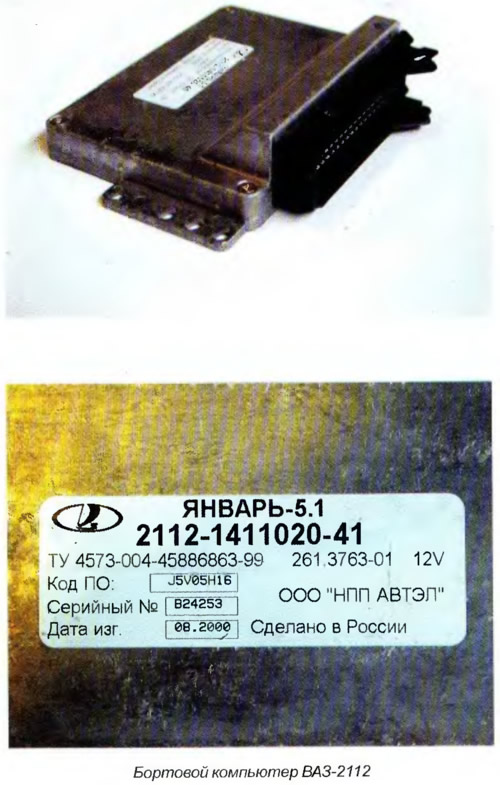
For "tens" working on distributed injection, with a neutralizer and oxygen sensor, the computers "BOSH MP 7.0" or "January 5.1" are used, the same one, but with a different program.
The electronic brain of this computer is the program embedded in its memory. This program was developed by domestic specialists and can work with either power supply system. For example, on the plate of the computer installed in your car it is written "January 5.1", its long catalog number and below the software code Y5V05H16, where the numbers and letters mean: Y5 - computer "January 5"; V — front wheel drive vehicles; the 3rd and 4th digits of the code indicate the toxicity level; 05 means Euro 2. The next letter is H, it can be from A to Z, the further from the beginning of the alphabet, the more perfect the program. And the last 2 digits indicate calibration; the higher the numbers, the newer the calibration. In our case, the calibration version is 16. Computers in certain groups, both domestic and German, can be replaced with one another.
What gasoline does the computer recommend the engine to run on?
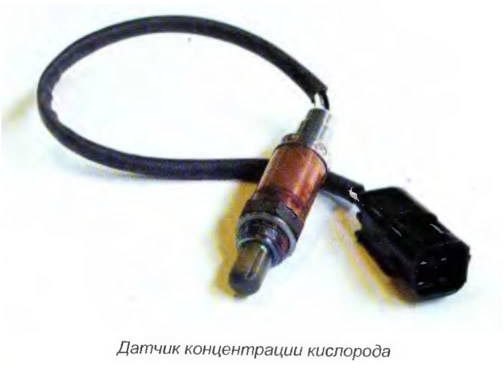
We have already discussed that the on-board computer receives information about the oxygen content, about the exhaust gases and issues commands to maintain the optimal ratio of the fuel-air environment. But the zirconium sensor is very afraid of lead, which is found in excess in leaded gasoline. Lead and its oxides get into the exhaust gases, settle on the oxygen sensor and disable it; cover the coggact surface. Now the potential difference that the sensor gives out corresponds to the excess of oxygen in the exhaust gases, and the computer gives a command to increase the fuel supply. The engine's dynamics and stability deteriorate, and fuel consumption increases significantly. In addition to the oxygen sensor, the lead in gasoline clogs the micropores of the neutralizer, and now it also gives false information about the conversion of carbon monoxide, nitrogen oxides into other components. The temperature regime in the exhaust system is also disrupted, which leads to mechanical destruction of the neutralizer.
The first conclusion is that gasoline must be unleaded, with an octane rating of 95, naturally, if the engine has a distributed injection system with a neutralizer and an oxygen sensor. And the question immediately arises: what will happen if the car runs on leaded gasoline? You can find information about this in the literature, friends can tell you about it, and you can even hear about it at a service station. Yes, the car will not stop, but the on-board computer will turn on a bypass program. And this will lead to increased toxicity. In our country, this is possible, because many crankcase ventilation hoses of a carburetor engine are led not to the carburetor, but under the car. No matter, we tolerate it while we still live. In addition, power, torque and efficiency are reduced - But these are already personal problems of each driver.
Distributed injection has nozzles with a small diameter at the outlet, and we already know that the fine filter should not let through particles larger than 10 microns. Therefore, most of the engine-related malfunctions are not due to the reliability of engine components, but to poor-quality gasoline. Moreover, it does not matter at all whether you have a neutralizer or not.
Bad gasoline, or rather gasoline unsuitable for cars with injection, may not differ at all from normal gasoline in appearance and even in octane number. It differs in the content of a large number of harmful impurities. For example, some entrepreneurs increase the octane number of cheap gasoline by adding solid hydrocarbons, naphthalene and other substances. This leads to severe contamination of the injectors.
Domestic gasoline contains resins, they settle on the injectors and clog their outlets.
The presence of various solvents, mechanical impurities and water in the fuel causes great harm to the fuel system. This can happen during transportation, pumping and storage of various liquids in the same containers and filling and drain hoses.
Where is the exit? How to check the gasoline? How to be sure that you are filling up with good gasoline? If you care about the health of your "friend", constantly monitor the behavior of the car after refueling. Ask your friends where they know good gas stations. Currently, there is a choice of gas stations and gasoline. Choose the best. The quality of gasoline directly depends on the appearance of the gas station, its equipment and hoses. Choose gas stations. And one more piece of advice. Cheap gasoline, as a rule, is of poor quality and is underfilled. More expensive gasoline is of better quality and is underfilled less often. Operating experience suggests that the "tens" engine works better and more reliably on good 92 gasoline than on bad 95.
The environmental protection system and exhaust system will meet the requirements of European standards
It consists of a crankcase ventilation system, a gasoline vapor management system, and an exhaust system. During idling, gases from the crankcase enter the throttle space, and when the throttle is open, the gases enter the air filter and then combine with the working mixture. The gasoline vapor management system consists of a separator, an adsorber, and a valve system. The separator collects gasoline vapors from the fuel tank and returns them to the tank as condensate. At a certain vapor pressure, gasoline enters the adsorber, which is activated carbon, through the outlet valve. After a certain time, the on-board computer directs outside air to the adsorber, it is saturated with gasoline vapors and enters the throttle space, where it is then burned. The exhaust system consists of an inlet pipe with two pipes on engines 2110 and 2111 (and on 2112 there are two pipes with a wide flange. At the pipe inlet there is a hole for the oxygen sensor), metal body of the neutralizer, a short resonator and a long muffler.
The oxygen sensor, or lambda probe, is a tube whose working fluid consists of zirconium dioxide. Its closed end is placed in the intake pipe, the open end remains outside the intake pipe and communicates with the atmosphere. If there is less oxygen in the exhaust gases than outside, a potential difference arises in the tube between the inner and outer parts of the zirconium. The greater the potential difference, i.e. the different oxygen content in the exhaust gases and outside, the greater the voltage. It performs the function of feedback between the exhaust gases and the composition of the air-fuel mixture at the input.