




Engine management systems 2112 (l,5i) and 21124 (l,6i) - electronic, with distributed phased fuel injection (that is, fuel is injected into the intake manifold of each cylinder in accordance with the engine's working cycle). The engine management system consists of the following elements:
- ECU (electronic control unit);
- sensors:
- 1. DPKV (crankshaft position sensor);
- 2. DPRV (camshaft position sensor);
- 3. TPS (throttle position sensor);
- 4. DD (knock sensor);
- 5. Coolant Temperature Sensor (coolant temperature sensor);
- 6. MAF (mass air flow sensor);
- 7. Vehicle speed sensor;
- 8. Oxygen concentration sensor (or two sensors for EURO III);
- 9. Rough Road Sensor (for EURO III);
- actuators:
- 1. Main relay;
- 2. Fuel pump relay;
- 3. Nozzles;
- 4. Ignition coils on engine 21124 (1.6i) or ignition module on engine 2112 (1.5i);
- 5. IAC (idle speed control);
- 6. Cooling system electric fan relay;
- 7. Engine malfunction indicator lamp;
- 8. Evaporative Evaporative Blow-Off Valve;
- connecting wires;
- diagnostic connector block.
The engine management system also integrates:
- car anti-theft system;
- speedometer;
- tachometer.
The main control element of the engine management system is electronic Control Unit (ECU), or as it is often called - a controller, with a built-in microprocessor. In essence, the ECU is a specialized mini-computer in which only one program is installed - engine control, and the sensors and actuators form the peripheral equipment of this computer. The ECU receives and analyzes signals from the sensors. Based on the received data, the ECU calculates control commands and issues them to the actuators. The ECU has three types of memory*: read-only memory (ROM), random access memory (RAM) and reprogrammable memory (EPROM).
ROM - non-volatile memory (that is, the information in the memory is retained when the power is turned off), and is a microcircuit ("chip")*. The microcircuit is installed on the ECU board via a detachable connection - a special connector, and is not soldered like other elements. This is done in order to unify the ECU for different car models. The ROM stores the calculation program and the data necessary for the calculation (engine parameters, transmission ratios and other characteristics). This information is individual for each vehicle modification.
Warning: Unqualified reprogramming of ROM or replacement of a chip from another car model (so-called chip tuning) may lead to engine malfunctions, failure of engine control system components, and engine damage.
The design of the ECU may be modified by the manufacturer.
Original source is on the resource: vazbook
During operation, the ECU monitors the serviceability of all elements and circuits of the engine management system. Having detected a malfunction, the ECU switches the engine management system to the backup mode and turns on the engine malfunction indicator lamp on the instrument panel. The engine will then be able to continue operating (except in case of crankshaft position sensor failure, see below), which allows you to get to the repair site under your own power. The ECU records the codes of detected faults in RAM. The operational information that the ECU microprocessor uses in calculations is also stored there. When the battery is disconnected from the vehicle's on-board network, all information stored in RAM will be deleted.
The EPROM stores the codes of the car's anti-theft system (immobilizer). This type of memory is non-volatile. After the immobilizer is activated, the ECU blocks the operation of the engine management system when trying to start the engine without special electronic keys.
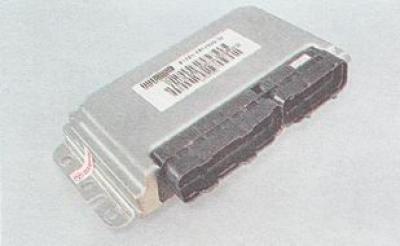
Electronic control unit (ECU)
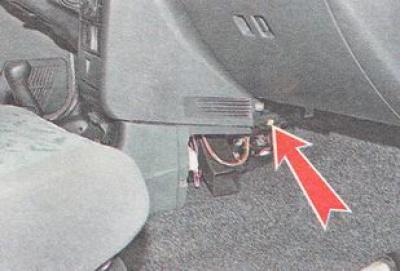
The ECU, immobilizer control unit, fuses and relays of the engine management system are located under the instrument panel console.
Note: The right instrument panel console trim has been removed.
Crankshaft Position Sensor (CPS) is designed to generate signals by which the ECU synchronizes its operation with the engine cycles. Therefore, this sensor is often called a synchronization sensor. The sensor operates on the principle of induction - when the crankshaft pulley teeth pass the sensor core, AC voltage pulses occur in the sensor circuit. The frequency of the pulses corresponds to the crankshaft rotation frequency. The teeth are located around the pulley circumference (6° apart). Two of them are spaced at an angular distance of 18°. This is done to generate reference signals in the sensor circuit - a kind of reference points relative to which the ECU determines the position of the crankshaft - the top dead centers in the first / fourth and second / third cylinders. Engine operation with a faulty crankshaft position sensor is impossible. The crankshaft position sensor cannot be repaired - in case of a malfunction, the crankshaft position sensor is replaced as an assembly.
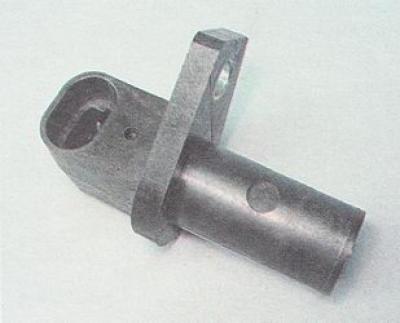
Crankshaft Position Sensor (CPS)
Camshaft Position Sensor (CMP) is designed to generate a signal by which the ECU determines the top dead center (TDC) of the piston of the first cylinder during the compression stroke. Sometimes this sensor is called a phase sensor. The operating principle of the sensor is based on the Hall effect.
When the projection of the ring, fixed on the pulley of the intake camshaft, passes through the slot in the end of the sensor, the sensor sends an electric signal to the ECU. If the DPRV is faulty, the electronic control unit switches the system to the backup mode.
The camshaft position sensor is an electronic device that cannot be repaired. If the camshaft position sensor is faulty, it should be replaced.
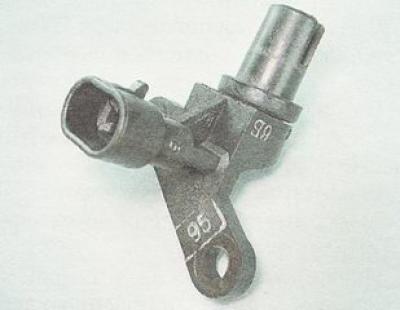
DPRV (camshaft position sensor)
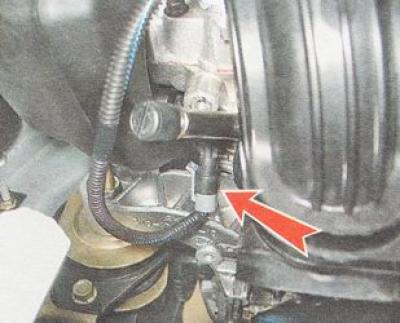
Camshaft Position Sensor (CMP) installed in the rear timing belt cover
Knock sensor (DS) — piezoelectric, reacts to engine vibration. Based on the sensor signals, the ECU determines the moment of detonation during engine operation and, accordingly, adjusts the ignition timing. If the DD fails, the electronic control unit switches the system to the backup mode.
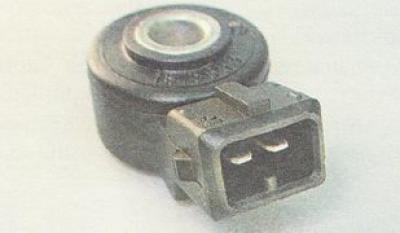
Knock sensor (DS)
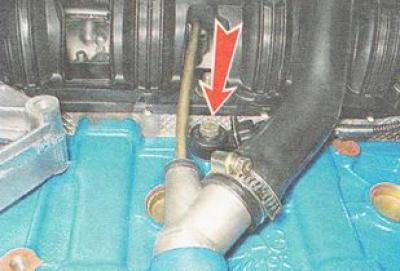
Knock sensor (DS) on the car it is installed on the front wall of the cylinder block
Mass Air Flow Sensor (MAF) film type, installed between the air filter and the throttle valve. Based on the sensor signal, the ECU calculates the amount of air entering the engine cylinders. If the MAF is faulty, the electronic control unit switches the system to backup mode.
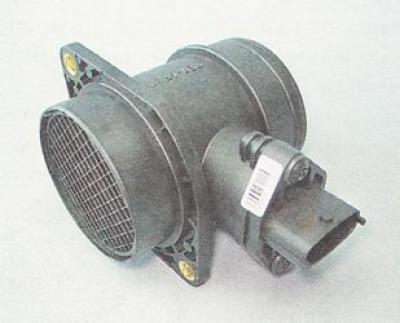
Mass Air Flow Sensor (MAF)
Throttle Position Sensor (TPS) is installed on the throttle body and is connected to the throttle axis. The TPS is a variable resistor, the resistance of which depends on the angle of the throttle position. Based on the TPS signal, the electronic control unit determines the amount of throttle opening. If the TPS fails, the electronic control unit switches the system to backup mode.
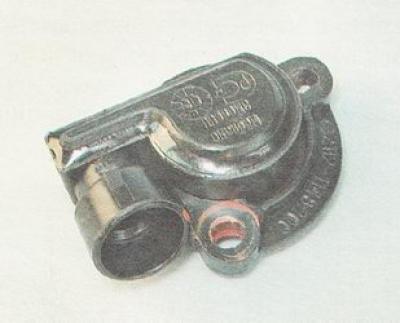
Throttle Position Sensor (TPS)
Idle speed control (ISC) — is a shut-off valve driven by a stepper motor. The IAC is mounted on the throttle body. The ECU, by sending a controlled signal to the IAC, regulates the engine crankshaft speed at idle, when starting and warming up the engine.
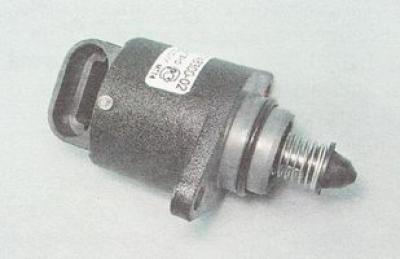
Idle speed control (ISC)
Oxygen concentration sensor provides an output signal, which the ECU uses to determine the oxygen concentration in the exhaust gases. Based on the data received, the ECU adjusts the amount of fuel injected into the engine cylinders, thereby maintaining the optimal air-fuel mixture ratio (this is necessary for the efficient operation of the catalytic converter). The oxygen concentration sensor's sensitive element is located in the exhaust gas flow (before the catalytic converter). The sensor can only operate when its sensitive element is heated to a temperature of at least 300°C. To reduce the warm-up time, a heating element is built into the sensor. On the 2112 engine (l.5i), the sensor is installed in the lower part of the intake pipe, and on the 21124 engine (1.6i) - in the upper part of the catalytic collector. The location of the oxygen concentration sensor on the collector allows you to reduce the time it takes for the sensor to warm up to operating temperature.
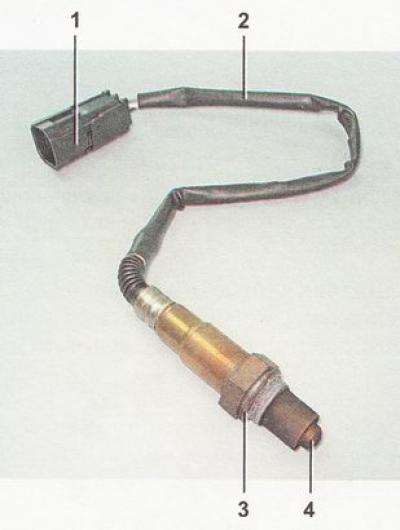
Oxygen concentration sensor: 1 - connection block; 2 - wiring harness; 3 - sealing ring; 4 - sensitive element with holes for supplying exhaust gases
On VAZ 2110, VAZ 2111, VAZ 2112 vehicles that meet the requirements of EURO III toxicity standards, a second oxygen concentration sensor is built into the exhaust system after the neutralizer.
Warning. The presence of lead and silicon compounds in the exhaust gases may cause the oxygen concentration sensor to fail. Therefore, the use of leaded gasoline is not allowed. When repairing the engine, do not use a sealant with a high silicone content (silicon compounds), vapors of which can enter the cylinders through the crankcase ventilation system and then into the exhaust tract. You should use a sealant that is specifically indicated on the packaging as being safe for the oxygen concentration sensor.
Coolant temperature sensor (CTS) — a semiconductor device — a thermistor, the electrical resistance of which changes with changes in the ambient temperature. The sensor is installed in the thermostat housing. Based on the sensor resistance, the ECU evaluates the engine temperature mode. The obtained data are used to calculate most control commands for the engine management system elements, as well as to turn on the electric fan of the engine cooling system. If the coolant temperature sensor fails, the electronic control unit switches the system to the backup mode.
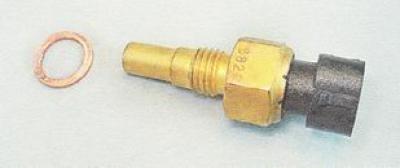
Coolant temperature sensor (CTS) with copper sealing ring
Vehicle speed sensor mounted on the gearbox. The speed sensor operates on the Hall effect. The ECU calculates the vehicle's speed based on the pulses generated by the sensor. The signal from the speed sensor also goes to the speedometer.
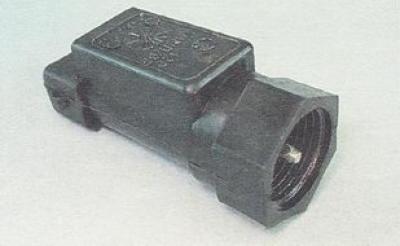
Vehicle speed sensor
Ignition systems of VAZ 2112 (l,5i) and VAZ 21124 (l,6i) engines have significant design differences: the VAZ 2112 (1.5i) engine has an ignition module, which consists of two two-terminal ignition coils made in a single housing. Spark formation occurs in two cylinders simultaneously (1-4 and 2-3). The ignition module is connected to the spark plugs by high-voltage wires with non-removable tips.
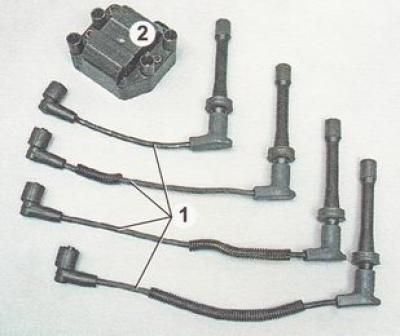
Elements of the ignition system of the injection engine VAZ 2112 (l,5i): 1 - set of high-voltage wires; 2 - ignition module
The VAZ 21124 (1.6i) engine uses four ignition coils. They are installed directly on the spark plugs. This eliminates the reduction in spark power due to current leaks (this is possible when the insulation of high-voltage wires is damaged).
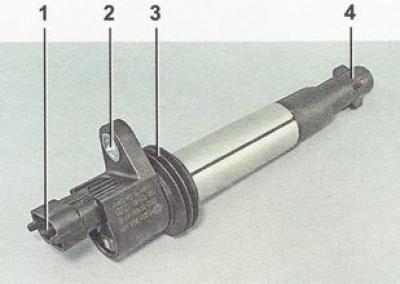
Ignition coil of the VAZ 21124 engine (l,6i): 1 - terminals for connecting the wiring harness connectors; 2 - eye for attaching the reel; 3 - rubber sealing ring; 4 - tip for connection to spark plug
On the engines of the VAZ 2110, VAZ 2111, VAZ 2112 cars, spark plugs AU17DVRM are used, where:
- A - thread M 14x1.25;
- U — hexagonal part of the body for a 16 mm key;
- 17 — heat rating;
- D — threaded part length 19 mm, with a flat seating surface;
- B — the protrusion of the thermal cone of the insulator beyond the end of the threaded part of the housing;
- R - built-in resistor;
- M - bimetallic central electrode
The engine can be equipped with spark plugs of similar type from different manufacturers.
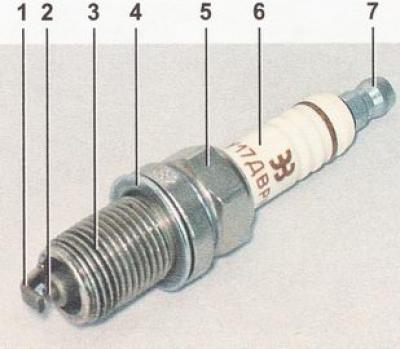
Spark plug: 1 - side electrode; 2 - central electrode (in the thermal cone of the insulator); 3 - threaded part of the body; 4 - sealing ring; 5 - hexagonal part of the body under the key; 6 - insulator (it has spark plug markings on it); 7 - contact tip (removable, threaded)
Nozzle — is an electromagnetic needle valve, on the outlet pipe of which a sprayer with four calibrated holes is made. The nozzle opens on the signal of the ECU, and the fuel under pressure is injected directly onto the inlet valve. The amount of fuel entering the cylinder is regulated by the opening time of the nozzle. The engine has one nozzle per cylinder.
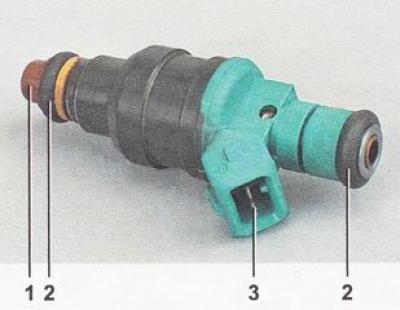
Injector for VAZ 2112 engine (l,5i): 1 - sprayer; 2 - sealing rubber ring; 3 - terminals for connecting the wiring harness
Evaporative Canister Purge Valve installed on the cover of the adsorber housing (for more details see. "Engine power supply system - device, description, diagram").
Diagnostic connector designed to connect an external diagnostic device (for example, DST-2M) to the engine management system. The diagnostic connector is installed on the instrument panel below on the driver's side.
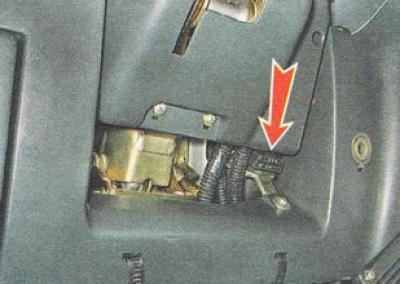
Location of the diagnostic connector.
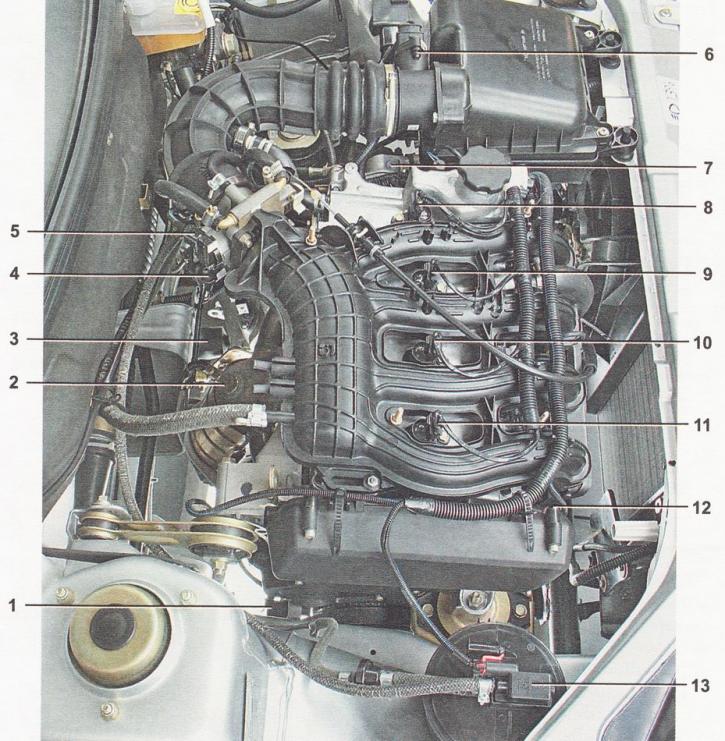
Location of the control system elements of the injection engine VAZ 21124 (l,6i) in the engine compartment*: 1 - crankshaft position sensor (CPS); 2 - oxygen concentration sensor (OCS); 3 - vehicle speed sensor; 4 - idle speed control (ISC); 5 - throttle position sensor (TPS); 6 - mass air flow sensor (MAF); 7 - installation location of the DTOJ coolant temperature sensor (on the thermostat housing); 8 - ignition coil of the fourth cylinder; 9 - ignition coil of the third cylinder; 10 - ignition coil of the second cylinder; 11 - ignition coil of the first cylinder; 12 - location of the camshaft position sensor (CMP); 13 - purge valve of the adsorber
* Engine trim removed.
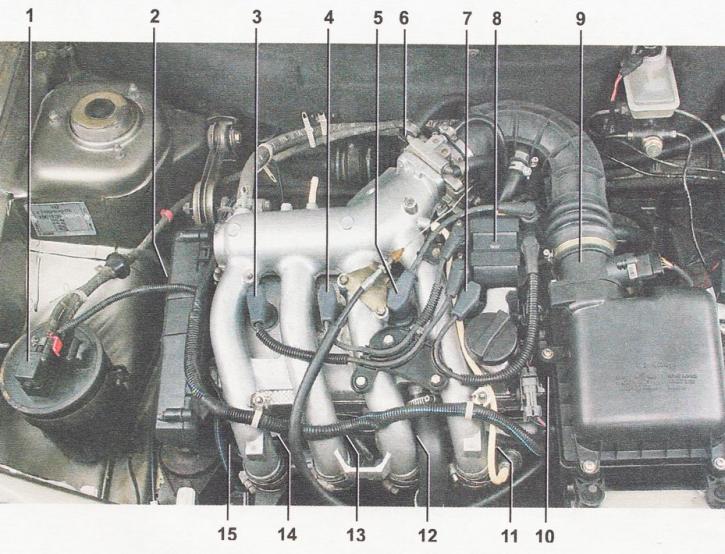
Location of the control system elements of the injection engine VAZ 2112 (l,5i) in the engine compartment*: 1 - purge valve of the adsorber; 2 - location of the crankshaft position sensor (CPS) in the cylinder block lug; 3, 4, 5 and 7 - high-voltage wires of spark plugs of the first, second, third and fourth cylinders, respectively; 6 - throttle position sensor (TPS) and idle speed control valve (ISC) (mounted on the throttle body); 8 - ignition module; 9 - mass air flow sensor (MAF); 10 - location of the coolant temperature sensor (CTS) (under the air filter on the thermostat housing); 11, 12, 13 and 14 - injectors of the fourth, third, second and first cylinders, respectively; 15 - location of the camshaft position sensor (CMP)
* Engine trim removed.
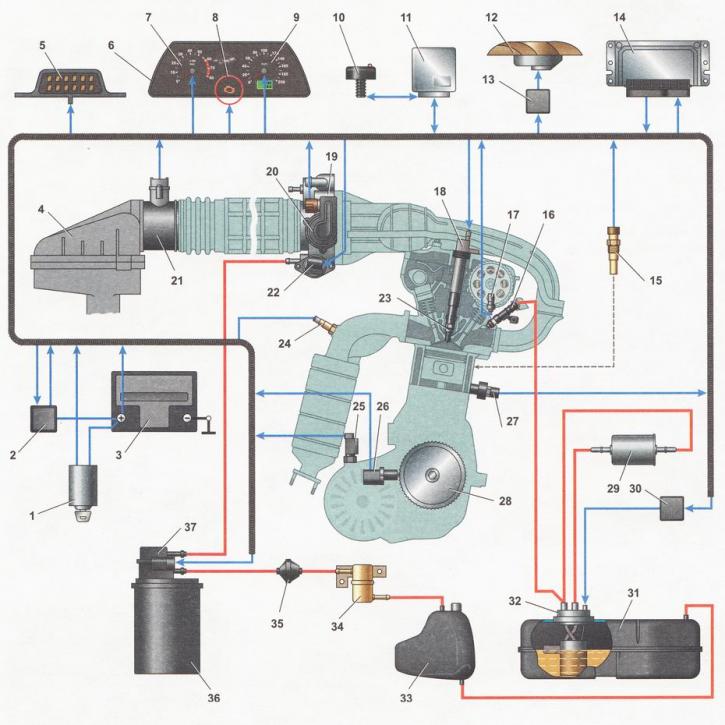
Injector engine control system diagram*: 1 - ignition switch; 2 - main relay; 3 - battery; 4 - air filter; 5 - diagnostic connector; 6 - instrument panel; 7 - tachometer; 8 - Engine management system malfunction indicator lamp; 9 - speedometer; 10 - immobilizer sensor with indicator; 11 - immobilizer control unit; 12 - Electric fan of the engine cooling system; 13 - Electric fan relay; 14 - Electronic control unit (ECU); 15 - coolant temperature sensor; 16 - injectors; 17 - camshaft position sensor (phase sensor); 18 - ignition coil*; 19 - throttle assembly; 20 - throttle position sensor (TPS); 21 - mass air flow sensor (MAF); 22 - idle speed control (ISC); 23 - spark plug; 24 - oxygen concentration sensor*; 25 - vehicle speed sensor; 26 - crankshaft position sensor (CPS); 27 - knock sensor (DS); 28 - crankshaft pulley; 29 - fuel filter; 30 - fuel pump relay; 31 - fuel tank; 32 - fuel module; 33 - separator; 34 - gravity valve; 35 - check valve; 36 - adsorber; 37 - purge valve of the adsorber
* The diagram is shown on the example of a car with an injection engine VAZ 21124 (l,6i). On a car with an engine VAZ 2112 (l,5i) instead of four coils an ignition module is installed; the oxygen concentration sensor is installed in the intake pipe.