




Contents: Removal ↓ Installation ↓
Attention! Before starting work, read the safety rules for working with the power supply system (see "Safety precautions for maintenance and repair of the power supply system").
Removal
1. Relieve the fuel pressure in the fuel line (see "Fuel line - pressure relief").
Caution! The fuel line pressure should be released even if the vehicle has not been used for a long time. After the pressure is released, a small amount of fuel remains in the fuel line tubes.
2. Remove accumulated dust and dirt from the fuel module and treat the threaded connections with penetrating lubricant.
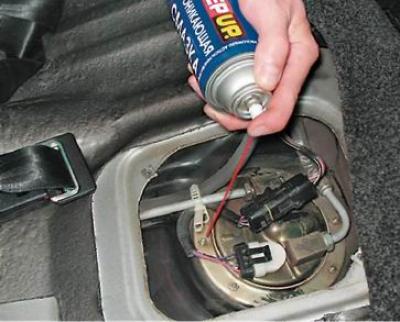
3. Having released the retainer, disconnect the wiring harness block (1) from the fuel module. Disconnect the wiring harness block (2).
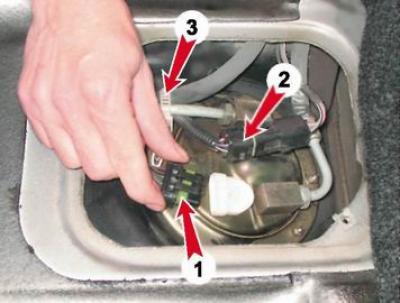
4. To keep the wires out of the way, cut the clamp (3) and remove the wire harness with connectors (1) and (2).
5. With an open-end wrench by 17 mm unscrew the fitting (1) of the fuel drain pipe into the tank. Similarly, unscrew the fitting (2) of the fuel supply pipe to the fuel filter.
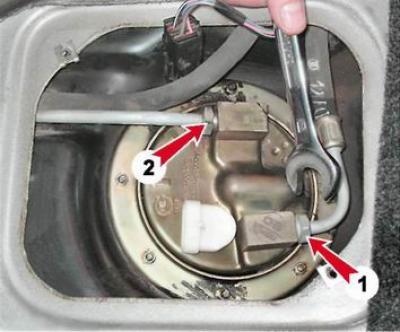
6. We take the pipelines away from the module. The ends of the pipelines have sealing rubber rings. Damaged rings must be replaced.
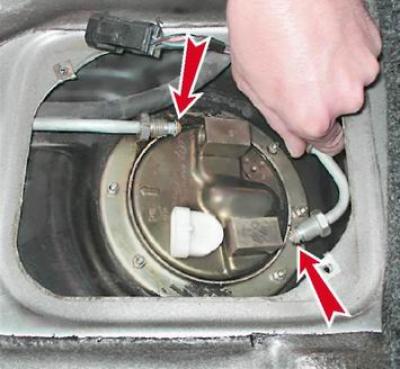
7. With a socket wrench by 7 mm we unscrew the eight nuts securing the fuel module.
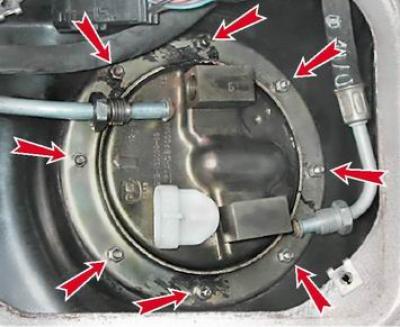
8. Remove the fuel module pressure ring. A spacer ring is installed underneath it.
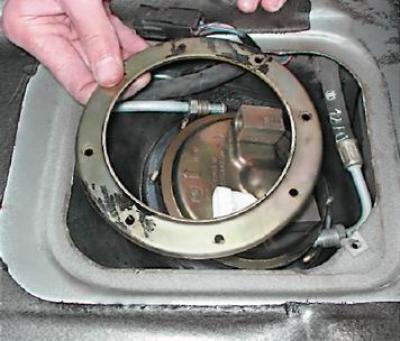
9. Remove the fuel module from the tank.
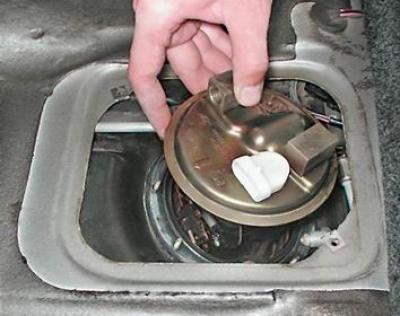
Warning! When removing the fuel module, do not bend the fuel level indicator sensor lever. To do this, slightly tilt the module and carefully remove the float from the tank hole
Note: It is usually not possible to remove the fuel module together with the intake chamber (a plastic container secured with two rubber bushings to the fuel module cover guides) and the camera remains in the tank.
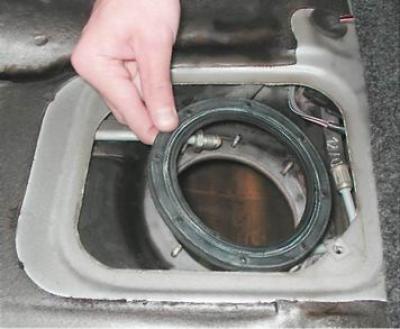
10. Remove the rubber sealing gasket. Replace the damaged sealing gasket.
11. Remove the intake chamber and pour out the gasoline from it.
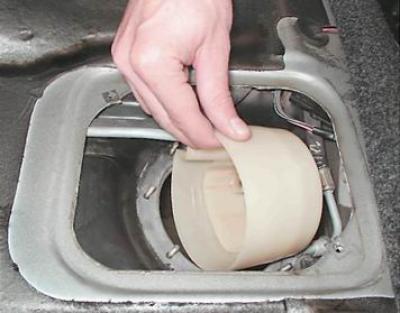
Installation
Recommendation: Install the fuel module in the tank together with the intake chamber.
1. Using a screwdriver, remove two rubber bushings from the hole in the fuel pump housing lugs.
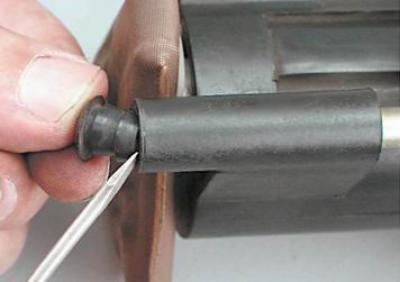
Note: One of the bushings may remain in the intake chamber opening.
2. After covering the bushings with a thin layer of motor oil, insert them into the holes of the intake chamber.
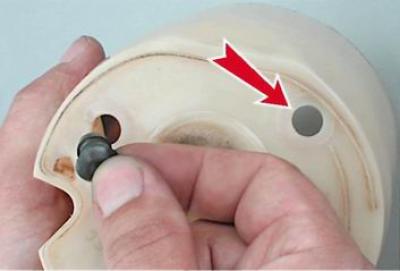
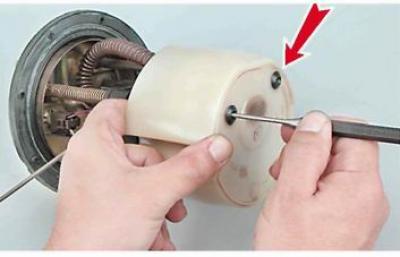
3. Insert the fuel pump into the chamber (the bushings must fit into the holes in the fuel pump housing lugs)...
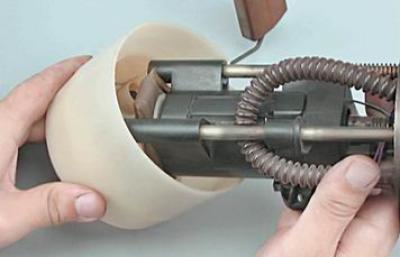
...and using a thin punch we insert the bushings into the holes.
4. Place the sealing gasket on the module.
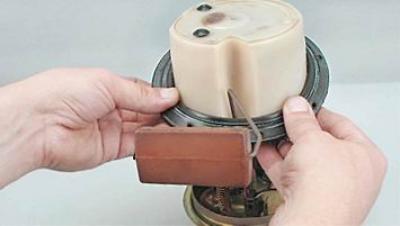
5. Carefully insert the float into the tank opening and install the fuel module...
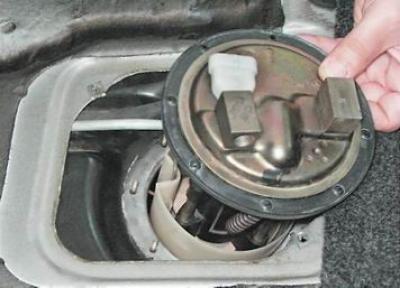
...and orient it in the tank so that the arrow points towards the trunk.
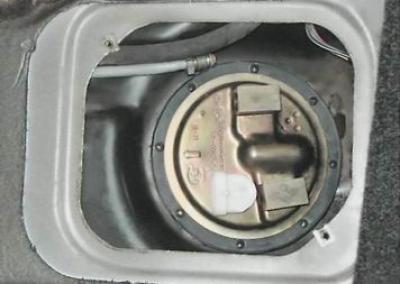
Warning! When attaching the fuel module, make sure the arrow on the cover points toward the rear of the vehicle. To avoid damaging the studs, do not overtighten the nuts
6. Install the pressure ring and evenly (in three or four doses) we tighten the nuts securing the module.
After connecting the fuel line fittings to the fuel module, turn on the ignition for 5 seconds and check the tightness of the connections. If necessary, tighten the fittings.
Once the work is completed, we install the hatch cover and the rear seat cushion back in place.