




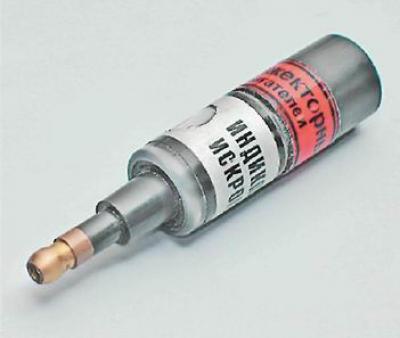
Advice. For a quick check of the ignition system, you can use a spark indicator for fuel-injected engines. It is placed on the spark plug and a high-voltage wire is connected to it. When checking, it is necessary to follow the instructions attached to the device.
Note: The 21114 engine uses an ignition coil. The 2111 engine may use an ignition coil or ignition module (see "Engine management system"). The ignition coil replacement is shown below. The module replacement is performed in a similar manner.
To complete the work you will need a multimeter.
Sequence of execution
1. Prepare the car for work (see "Preparing the car for maintenance and repair"), turn off the ignition.
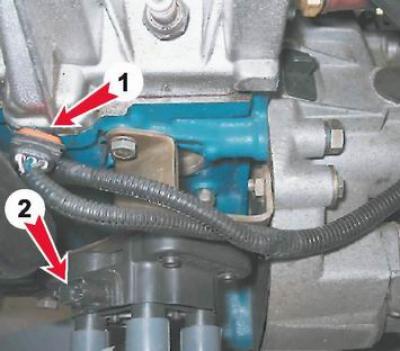
2. Having released the retainer, disconnect the wiring harness block (1) from the terminals of the ignition coil (module) (2).
3. Turning on the ignition, we measure the voltage between pin 15 and the "ground" with a voltmeter (for ignition coil) or between terminals C and D (for ignition module) wiring harness pads.
Warning! After taking measurements, turn off the ignition.
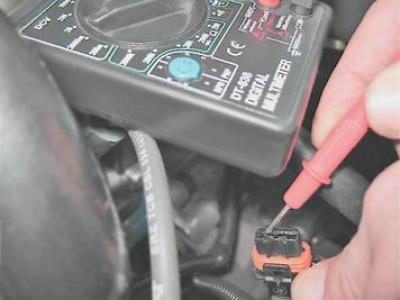
Note: The voltage must be at least 12 V. If the voltage does not reach the connector or is less than 12 V, the battery is discharged, the power supply circuit is faulty, or the ECU is faulty.
Make sure there is a malfunction ignition module it is possible by replacing it with a known good one. Ignition coil you can check it with an ohmmeter.
4. Disconnect the high-voltage wires from the spark plugs (see "High-voltage wires of engines 2111 and 21114 (8v) - checking and replacement").
5. With a socket wrench by 13 mm unscrew the two bolts of the upper mounting bracket of the ignition coil (module).
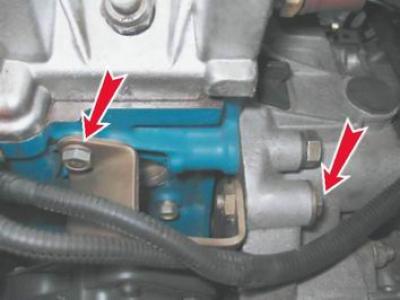
6. Key by 17 mm, having loosened the tightening of the lower bracket mounting bolt, we remove the bracket together with the coil (module).
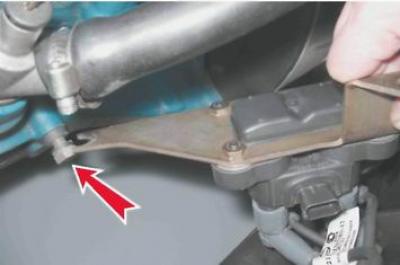
7. Disconnect the high-voltage wires from the ignition coil (see "High-voltage wires of engines 2111 and 21114 (8v) - checking and replacement").
8. Using an ohmmeter, measure the electrical resistance between the central terminal 15 and the body (bracket). The device should show the absence of a short circuit of the primary winding of the coil to the "ground". We measure the electrical resistance between the central terminal 15 and the outer terminals 1a and 1b in sequence. The resistance of each of the primary windings of the coil should be about 0.5 Ohm.
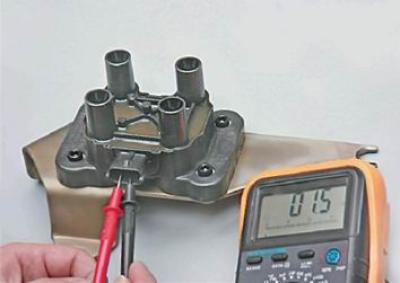
Note: When measuring small values of electrical resistance (about 1 Ohm) it is necessary to take into account the internal resistance of the device, which can be determined by short-circuiting the ohmmeter probes.
9. Using an ohmmeter, measure the resistance between the high-voltage terminals of coil 1 and 4, and then 2 and 3. The resistance of the windings should be about 5.4 kOhm.
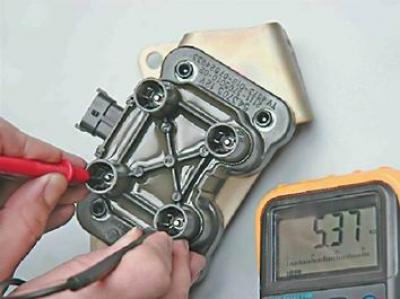
Recommendation: A faulty ignition coil must be replaced.
10. With a hex key by 5 mm we unscrew the four screws that secure the coil to the bracket and remove the coil.
Note: To remove the ignition module, use a 10 mm deep-head socket wrench to unscrew the 3 screws that secure it
11. Install the ignition coil (module) in the reverse order. Connect the high-voltage wires in accordance with the cylinder numbers printed on each wire and on the coil (module) body next to the terminals.
Advice: Since the terminal numbers on the coil (module) installed on the engine are not visible, it is better to connect the high-voltage wires to the terminals of the ignition coil (module) before installing it on the engine.