




Contents: Removal and inspection ↓ Installation ↓
Warning! Before performing work, read the precautions for repairing the engine management system (see "Precautions when repairing the engine management system").
To complete the work you will need a multimeter (in voltmeter mode).
Removal and inspection
1. Prepare the car for work (see "Preparing the car for maintenance and repair").
On engines 2112, 21124 and 21114 remove the decorative trim (see "Engine trim - removal and installation").
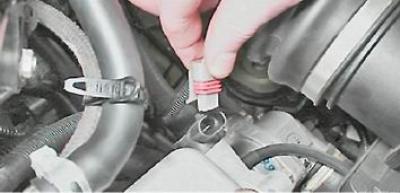
2. Having released the retainer, we disconnect the wiring block from the camshaft position sensor on the 8-valve engine.
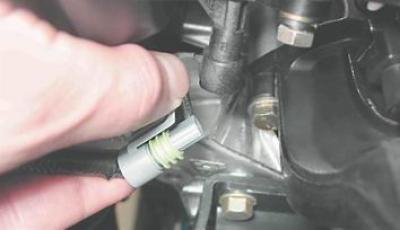
Note: On a 16-valve engine, the operation is as follows:
3. Connect the "negative" probe of the voltmeter to the "mass" (to the car body).
4. Turn on the ignition and use a voltmeter to measure the supply voltage at terminal A of the wiring harness connector (terminal designations are made on the block).
Note: The voltage at the terminal must be at least 12 V. If the voltage does not reach the connector or is less than 12 V, the battery is discharged, the power supply circuit is faulty, or the ECU is faulty.
On engines 2112 and 21124:
5. With a socket wrench by 10 mm we unscrew the two bolts securing the camshaft position sensor.
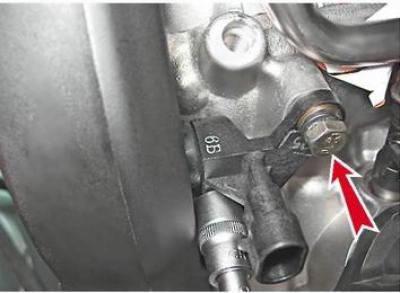
6. Remove the sensor from the hole in the rear timing belt cover.
On engines 2111 and 21114:
5. With a socket wrench by 10 mm unscrew the bolt securing the camshaft position sensor.
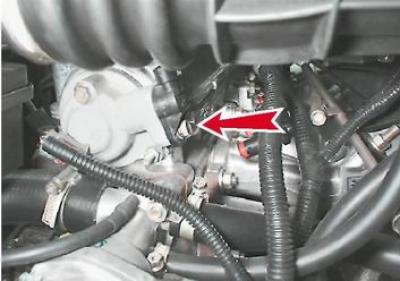
6. Remove the camshaft position sensor from the cylinder head plug hole.
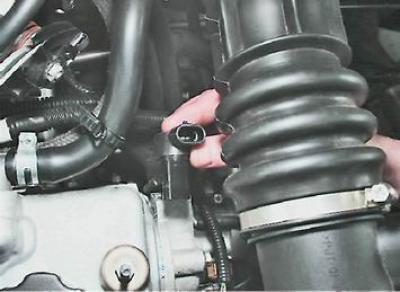
7. Remove the rubber sealing ring from the sensor. Replace the damaged ring.
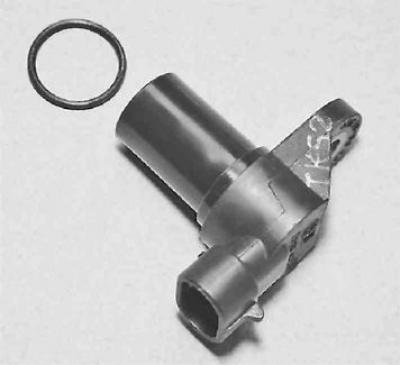
Advice: You can verify that the camshaft position sensor is faulty by replacing it with a known good one
Installation
We install the camshaft position sensor in the reverse order.