




You will need: a special key for removing spark plugs, a set of round feeler gauges.
1. Remove the spark plug caps. Clean the spark plug and the area around it from dirt so that no dirt gets into the cylinder when you unscrew the spark plug.
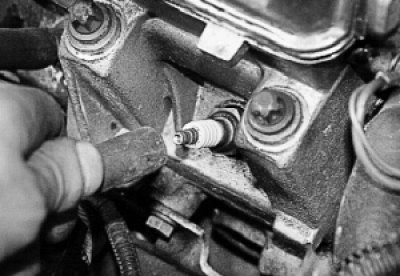
2. Loosen the spark plug tightening and remove the spark plugs from the cylinder head.
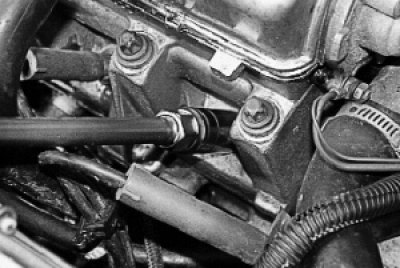
3. Inspect the spark plugs. If there are cracks in the insulators, damaged threads or electrodes, the spark plugs must be replaced.
Light brown carbon deposits, which evenly cover the lower part of the spark plug with a thin layer, do not affect the operation of the ignition system and do not need to be cleaned off.
The absence of carbon deposits on the spark plug indicates either that the engine is running on a lean mixture, or that the ignition timing is set incorrectly, or that the spark plug brand does not match the engine type.
Shiny black carbon deposits are a sign of oil getting into the engine cylinder. Such a spark plug must be cleaned.
4. Check the gap between the spark plug electrodes (only with a round feeler gauge). For carburetor engines it should be 0.7–0.85 mm, for engines with an injection system – 1.00–1.13 mm.
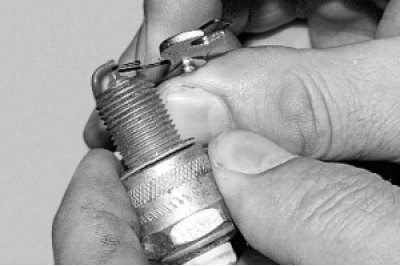
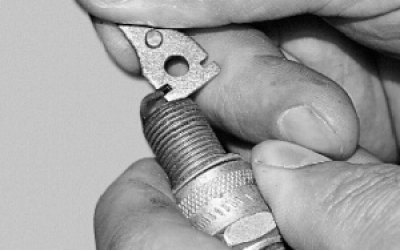
5. If the gap differs from the specified one, adjust it by bending the side electrode.
6. When installing spark plugs, first tighten them by hand and then tighten them with a wrench. Do not exceed tightening torque.
Useful tips: Gone are the days when the question "Which spark plugs should I buy?" was irrelevant and you could only buy domestic ones and only the same model as the one in your car. Now there is a huge selection of spark plugs from almost all foreign manufacturers on the shelves. And, naturally, "home-brewers" immediately began to counterfeit them.
In order not to buy such candles, first of all pay attention to the packaging - the quality of printing from real manufacturers is impeccable, and from counterfeit ones - the outlines of the drawings often do not match. If there is no packaging at all, further inspection of the candles does not make sense - there are no branded candles without it.
Then inspect the spark plugs. The central electrode should have a clear cylindrical shape, and its surface should be absolutely smooth. If there are defects on the electrode and especially if it is installed crookedly, you have a fake in front of you.
The side electrode of a counterfeit spark plug is often also welded crookedly, and its edges are oblique. The thread of genuine spark plugs is made by rolling, so it is absolutely smooth. In counterfeit ones, it is cut and has small chips.
The sealing ring of a real spark plug cannot be removed. In a fake one, it is either screwed on by a thread or easily removed.
The insulator of a real spark plug is absolutely smooth and shiny. A fake often has longitudinal seams from an imprecisely joined press form.
Finally, the inscription on the insulator must be clear, even and neat.
And lastly, real branded candles cannot be cheap. Too low a price should alert you.
Sometimes, during intensive acceleration with the engine "spinning up" almost to maximum revolutions, sharp jerks appear, perceived as impacts. The spark plugs are to blame, although checking with a piezo tester ("gun") indicates that they are in good working order. The reason is that the spark plugs lose their tightness over time and a spark plug that works normally at low and medium loads misfires at high pressure in the combustion chambers. Therefore, it is not recommended to operate the spark plugs without replacing them for more than 15 thousand km.
[The original is on the portal: VAZBOOK.ru]