

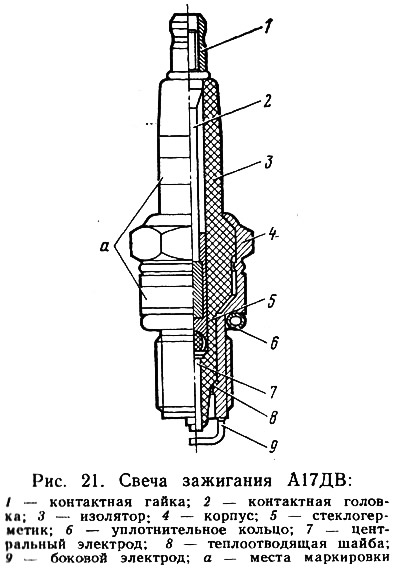
The letter A means that the thread of the screwed-in part is M14X. The number 17 is a glow number indicating that this candle is cold.
The letter D - determines the length of the threaded part of the body. Information about the length of the threaded part, like all other data, is deliberately emphasized, since longer or shorter candles cannot be used. In the first case, the threaded part will go deep into the combustion chamber, overheat and turn into a source of glow ignition with all the ensuing consequences.
In the case when the candle has a short threaded part, the spark gap will be in a poorly ventilated zone, and therefore the candle will work unevenly. In addition, when the turn comes to screw a spark plug with a standard threaded length into the engine, unforeseen difficulties will arise. Previously, the free part of the thread will be covered with a layer of soot, which will be the culprit of the difficulties.
The letter B indicates the design features, in this case, the protrusion of the thermal cone.
Candles are an important source of information. The condition of their threaded part and electrodes indicates the operating conditions of the candle.
A good, already working spark plug has some deposits on the insulator, so the insulator is light brown or grayish in color, clean body, no signs of wear on the electrodes. All this suggests that the conditions in which the candle works are fully consistent with its requirements.
Here is another candle. The case, the insulator, and the electrodes are covered with blackness. It is clear that the spark plug works either in very bad conditions, or it got on the engine by accident, that is, it does not correspond to this engine. Some motorists install spark plugs from well-known companies on their car («Champion», «Marelli»), without worrying about whether these candles are suitable for the Zhiguli engine. In order not to get candles blindly, use the recommendations of the Research Institute of Avtopriborov. For VAZ vehicles with A17DV spark plugs (GOST 2043-74*), it is allowed to install candles of the following brands: FE55P («Spark», Poland), 14L—7Y («Pal», Czechoslovakia), CLNY («Lodge», Great Britain), FM14-175/2 («Insulator», GDR), N-11Y («Champion», USA), W160T30 and W175T30 («Bosch», Germany), BP-6ES (NLC, Japan).
Soot on candles is not an accidental phenomenon. This is a consequence of such reasons as incorrect adjustment of the contacts of the breaker-distributor, violation of the gaps between the electrodes of the candles, a malfunction of the capacitor, high voltage wires, an over-rich mixture, or prolonged idling of the engine.
On the third candle, the electrodes are oily. If the engine is already «not early youth», then traces of oil on the candles are a quite definite sign - the piston group needs repair. Another reason for oiling the candle is often found - damage to the cap 5 (see fig. 12) valve. The defect is accompanied by a noticeable oil consumption.
Burnt or severely corroded electrodes, as well as a burnt out, pronounced insulator, signal a mismatch of the candle (too low heat number), incorrect setting of the ignition timing, the use of low-octane gasoline. Spark plug damaged due to incorrect ignition timing (early), has pronounced features: the electrodes are melted, the insulator is damaged.
In order for the candle to perform its functions well, all engine systems must work properly. In turn, the candle must also be in good condition, that is, it must not have cracks and chips in the insulator, and the gaps between the electrodes must be within 0.5-0.6 mm. Usually candles work effectively for 30-35 thousand km, and then they are changed to new ones. After every 10 thousand km, the candles must be turned out, cleaned of soot, checked and, if necessary, adjusted the gap.
To perform this operation, you must have: a socket wrench for spark plugs, a probe for ignition devices, a hard nylon brush, cleaning material (napkins, rags) and a special liquid for cleaning candles. To prevent dirt from entering the engine cylinders, freed from wires (take them off), Wipe the candles with a brush and napkins, and especially carefully the nests where the candles are located.
It is necessary to handle candles carefully, since a slight skew of the socket wrench (and this is possible, because access, especially to the first candle, is not so free) - and the insulator is damaged. The turned-out candles must be inspected with passion, then thoroughly cleaned using a brush, a napkin moistened with a special liquid (in the absence of it - gasoline, alcohol) and wipe dry. The required gap is known, it remains to be recalled that all actions to adjust the gap can only be performed with the side electrode. The central electrode is inviolable: one careless movement - and the deformation of the insulator is guaranteed.
Reinstall the finished spark plugs with o-rings. Candles are first screwed in by hand, and then tightened with a key, but without much effort. When screwing in a candle, it is necessary «feel» carving. The fact is that the body of the candle is steel, and the cylinder head is made of aluminum alloy. Having broken the thread of the socket, you will have to remove and repair the head of the block.