




In building 16 (figure 147) four poles 17 with excitation windings are secured, three of which are series and one is shunt. The housing together with covers 6 and casing 14 are tightened with two bolts. The anchor has an end collector. The rear end of the anchor shaft rotates in a metal-ceramic bushing pressed into cover 15, and the front end - in a bushing pressed into the clutch housing.
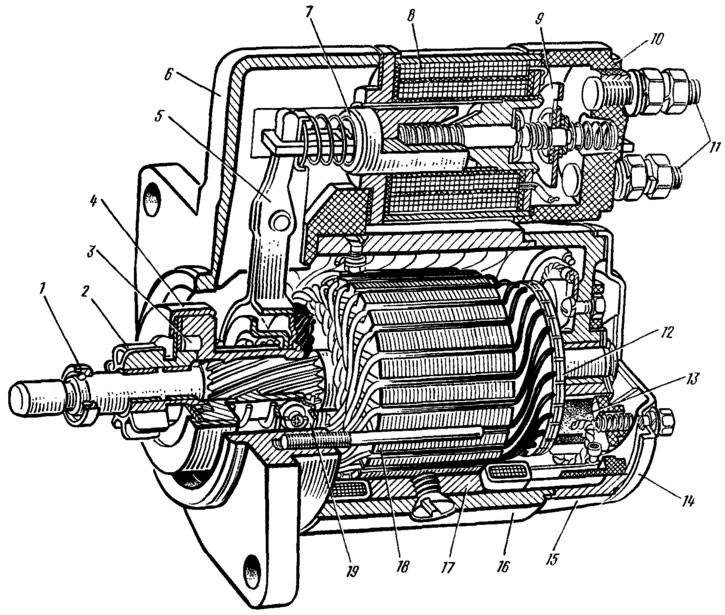
Figure 147. Starter 39.3708: 1 - limiting ring; 2 — drive gear; 3 — overrunning clutch roller; 4 — overrunning clutch; 5 — drive lever; 6 - drive side cover; 7 — relay anchor; 8 — relay winding; 9 - contact plate; 10 — relay cover; 11 - contact bolts; 12— collector; 13 - brush; 14 — casing; 15 — back cover; 16 — body; 17 — pole; 18 - anchor; 19 - leash ring.
The starter connection diagram is shown in Figure 148. When the starter is switched on, voltage from the battery is supplied to both windings of the starter traction relay via auxiliary relay 3 type 113.3747-10. After the traction relay contacts are closed, the pull-in winding is disconnected.
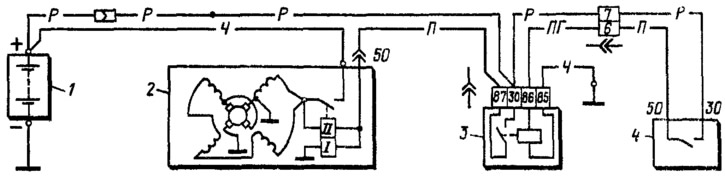
Figure 148. Starter connection diagram: 1 - battery; 2 - starter; 3 — starter relay; 4 ignition switch.
Brief technical characteristics of the starter:
- Nominal power, kW — 0.9
- Current consumption, A:
- at maximum power, no more than - 230
- in a inhibited state, no more than - 310
- at idle, no more than - 60