




To complete the work you will need: a torque wrench, an inspection pit or overpass, a height-adjustable stop (for example, a screw jack), lifting device (hoist, hoist or winch with a lifting capacity of at least 100 kg) or a second adjustable stop. It is better to do the work with an assistant.
Note: If there is no lifting device, the engine can be removed with two assistants. This requires a steel pipe with a diameter of 50-60 mm and a length of 2-2.5 m, as well as a cable.
Sequence of execution
1. Prepare the car for work (see "Preparing the car for maintenance and repair").
2. Using a bore gauge, check the wear of the cylinder walls (see "Piston and connecting rod - replacement").
3. Using a micrometer, check the wear of the crankshaft connecting rod journals (see below).
Note: Further work is necessary if there is unacceptable wear of the cylinder block, crankshaft connecting rod journals, if there is a suspicion of wear of the crankshaft main journals or rotation of the main bearing shells.
4. After loosening the clamp, remove the crankcase ventilation hose from the cylinder block pipe.
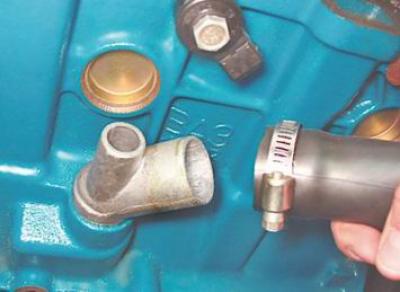
5. Key by 10 mm we unscrew the two bolts securing the supply pipe to the cylinder block and disconnect it from the block.
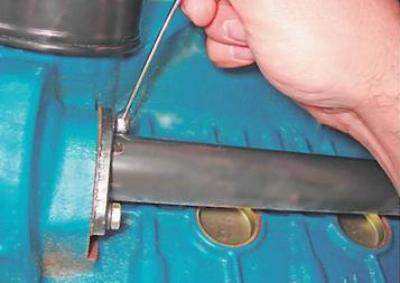
Note: The connection is sealed with a gasket.
6. Remove the knock sensor (see "Knock sensor - testing and replacement").
7. Remove the crankshaft position sensor (see "Crankshaft Position Sensor - Checking and Replacing").
8. Remove the coolant pump (see "Coolant pump - replacement").
9. Remove the starter (see "Starter - removal and installation").
10. Remove the generator (see "Generator - removal and installation").
Note: On 16-valve engines, disconnect the lower engine mount rod from the front suspension crossmember (see "Lower mounting rod for engines 2112 and 21124 (16v)"), with a socket wrench by 17 mm we unscrew the three bolts securing the lower generator bracket and remove the bracket together with the rod.
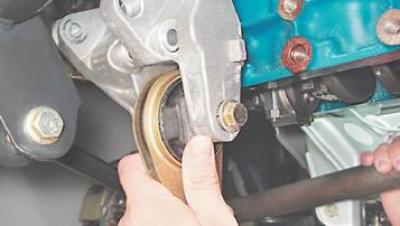
11. Install an adjustable stop under the gearbox and hang the cylinder block on a lifting device or install an adjustable stop under the cylinder block. Slightly lift the cylinder block, relieving the power unit supports.
12. Remove the lower cover of the clutch housing and unscrew the bolts securing the gearbox to the cylinder block (see "Gearbox - removal and installation").
13. Unscrew the upper nut of the right support cushion bolt (see "Right support").
14. With a socket wrench by 13 mm we unscrew the three bolts securing the bracket of the right engine support to the cylinder block.
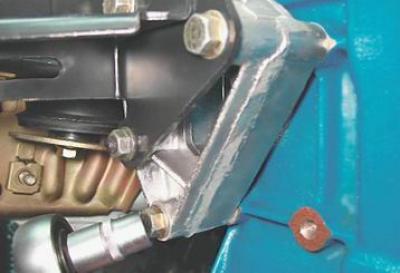
15. Remove the engine support bracket together with the upper generator mounting bracket.
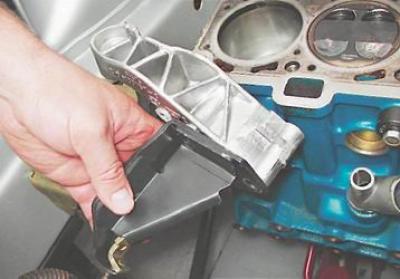
16. With a socket wrench by 15 mm under the right front wing of the car, unscrew the three bolts securing the support bracket to the right side member.
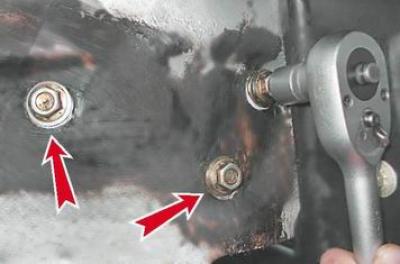
17. Remove the bracket together with the right support of the power unit.
18. Slightly rocking the cylinder block, disconnect it from the gearbox and remove it from the engine compartment.
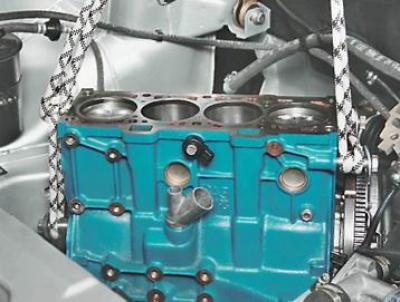
19. Remove the flywheel (see "Flywheel - removal and installation").
20. With a socket wrench by 10 mm we unscrew the six bolts securing the rear crankshaft oil seal holder and remove it.
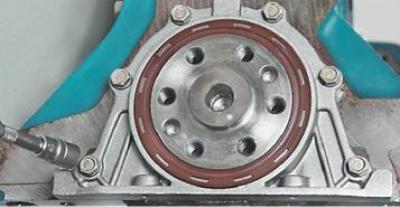
Note: There is a gasket installed under the holder that must be replaced during assembly.
21. Remove the oil pump (see "Oil pump - removal, installation, assembly and disassembly").
22. With a socket wrench by 17 mm we unscrew two bolts securing five main bearing caps.
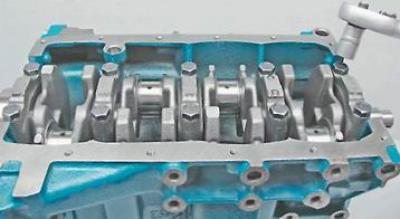
23. Remove the main bearing caps.
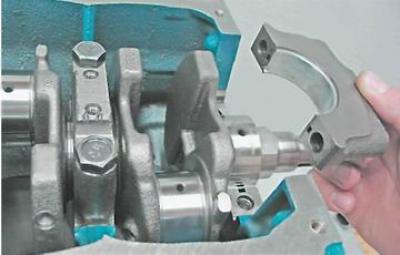
24. Remove the lower main bearing shells from the covers.
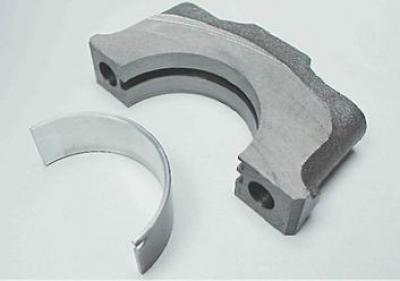
25. Remove the crankshaft from the cylinder block.
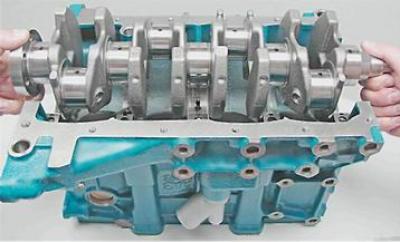
26. From the grooves of the third support we remove two thrust half rings.
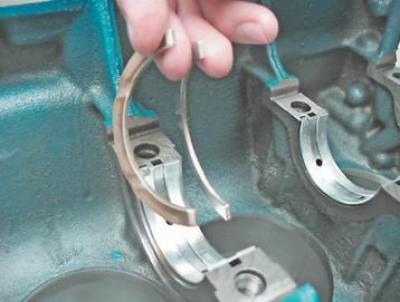
27. Remove the upper main bearing shells from the cylinder block supports.
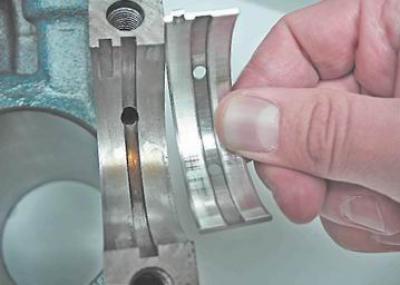
28. We wash the cylinder block from dirt and deposits with a special detergent, diesel fuel or kerosene, and blow out the oil channels.
29. Using thin copper wire, clean the outlet holes of the oil injectors on engines 2112, 21124 and 21114.
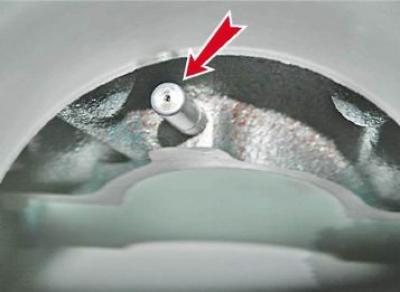
30. Wipe the block dry and inspect it. Cracks and chipping of metal are unacceptable.
31. Using a micrometer, we measure the main journals of the crankshaft, as well as (if this has not been done previously on the cylinder block installed on the vehicle) connecting rod journals.
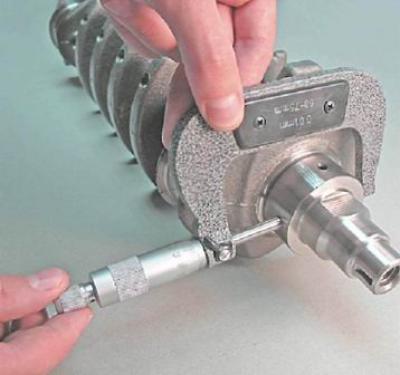
The crankshaft is subject to replacement or grinding if the wear of its journals is more than 0.03 mm or the ovality of the journals is more than 0.03 mm, or there are burrs and scratches on the journals. It is possible to grind the journals of the shaft with a reduction in their diameter by 0.25; 0,5; 0.75 and 1.00 mm.
Table 8.2. Repair dimensions of crankshaft journals, mm
|
Neck sizes |
Root necks |
Connecting rod journals |
|
Denomination |
50,799-50,819 |
47,83-47,85 |
|
1st repair (-0.25) |
50,549-50,569 |
47,58-47,60 |
|
2nd repair (-0.50) |
50,299-50,319 |
47,33-47,35 |
|
3rd repair (-0.75) |
50,049-50,069 |
47,08-47,10 |
|
4th repair (-1.00) |
49,799-49,819 |
46,83-46,85 |
Recommendation. If the engine cylinders have been bored, it is necessary to wash the cylinder block with diesel fuel or kerosene and blow it with compressed air, then wipe the shaft dry. After grinding the journals of the engine crankshaft, remove the plugs of the outlet openings of the channels. It is also necessary to wash the crankshaft with kerosene and blow out the crankshaft channels with compressed air.
Warning! Install new plugs into the channel openings.
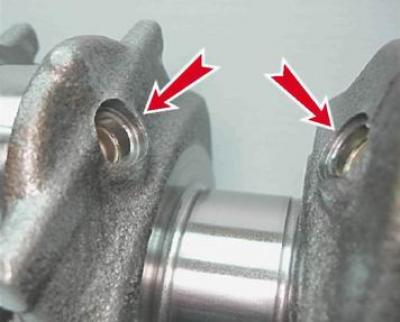
32. Select the appropriate rings, pins and pistons (see "Selection of pistons for block cylinders"), as well as crankshaft bearing shells (see above).
33. Degrease the bearing shell seats in the bearing supports and caps.
34. Place the main journal liners with grooves into the bearing sockets.
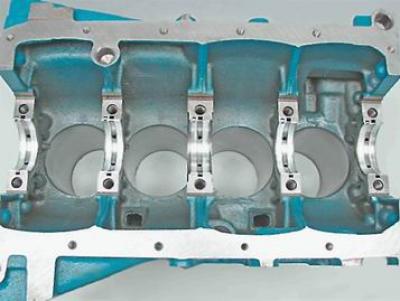
35. Place the liners without grooves into the bearing caps.
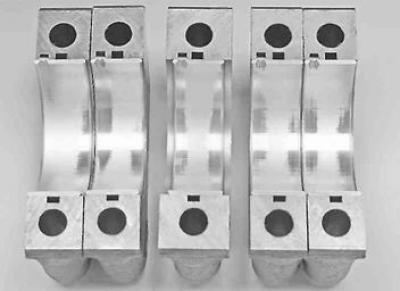
36. We install thrust half rings in the grooves of the third main bearing. On the front side, the steel-aluminum (white on the inside and yellow on the outside), from the back - metal-ceramic (yellow on both sides).
Note. The half rings are manufactured with a nominal thickness and a thickness increased by 0.127 mm. The axial movement of the crankshaft should be within 0.06-0.26 mm.
37. We install the half rings with the grooves facing outwards (to the crankshaft cheeks).
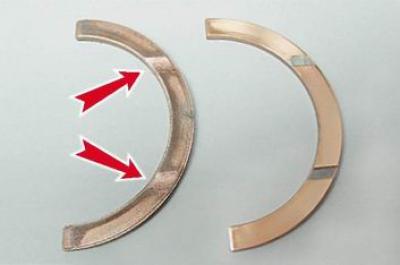
38. Lubricate the crankshaft journals and bearings with clean engine oil.
39. Place the shaft in the cylinder block supports and install the main bearing caps.
Note: Bearing numbers are marked on the covers with marks (from 1st to 5th). The cover of the fifth main bearing is marked with two marks, spaced apart towards the edges of the cover.
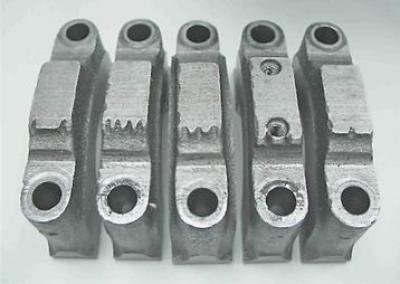
When installed in the block, the covers must be with the notches facing the side of the block on which the oil level indicator guide is installed.
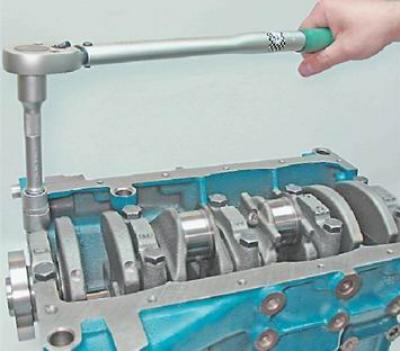
40. Tighten the cover mounting bolts with a torque wrench to 68.31-84.38 N·m (6.97-8.61 kgf·m).
41. We carry out further assembly in reverse order.
Recommendation: If you have a suitable lifting mechanism, it is more convenient to assemble the cylinder block and then install it in the car.