




The liners are installed in the sockets and caps of the main bearings, the crankshaft is placed in the main bearings, assembled with the balance shaft drive gear, and the thrust half rings are inserted into the sockets of the middle main bearing with the grooves facing the thrust surfaces of the crankshaft (an antifriction layer is applied to the surface of the half rings from the groove side).
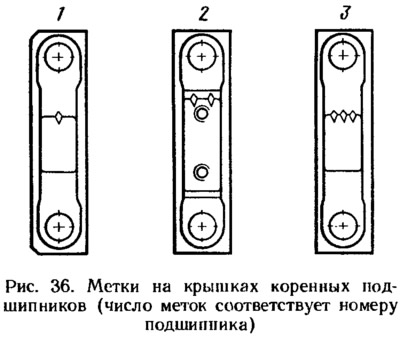
Install the main bearing caps in accordance with the marks on their outer surface (figure 36). The covers must be positioned so that the marks are on the generator mounting side. Tighten the cover mounting bolts.
Check the axial play of the crankshaft. To do this, turn the block with the back side up and install a stand with an indicator on it so that the indicator leg rests on the crankshaft flange. Move the shaft up and down with screwdrivers like levers, measure the axial play with an indicator. It should be within 0.06-0.26 mm. If the play is greater, then bring it to normal by replacing the old half rings with new ones or installing half rings with a thickness increased by 0.127 mm.
The gears are installed on the balance shafts in such a position that the timing marks on the gears are opposite the marks on the crankshaft drive gear (see figure 25). Install the washers and secure the gears with bolts.
Install in holder 3 (figure 37) rear oil seal 1 of the crankshaft, having previously lubricated it with engine oil. The displacement of the oil seal inward relative to the outer surface B of the holder should be no more than 0.25 mm. The protrusion of the oil seal relative to surface B is not allowed. Two installation bushings 2 are pressed into the rear oil seal holder, ensuring that the bushings protrude (6.5±0.2) mm on the side opposite the cylinder block.
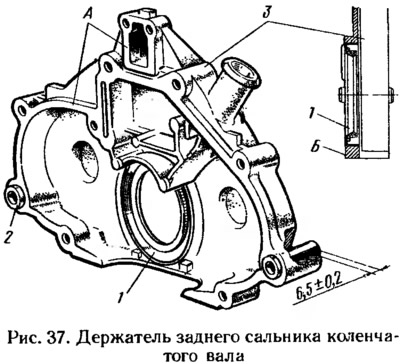
Clean the mating surfaces of the holder and the cylinder block from the remains of the old sealant, dirt, oil and degrease. Apply KLT-75T sealant in a continuous strip of at least 3 mm wide to the surfaces A of the holder mating with the cylinder block. Put the holder with the seal on the conical mandrel 41.7853.4011 (see figure 23) and move it from the mandrel to the crankshaft flange. Attach the holder to the cylinder block with bolts and nuts.
Install the flywheel on the crankshaft using the mounting sleeve so that the mark (cone-shaped hole) near the rim was located opposite the axes of the crankshaft connecting rod journals. Install the washer and flywheel mounting bolts. Lock the flywheel with a lock (see figure 35) and tighten the mounting bolts.
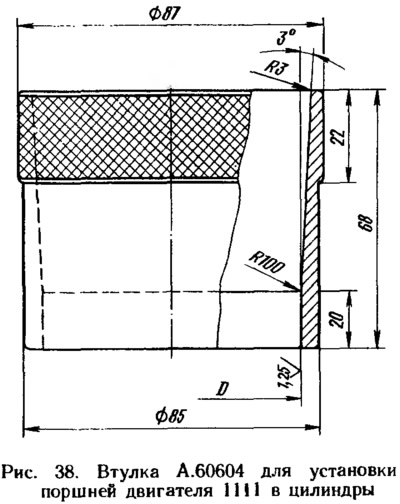
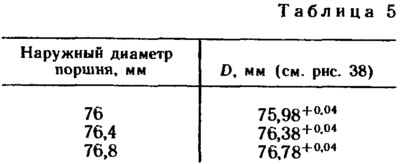
Assemble the pistons with connecting rods (see section "Connecting rod and piston group"). Using bushing A.60604 (figure 38) for engines 11111, which compresses the piston rings, insert the pistons with connecting rods into the cylinders. The inner diameter (Table 5) of the bushing is selected in accordance with the diameter of the piston being installed. To install the pistons of the 11113 engine, a split adjustable bushing 67.7854.9519 is used.
The pistons are positioned with an arrow (see figure 5) towards the camshaft drive.
Install the liners in the connecting rods and connecting rod caps. Connect the connecting rods to the crankshaft journals, install the caps and tighten the connecting rod bolts. Connecting rod caps must be installed so that the cylinder number on the cap is opposite the cylinder number on the lower connecting rod head.
Using mandrel 67.7853.9580, press the front crankshaft oil seal into the oil pump cover. Pour some engine oil into the oil pump and turn the drive gear several times, stopping it in a position so that it can be put on the front end of the crankshaft. Insert the guide sleeve of mandrel 67.7853.9580 into the oil seal pressed into the oil pump and move the pump from the guide sleeve onto the shaft. Install a gasket under the pump and attach it to the cylinder block.
To ensure correct installation of the pump, two guide pins are pressed into its housing, which must fit into the corresponding holes in the cylinder block.
Insert the oil receiver with a sealing ring into the hole of the oil pump, attach it to the oil pump and to the cover of the middle main bearing of the crankshaft (see figure 34).
Install the oil pan with the gasket and secure it. Install the oil filter flange with the gasket on the cylinder block and secure it with bolts. Screw the oil pressure indicator lamp sensor into the flange. Lubricate the oil filter sealing ring with engine oil and manually screw the oil filter to the flange fitting.
Two centering bushings are inserted into the cylinder block (figure 39) and install a new cylinder head gasket on them; it is not allowed to use a used gasket.
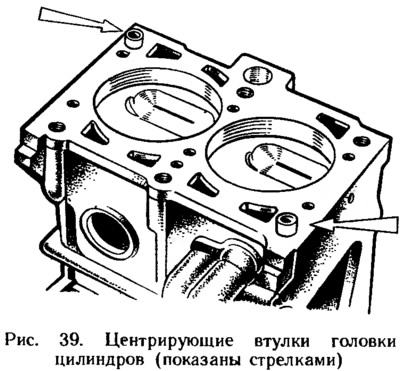
Before installing the gasket, remove oil from the mating surfaces of the block and cylinder head. The gasket must be clean and dry. If oil gets on the surface of the gasket, degrease it.
Rotate the crankshaft so that the pistons are located in the middle part of the cylinders, and install the cylinder head assembled in accordance with the instructions of the subsection "Cylinder head" (see sec. "Disassembly and assembly of engine components").
Check the length of the cylinder head bolts (excluding bolt head). If the length of the bolts is more than 135.5 mm, then replace them with new ones. In advance, before assembling the engine, lubricate the threads and heads of the bolts by dipping them in engine oil, and then allow the excess oil to drain. In addition, it is necessary to remove oil from the holes for the bolts in the cylinder block (if it got there), otherwise, when tightening the bolts, cracks may appear in the cylinder block.
To ensure a reliable seal and to avoid tightening the bolts during maintenance, the cylinder head mounting bolts are tightened in a specific sequence (see figure 21) and in four steps (see section. "Cylinder head").
Insert the coolant pump with the gasket into the cylinder block socket, checking the reliability of the pump pulley pressing onto the shaft (see section. "Coolant pump"). Install the rear cover of the timing belt and attach it together with the pump cover to the cylinder block. Additionally, attach the cover with a bolt to the cylinder block and a nut to the stud on the cylinder head.
Insert segment keys into the sockets on the front ends of the crankshaft and camshaft and install the toothed pulleys. Hold the pulley from turning with device 67.7811.9513 and secure the pulley with a bolt and washer. Apply UG-6 sealant to the bolt threads before installation.
Turn the camshaft pulley until the mark on the pulley aligns with the installation tab on the rear protective cover of the timing belt.
Turn the crankshaft towards the smaller rotation angle until the alignment mark on the pulley aligns with the mark on the oil pump cover.
The crankshaft can be turned using a wrench on the bolt temporarily screwed into the front end of the shaft, or on the flywheel.
Install the tension roller with the axle and spacer ring and secure it in a position corresponding to the minimum belt tension.
Place the toothed belt on the camshaft pulley and, while pulling both branches of the belt, place the left branch behind the tension roller and then wrap it around the coolant pump pulley. Place the lower part of the belt on the crankshaft pulley. When installing the belt, do not allow it to bend sharply with a radius of less than 20 mm, so as not to damage the fiberglass cord of the belt. Slightly pull the belt in the direction of rotation and check that the installation marks match (see figure 7).
If the marks do not match, repeat the belt installation operations, adjusting the position of the camshaft pulley. If the marks match, adjust the belt tension and valve clearances as described in Section. "Engine adjustments". Install the front timing belt cover and secure it with bolts.
Carefully place the gasket in the groove of the cylinder head cover along the entire perimeter. Install the cover on the cylinder head, put the rubber bushings on the studs and nuts with washers.
If the bushings show signs of damage, they are replaced with new ones. The nuts are tightened evenly in several stages until the washer stops in the stud. It is necessary to remember that the tightness of the cover depends on the thoroughness of all operations for its installation.
Spark plugs and sensor 1 are screwed into the cylinder head (figure 40) coolant temperature gauge.
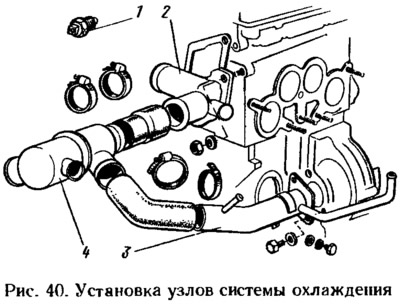
Install the outlet pipe 2 of the cooling jacket with a gasket on the cylinder head and secure it with two nuts. Install the gasket and attach the flange of the supply pipe 3 of the coolant pump to the cylinder block. Put the hoses leading to the thermostat on the pipe and the supply pipe, install the thermostat 4 and secure the hoses with clamps.
The auxiliary unit housing with the sealing ring is installed on the cylinder head and secured with a bolt. When installing the housing, pay special attention to the position of the sealing ring in the groove, since when tightening the bolt, the ring may jump out of the groove and get stuck between the edges of the groove and the surface of the cylinder head. If the sealing ring shows signs of "biting", it must be replaced with a new one.
Install the fuel pump with a heat-insulating spacer, with gaskets and a pusher (see section. "Fuel pump").
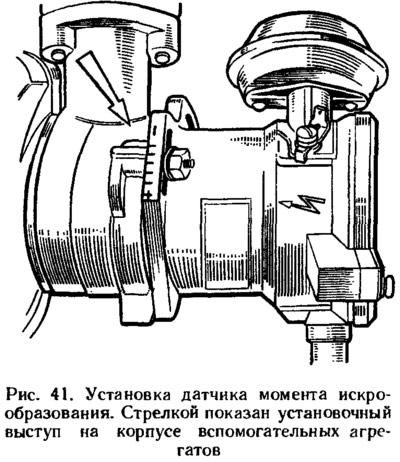
Lubricate with engine oil and put the sealing ring on the flange of the spark timing sensor. Attach the sensor to the auxiliary unit housing in such a position that the middle mark on the sensor flange is opposite the mounting protrusion on the auxiliary unit housing (figure 41). The sensor shaft connects to the camshaft tailpiece in only one position. Therefore, before installation, turn the shaft so that the cams of the shaft coupling enter the grooves of the camshaft tailpiece.
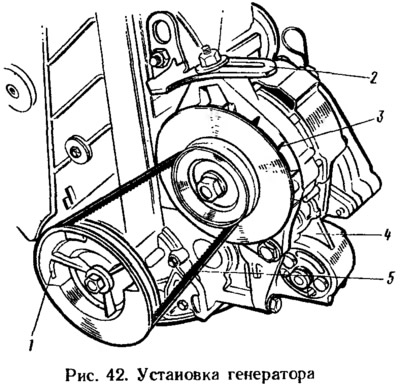
Attach bracket 4 to the cylinder block (figure 42) with the front suspension support of the power unit. Fasten the tension bar 2 of the generator with the eye on the cylinder head and install the generator 3, attaching it to the tension bar and to the bracket 4 of the front suspension support of the power unit. Put the pulley 1 of the generator drive on the crankshaft and fasten it with a bolt and washer. Put the belt 5 on the pulleys of the crankshaft and generator and adjust its tension as indicated in the section "Engine Adjustment".
Place a gasket on the cylinder head studs, install and secure the intake pipe with the bracket of the intermediate lever of the carburetor drive and the return spring. Install the carburetor with the gasket, secure it with nuts and close it with a technological plug on top. Do not tighten the nuts or secure the heated carburetor. Install the throttle drive rod, connecting it to the carburetor and to the intermediate lever on the intake pipe.
Place the crankcase exhaust ventilation hose on the cylinder head cover and rear oil seal holder. Secure the hose with clamps. Install the oil level indicator so that the oil level indicator handle is in a vertical position, otherwise the indicator readings will be distorted.
Install the fuel supply hose from the fuel pump to the carburetor and secure it with clamps. Install the vacuum regulator hose of the spark timing sensor, as well as the crankcase ventilation system hose running from the cylinder head to the carburetor.
Place the hoses going to the heater on the outlet pipe of the cylinder head and on the supply pipe of the coolant pump and secure them with clamps.
Oil is poured into the engine through the filler neck on the cylinder head cover.
Notes
1. Dimension D see table 5. For installation of pistons ∅ 82 mm (engines 11113) it is possible to use similar bushings with diameters increased by 6 mm.