




Contents: Valve seats ↓ Valves ↓ Valve guide bushings ↓ Oil deflector caps of guide bushings ↓ Springs and pushers ↓ Adjusting washers, cylinder head…↓
The cylinder head is thoroughly washed and the oil channels are cleaned. Carbon deposits are removed from the combustion chambers and from the surface of the exhaust channels with a metal brush.
Inspect the cylinder head. There should be no scoring or damage on the bearings under the camshaft journals and in the holes under the valve tappets. Cracks in any places of the cylinder head are not allowed. If there is a suspicion of coolant getting into the oil, check the tightness of the cylinder head.
To check for leaks, close the cooling jacket openings with plugs and pump water under a pressure of 0.5 MPa. No water leakage should be observed for 2 minutes. You can check the cylinder head for leaks with compressed air, for which close the cooling jacket openings with plugs, lower the cylinder head into a bath of water heated to 60-80°C, and let it warm up for 5 minutes. Then feed compressed air into the head under a pressure of 0.15-0.2 MPa. No air leakage from the cylinder head should be observed for 1-1.5 minutes.
Valve seats
On the working chamfers of the saddles (figure 59) there should be no pinholes, corrosion marks or other damage in the valve contact area. Minor damage on the surface of the working chamfers is removed by grinding with a grinding machine or manually, removing as little metal as possible.
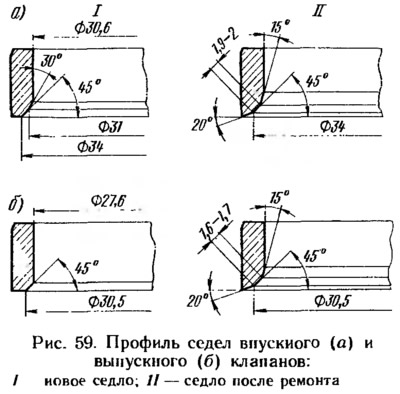
Before grinding with cutters, clean the chamfers from work hardening and carbon deposits, for which the centering rod A.94059 is inserted into the valve guide sleeve and a 15° chamfer is milled with cutter A.94092 for the inlet valve seat or A.94003 for the outlet valve. The cutters are put on spindle A.94058. Then a 2-0° chamfer is milled with cutter A.94031 for the inlet valve seat or A.94101 for the outlet valve.
(The original is available on the online resource VAZBOOK.RU)
After cleaning the chamfers, grind the 45° chamfer, providing the chamfer width according to Figure 59 and base diameters of 34 and 30.5 mm. The chamfers are ground with conical wheels A.94100 for inlet valve seats and A.94078 for outlet valve seats. The wheels are placed on spindle A.94069. When the wheel touches the seat, the grinding machine must be switched off, otherwise vibration will occur and the chamfer will be incorrect.
After grinding, the cylinder head seats and channels are thoroughly washed and blown out with compressed air.
Valves
Remove carbon deposits from the valves. Check to see if the stem is deformed (rod non-straightness 0.015 mm) and whether there are any cracks on the valve head. The damaged valve is replaced.
Check the condition of the valve working chamfer. In case of minor damage, it can be ground, maintaining the chamfer angle of 45°30' ±5'. In this case, the distances from the lower plane of the valve head to the base diameters (∅ 34 and ∅ 30.5 mm) should be 1.3-1.5 mm for the inlet valve and 1.8-2.0 mm for the outlet valve.
Valve guide bushings
Check the clearance between the valve guides and the valve stems by measuring the valve stem diameter and the guide bore. The clearance value should match the data table 2. If the clearance is greater than the permissible value, replace the valve. If the excessive clearance is not eliminated by replacing the valve alone, replace the guide bushing as well. Use the A.60153/R mandrel for this operation (figure 60), pressing in the bushings with the retaining ring fitted until it rests against the cylinder head body.
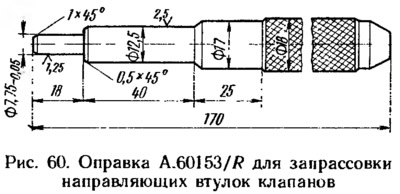
Guide bushings are supplied as spare parts with an outer diameter increased by 0.02 mm and an allowance for the inner diameter. Therefore, after pressing in, the holes in the guide bushings are reamed with reamers (A.90310/1 for inlet valve bushings and A.90310/2 for outlet valve bushings). Then the valves are checked for leaks and, if necessary, the valves are ground to the seats.
Oil deflector caps of guide bushings
The oil deflector caps must not have rubber peeling off from the fittings, cracks or excessive wear of the working edge. When repairing the engine, it is recommended to always replace the oil deflector caps with new ones.
Damaged caps must be replaced on a removed cylinder head to avoid bending the valve stems. To press on the caps, use mandrel 47.7853. 4016 (see figure 47).
Springs and pushers
The springs are checked for elasticity and the presence of cracks. The elasticity of the valve springs is checked by the length of the spring in a free state (45.2 mm - external and 34.1 mm - internal) and under load: (255.1±16.7) N and (453.2±23.5) N for the external spring (in this case the length should be 33.7 and 24.7 mm respectively); (88.3±7.8) Ni (269.8±14.7) N for internal (the length is 29.7 and 20.7 mm respectively).
The valve tappets are checked for the condition of the working surface. There should be no burrs or scratches on it. If damaged, the tappet is replaced.
Adjusting washers, cylinder head mounting bolts
The working surfaces of the washers must be smooth, without nicks, scratches and burrs. They must not have stepped or one-sided wear or metal rubbing. Concentric traces from running-in with the camshaft cams are allowed.
When using cylinder head bolts repeatedly, they stretch out. Therefore, check whether the bolt length does not exceed 135.5 mm (excluding the height of the bolt head), and if it is larger, then replace the bolt with a new one.