Doorway seals are made of sponge rubber in the form of a tube with an extension to which a plastic facing edging is sewn. The outer surface of the edging has a decorative embossing. A metal perforated frame is inserted inside the edging, which ensures the fastening of the seal on the flanges of the doorways.
The openings of the windshield and rear windows, as well as the openings of the side windows of the 2102 and 21021 vehicles, are sealed with rubber seals that have special tongues.
Door glass seals are made of special rubber profiles, lower seals of drop-down windows are made of plastic profile, which ensures easy and reliable installation of seals. Water that has leaked under the door glass seals flows inside the door and pours out through drain holes. Lock and window lift mechanisms are protected from water by a plastic film fixed to the door.
The air intake box is sealed from the ingress of smoky air from the engine compartment by a rubber seal, which is held on the flange by a metal perforated frame in the lower part of the seal. The trunk lid seal has a similar design.
When removing and installing seals with metal frames, do not allow the frame to be crushed or corrugations to form on the seals.
The contact spot welding seams, which are used to weld the stamped body parts, do not provide a tight connection. They are subject to intense corrosion, especially on sheet bends with small rounding radii, in places of metal overstress and especially when exposed to moisture. The welded seams are sealed against moisture and dirt with plastisol D-4A after priming the body. The plastisol hardens during drying after painting.
After replacing individual body parts, after welding and applying primer, the seams on both sides are coated with plastisol.
Sealing of gaps in the joints of body parts is carried out by applying non-drying sealing mastic 51-G-7 at the points shown in Fig. 205.
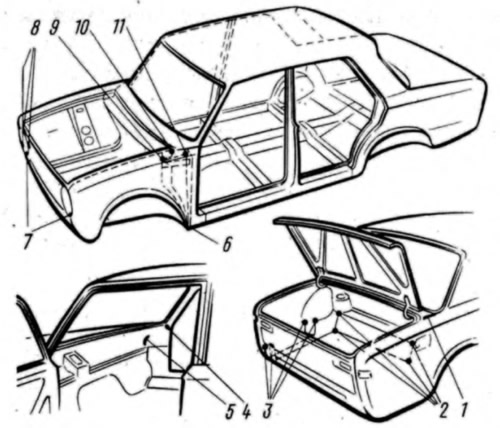
Fig. 205. Places of application of non-drying sealing mastic:
1 - joints of the rear wings with the rear panel (inside the body); 2 - corners of the joints of the trunk floor with the rear floor; 3 - joints of floors under spare wheel and fuel tank with rear panel, with side members and rear wings; 4 - joints of the bases of the front pillars; 5 - joints of the front side panels with the upper reinforcements of the front shield; 6 - joints of the front shield with the front side panels; 7 - joints of the front fenders with the headlight housings and the front panel; 8 - casing joints (from the inside); 9 - joints in the corners of the lower front panel; 10 - angles of joints of wings and windshield frame panel; 11 - joints of the reinforcement and the front side pillar.
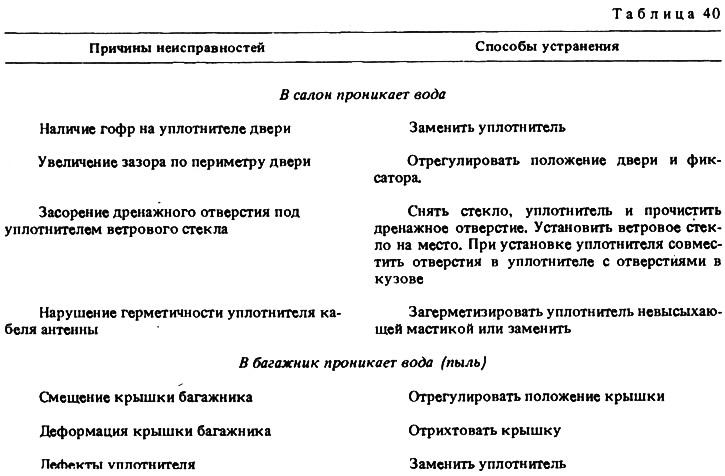
Possible malfunctions of the sealing system, their causes and methods of elimination are given in Table 40.