




Device
Windscreen 3 (Fig. 196) is curved, safe, made of two layers of polished glass 3 mm thick, glued together with plastic film. In the body opening, the glass is held by a rubber seal 4, put on the flange 5 of the body. A frame 2 made of transparent plastic with an internal metallized lining 1 is placed in the groove of the seal. To prevent water from getting into the passenger compartment, there is a hole 6 in the seal for draining water, and in the lower corners of the opening there are drain pipes 7.
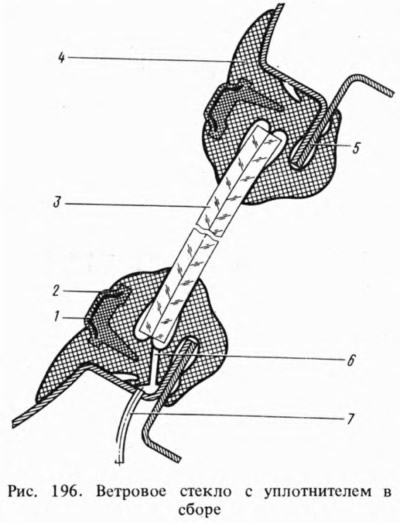
The rear window and the rear door window of the 2102 and 21021 cars are curved, safe, tempered, held by seals of the same profile. The door and side windows of the 2102 and 21021 cars are flat, safe, tempered.
The windshield washer consists of a pressure pump, two jets, a tank, a tee and plastic connecting tubes. The diaphragm-type pump, non-separable, with a foot drive is located at the bottom of the front shield and is equipped with a device that turns on the windshield wiper 2-3 seconds after pressing the foot on the cap of the diaphragm rod. On the first releases of cars, the pump was mounted on the inside of the instrument panel and was activated by pressing a finger on the bottom of the diaphragm in the hole in the instrument panel.
The tank is welded from a polyvinyl chloride film, to which a plastic neck is welded. A suction tube with a mesh filter passes through the neck cover. In the summer, clean water can be poured into the tank; in the cold season (up to -25°C), a mixture of NIISS-4 liquid (25-33%) with water or "Auto-cleaner-2 glass" is poured (30 cm³ per 1 l of water).
The jets are inserted into the bushings at the bottom of the windshield frame. The direction of the liquid stream from the nozzle hole is adjusted by turning the nozzle when loosening the fastening screw or by turning the jet on the body.
Glass replacement
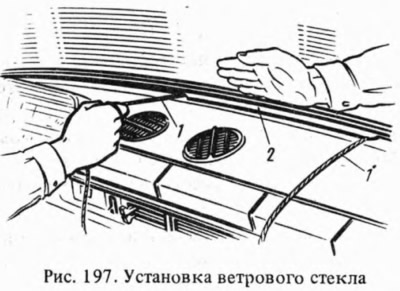
To replace a damaged windshield, remove the windshield wiper arms, the seal edging and, pressing on the upper corners of the glass, push it out. An assistant supports the glass from the outside. When installing the windshield, wash the seal grooves with gasoline and put the seal with the edging on the glass. Using a screwdriver, insert cord 1 into the groove with which seal 2 (Fig. 197) is put on the flange of the body opening. Install the glass in the body opening and pull the ends of the cord from inside the body so that the seal sits in place. An assistant presses lightly on the glass from the outside.
To remove the rear window, remove the seal edging and, pressing on the lower corners of the window, push it out. An assistant supports the window from the outside. Installing the rear window is the same as installing the windshield.
Removal and installation the pressure pump and windshield washer jets
To remove the pump, unscrew the fastening nuts and remove it as a whole. Then disconnect the electrical wires from the pump and remove the tubes from the fittings. Installation is performed in the reverse order.
Removing the jets is necessary when the sprayers are clogged or when replacing parts. To do this, slightly squeeze the plastic sleeve from the air intake box side of the body, and hook it from above with a screwdriver and, overcoming the resistance, remove the jet together with the sleeve. Unscrew the screw and clean all the parts and blow them out with compressed air. After assembling the jet, insert the sleeve into the body hole. Then sharply insert the jet into the sleeve so that the body of the jet fits into the edges of the sleeve with a groove, and check the operation of the jet. By turning the jet or sprayer, adjust the direction of the liquid stream.
(The article is taken from an online resource: «www.vazbook.ru»)