




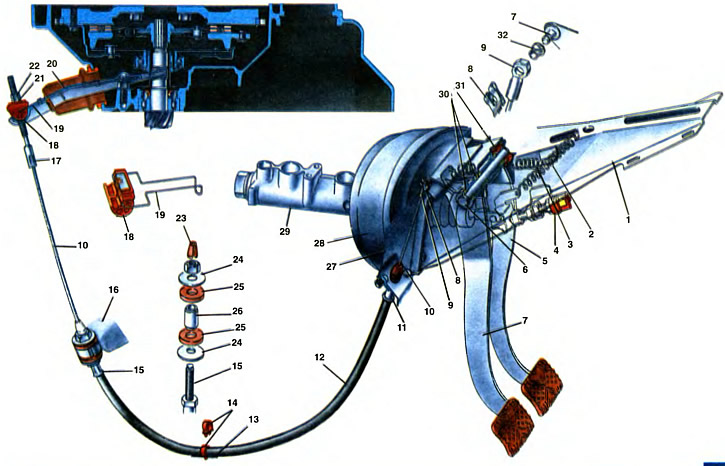
1. Clutch and brake pedal bracket. 2. Brake pedal return spring. 3. Clutch pedal return spring. 4. Brake light switch. 5. Brake pedal. 6. Pedal shaft. 7. Clutch pedal. 8. Locking bracket. 9. Upper cable end. 10. Cable. 11. Upper cable sheath end. 12. Cable sheath. 13. Body mudguard. 14. Cable fastening bracket. 15. Lower cable sheath end. 16. Gearbox cover. 17. Lower cable end. 18. Clutch link. 19. Linkage retainer. 20. Clutch release fork. 21. Adjusting nut. 22. Lock nut. 23. Protective cap. 24. Washer. 25. Rubber bushing. 26. Spacer bushing. 27. Front shield. 28. Vacuum booster. 29. Brake master cylinder. 30. Clutch pedal bushing. 31. Spacer bushing. 32. Cable end bushing.
The clutch is released via a mechanical drive, in which there is no gap between the clutch release bearing and the petals of the pressure spring, i.e. the clutch pedal does not have a free code. There is also no fixed position of the pedal, since there is no stop limiting the upward movement of the pedal. The main parameter determining the normal operation of the clutch drive is the working stroke of the pedal, which should be equal to 105... 115 mm. When the linings of the driven clutch disk wear out, the pedal stroke increases, and at a certain point (with a stroke of 140 mm and above) there is a need to adjust the clutch drive.
The clutch drive is cable-operated and consists of pedal 7, cable 10 assembly and fork 20 acting on the clutch release bearing sleeve.
The clutch pedal is suspended on a common axis 6 with the brake pedal 5 in the bracket 1. The clutch and brake pedal bracket is attached to the shield 27 of the front of the body. The vacuum booster 28 is attached to the bracket plate on the engine compartment side, complete with the master cylinder 29 of the brake drive. The steering column shaft bracket is attached at four points to the pedal bracket below, in the body interior.
The clutch pedal 7 with the hub is clamped between the bracket cheek and the washer of the pedal axis 6. The pedal hub is fitted with split plastic bushings 30, which are lubricated with Litop-24 grease during assembly. The bushings do not require additional lubrication during vehicle operation. The brake pedal is mounted on the axis between the bracket cheek and the spacer plastic bushing 31. The pedal axis is fixed in the bracket with a locking clamp.
The upper end 9 of the cable is connected via a plastic sleeve 32 to the clutch pedal finger and is fixed with a locking bracket 8, and the lower end 17 of the cable is connected via a leash 18 to the clutch release fork 20. The leash is held on the fork with a wire retainer 19 during possible movements of the cable end. The route of the cable in the underhood space is determined by its casing 12, the upper end 11, which is fixed via a seal on the front shield of the body, and the lower end 15 of the casing is installed in the socket of the lug of the cover 16 of the gearbox together with the damping 25 and spacer 26 bushings and is fixed via thrust washers 24 with a nut. To protect the inner cavity of the casing from contamination, the ends are provided with protective caps 23. Additionally, the cable casing is fixed on the mudguard 13 of the body with a plastic bracket 14.
Bearing 12 (see chapter 17) the clutch release coupling is ball-type, self-aligning, with protective washers. It is installed with a small radial clearance on the coupling 13 and in the socket of the metal flange 19. The bearing is pressed to the flange by a wave spring washer, into the slots of which the antennae of the coupling enter, which are then bent back. Such a connection allows the bearing to "float", i.e. self-align on the coupling, which increases the durability of the contacting pair: the bearing and the pressure spring. The inner race of the bearing is wider than the outer one, it is constantly pressed against the petals of the pressure spring and rotates due to this contact together with the leading part of the clutch. The coupling 13 of the clutch release bearing is located on the guide sleeve 20, which is attached to the clutch housing with its flange. The clutch release fork 14 is stamped from steel and has a box-shaped section. A hemispherical socket is stamped in the fork, with which it rests on the ball joint 16. The fork is pressed against its support by a wire spring 15, fixed to the fork. The inner end of the fork enters the groove of the clutch release bearing coupling flange, and the outer end is connected via a leash to the cable.
Despite the constant pressure of the bearing against the petals of the pressure spring, its operability is maintained for the entire mileage until major repairs. This is ensured by improved bearing sealing and the absence of dynamic loads on the bearing when disengaging the clutch. The latter is typical in drives where there is a gap between the bearing and the petals of the pressure spring, when at the moment of disengaging the clutch the bearing perceives sharply increasing loads
Clutch operation
The clutch is of a permanently closed type, i.e. it is constantly engaged. In this position, the driven disk 4 (see chapter 17) under the force of the pressure spring 7 is clamped between the surfaces of the flywheel 2 and the pressure plate 6. Due to the friction forces between the surfaces of the disks, the torque from the flywheel and the pressure plate is transmitted to the driven disk and through the damper parts to the hub 24 of the driven disk and to the primary shaft 22 of the gearbox. Thus, when the engine is running and the clutch pedal is released, the parts of the leading and driven parts of the clutch rotate as a single unit. And if a gear is engaged in the gearbox, the torque from the engine will be transmitted to the drive wheels of the car.
To disengage the clutch, the driver presses pedal 7 (see chapter 18) clutch. Turning on axis 6, it pulls cable 10 with its upper arm through the pin and simultaneously stretches release spring 3. Moving in the casing, the cable turns fork 14 on the ball joint (see chapter 17) disengaging the clutch. The inner shoulder of the fork moves the coupling 13 with the bearing 12 of the clutch release along the guide sleeve towards the flywheel. The force of pressing on the petals of the pressure spring increases, and the spring 7, bending on the support rings 8, stops pressing on the pressure plate 6. The driven disk 4 is released, the friction forces between the disks disappear, and the torque stops being transmitted to the transmission units. At this point, shock-free gear shifting is possible, after which the driver smoothly releases the clutch pedal to prevent a sharp increase in the load on the transmission parts. This prevents their premature wear, especially the clutch disks and gears of the gearbox.
When the pedal is released, it returns to its original position under the action of the return spring. Together with it, the fork with the clutch release bearing sleeve takes its original position. The pressure spring, taking its original shape, moves the pressure plate towards the flywheel. When smoothly pressing on the driven disk, its wavy surface gradually becomes flat, allowing the disk to slip at first, as a result of which the clutch is engaged smoothly. In this case, the torque from the flywheel 2 is transmitted to the clutch housing 5 and the pressure plate 6 and, due to friction forces, to the driven disk 4, then from it through the damper parts to the hub 24 of the driven disk and through the splined connection to the primary shaft 22 of the gearbox.
Torsional vibrations of the engine crankshaft are absorbed by the friction element of the damper and its six springs. When the magnitude of the torque changes, the driven disk 4 together with the plates 26 and 34 of the damper move relative to the hub 24. In this case, friction occurs between the surfaces of the hub, friction ring 31 and support ring 33, and the springs 25 of the damper are compressed, absorbing torsional vibrations. Therefore, the variable torque will be transmitted to the hub of the disk more smoothly and the load on the splined connection of the hub and the primary shaft will also be transmitted smoothly. The compression stroke of the damper springs depends on the magnitude of the transmitted torque. The rotation of the driven disk with the damper plates relative to the hub is limited by the stop of the rivets 30 in the horseshoe-shaped cutouts of the hub, after which the compression of the springs stops.
Due to wear of the clutch discs, the pedal travel gradually increases, i.e. the pedal rises, since its rise is not limited by anything. At the same time, the levels of the clutch and brake pedals change. This makes it difficult to use the pedals. Therefore, if the clutch pedal travel is 115 mm or more, it should be adjusted with nut 21 (see chapter 18), the position of which is fixed by lock nut 22. The adjustment procedure is as follows:
- loosen lock nut 22, turn adjusting nut 21 to set clutch pedal travel equal to 105...115 mm;
- press the clutch pedal until it hits the floor mat at least three times and check the pedal travel;
- if necessary, adjust the pedal stroke with nut 21;
- without changing the position of the pedal, tighten the lock nut 22 to a torque of 1.5...2.0 kgf·m.