




Open large image in new tab »
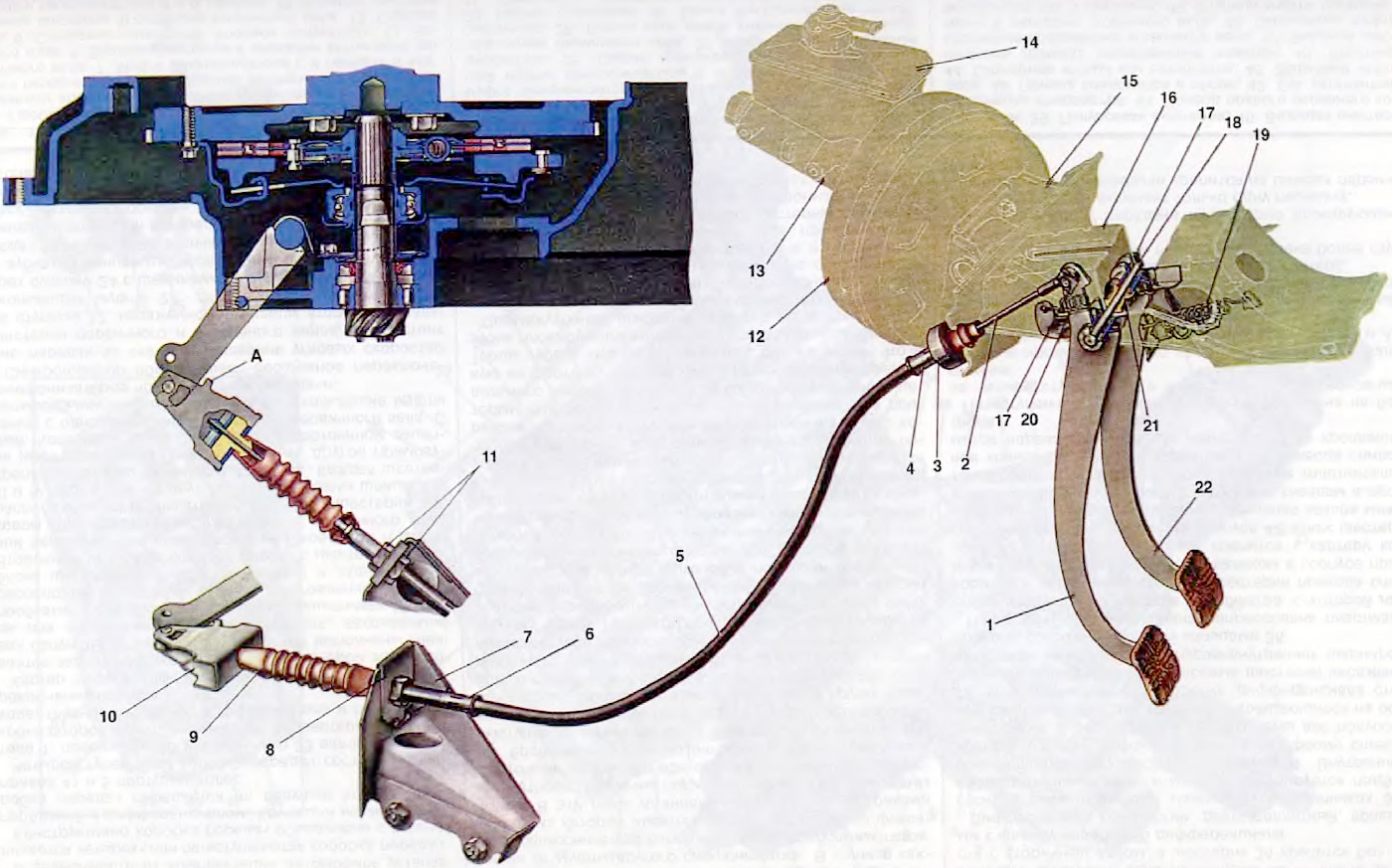
Figure 17. Clutch drive: 1. Clutch pedal; 2. Cable; 3. Rubber buffer sleeve of the cable; 4. Upper end of the cable sheath; 5. Cable sheath; 6. Lower end of the cable sheath; 7. Bracket for fastening the lower end of the cable; 8. Cable end mounting plate; 9. Protective case; 10. Cable leash; 11. Adjusting nuts; 12. Vacuum booster; 13. Master cylinder of the brake hydraulic drive; 14. Master cylinder reservoir; 15. Vacuum booster bracket; 16. Clutch and brake pedal bracket; 17. Locking bracket; 18. Pedal axle; 19. Brake pedal release spring; 20. Clutch pedal release spring; 21 Spacer sleeve; 22. Brake pedal.
The clutch drive is mechanical cable. The clutch and brake pedals are suspended from bracket 16 on a common axle 18. The pedal bracket is welded to the front shield and to the air intake box. Each of the pedals is mounted on the axle on two plastic bushings installed in the pedal hubs. A plastic spacer bushing 21 is installed between the brake pedal and the bracket cheek on the axle. The clutch pedal is located on the axle between the bracket cheek and the thrust washer installed under the pedal axle head. The axle is held in the bracket by locking clamp 17. The upper end of the pedal is connected by a pin to cable 2, which is located in casing 5, at both ends of which tips are fixed. The upper end 4 is located in the rubber buffer, and it, in turn, in the steel collar 3. The buffer rests with its end against the socket of the front of the body, and the tail of the buffer enters the hole of the front, which ensures the fixation of the buffer in the socket. The lower end 6 of the cable sheath is clamped in the socket of the bracket 7 of the gearbox with two nuts 11 and is fixed with plate 8. Nuts 11 adjust the pedal travel. The end of the cable is connected to the leash 10, into the slot of which the hook of the clutch release fork lever enters. The hook of the lever covers the finger of the leash. The exposed part of the cable is covered with a protective cover 9.
Clutch operation. The clutch is of a permanently closed type, i.e. it is permanently engaged. In this case, clutch pedal 1 is pulled back to its original position by spring 19 until the clutch release bearing rests against the petals of the pressure spring. The driven disk is clamped between the surfaces of the flywheel and the pressure disk under the action of the force of the pressure spring. Due to the friction forces between the surfaces of the disks, the torque from the flywheel and the pressure disk is transmitted to the driven disk and through the damper parts to the hub of the driven disk and to the primary shaft of the gearbox.
To disengage the clutch, press pedal 1, which rotates on axis 18 and pulls the cable with its upper arm. Moving in the casing, the cable through the leash and the lever turns the clutch release fork. The fork moves the coupling with the clutch release bearing along the guide sleeve, which presses on the petals of the pressure spring, and it bends on the support rings of the casing. In this case, the outer edge of the spring stops pressing on the pressure plate and the driven disk moves slightly away from the flywheel surface. The transmission of torque to the driven disk stops.
Due to the gap-free drive, the full stroke of the clutch pedal is reduced and a more precise clutch disengagement is ensured, thereby improving the operating conditions of the gearbox synchronizers.
When the pedal is released, it returns to its original position under the force of spring 19, and the clutch release bearing stops pressing on the petals of the pressure spring, so it takes its original shape. By exerting pressure, it moves the pressure plate toward the flywheel. When pressing on the driven disk, its wavy surface gradually becomes flat, allowing the disk to slip at first, as a result of which the clutch is engaged smoothly. In this case, the torque from the flywheel is transmitted to the casing and the pressure plate and, due to friction forces, to the driven disk, then from it through the damper parts to the hub of the driven disk and through the splined connection to the primary shaft of the gearbox.
[The article is copied from the website: VAZBOOK.ru]
Torsional vibrations of the engine crankshaft are absorbed by the friction element of the damper and springs. When the torque changes, the driven disk together with the damper plates moves relative to the hub. In this case, friction occurs between the surface of the hub and the friction rings, the springs are compressed, transmitting torque to the hub. The compression stroke of the springs depends on the magnitude of the transmitted torque. The rotation of the driven disk with the damper plates relative to the hub is limited by the rest of the fingers in the horseshoe-shaped cutouts of the hub, after which the compression of the springs stops.
In a clutch with a backlash-free drive, in the initial position of the pedal, the clutch release bearing rests against the petals of the pressure spring, which causes them to rotate together. When the clutch is released, the working stroke begins immediately, as a result of which the value of the full pedal travel decreases. The full pedal travel should be 125-130 mm. It is adjusted with nuts 11, which change the length of the lower branch of the cable. During operation of the car, due to wear of the driven disk linings, the full travel of the clutch pedal increases (the pedal rises). The maximum permissible pedal travel should not exceed 160 mm.
The clutch release bearing of the backlash-free drive is self-aligning with built-in protective washers. Its constant contact with the diaphragm spring not only reduces the pedal stroke, but also increases the wear resistance of the pair, the petals of the pressure spring and the inner ring of the clutch release bearing
On cars manufactured before 1986, a mechanical clutch release drive was also installed with a gap between the clutch release bearing and the pressure spring petals and with a servo mechanism.