




Open large image in new tab »
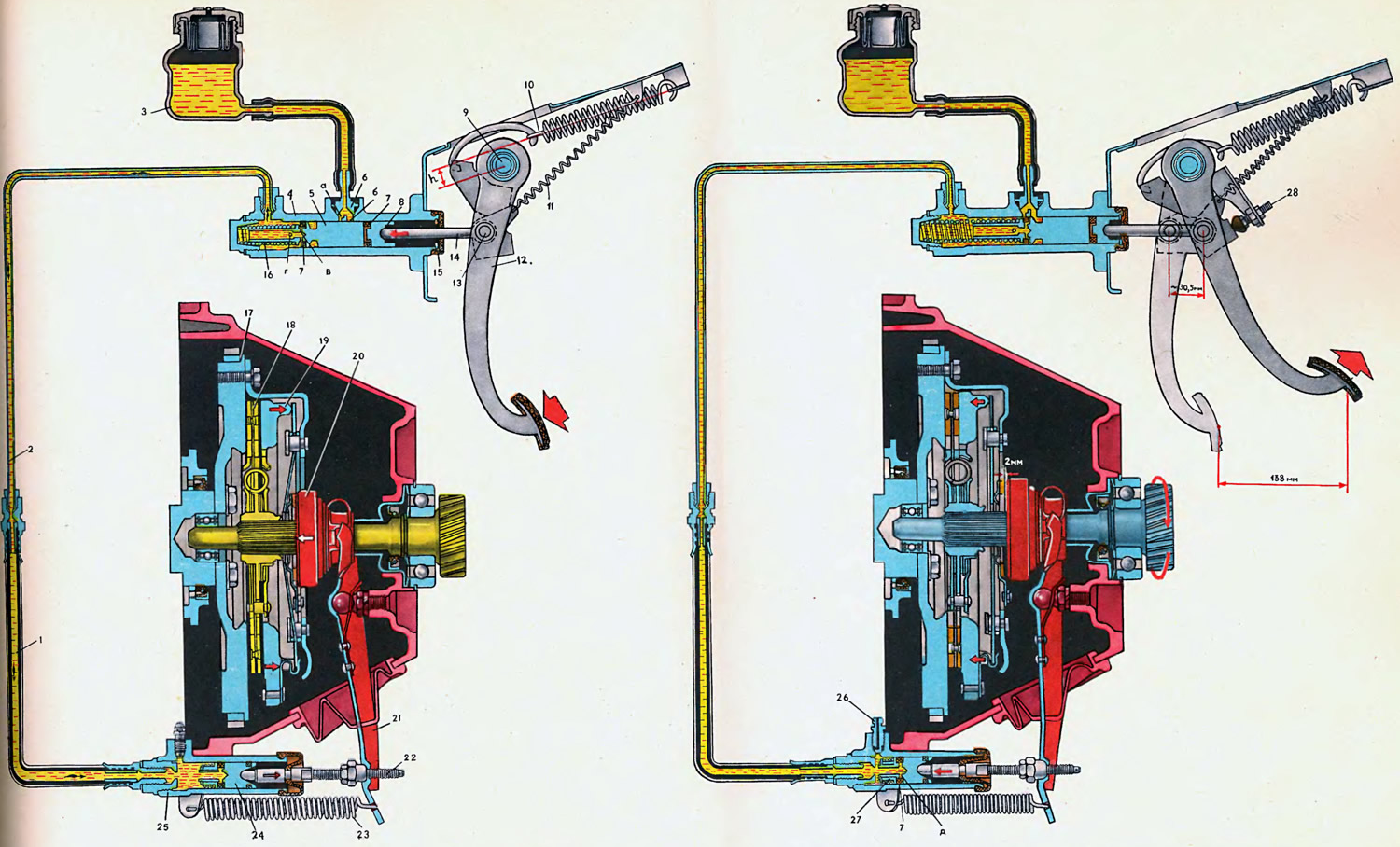
1. Flexible hose of the clutch release drive. 2. Clutch release drive tube. 3. Reservoir. 4. Clutch release drive master cylinder housing. 5. Master cylinder piston. 6. Fitting. 7. Sealing ring. 8. Master cylinder pusher piston. 9. Pedal axle. 10. Reinforcement spring (servo spring). 11. Return spring. 12. Clutch pedal. 13. Pusher shaft. 14. Clutch pedal plunger. 15. Retaining ring. 16. Return spring. 17. Engine flywheel. 20. Clutch release sleeve. 21. Clutch release fork. 22. Release fork plunger. 23. Fork return spring. 24. Slave cylinder piston. 25. Slave cylinder body. 26. Clutch drive bleeding nipple. 27. Support plate. 28. Clutch pedal limiting screw. h — spring force arm 10; a, b - holes in the master cylinder; c, g - holes in the piston; d - hole for pressure transmission.
VAZ vehicles use a hydraulic clutch release drive with a suspended pedal. Compared to the mechanical one, the hydraulic drive ensures smoother clutch engagement, simplifies maintenance, increases the durability of the drive and has a higher efficiency factor. Smooth clutch engagement reduces dynamic loads in the transmission and increases driving comfort.
Maintenance of the drive involves only adjusting the free travel of the clutch pedal and, if necessary, bleeding the system.
The clutch pedal is installed in a special clutch and brake pedal bracket, fixed to the shield of the front part of the car, and rotates on a fixed bushing, clamped in the bracket by a central bolt, common to the clutch and brake pedal bushings.
The pedal hub contains two polyamide bushings that do not require lubrication during operation.
In the initial position, the pedal is held by the force of the release spring 11 and pressed by it against the limiting screw 28 with a rubber buffer. The pusher 14 is pivotally connected to the pedal, the spherical end of which contacts the piston 8 of the master cylinder pusher. Light contact of the piston with the pusher with a gap of no more than 0.1-0.5 mm corresponds to a pedal travel of 0.4-2 mm and is regulated by the limiting screw 28. The specified gap allows the piston of the master cylinder, when the clutch is engaged, to rest against the locking ring under the action of the spring 16, i.e. to take the initial position, guaranteeing communication of the working cavity of the master cylinder with the feed tank 3 through the bypass hole a.
The housing 4 of the clutch release drive master cylinder is a cast iron casting with a flange for attachment to the pedal bracket. The front of the master cylinder is closed with a plug with a copper gasket, and the rear is closed with a rubber protective cap. The protective cap, the inner flange of which is put on the pusher rod, and the outer one enters the groove on the housing, protects the cylinder from dust. At the top, in one of the bosses of the master cylinder housing, a nipple 6 of the flexible hose coming from the feed tank 3 is installed with the help of a steel locking ring. To seal the connection of the nipple and the housing, a rubber ring is installed between them.
In another lug of the main cylinder body, the end of the bent steel tube 2 is secured with a connecting nut.
A rolled, double-layer steel tube with a galvanized surface, together with connecting nuts put on before flaring the ends, is part of the pipeline connecting the master and slave cylinders of the clutch release drive.
The conical flaring of the tube ends and the shape of the end of the union nut in combination with the conical surface of the body seat ensure a tight seal.
The second part of the clutch release drive pipeline is made of a flexible rubber hose 1 with steel tips. The flexible rubber hose compensates for the change in the pipeline length associated with the change in the position of the power unit, suspended on rubber cushions, relative to the body.
Inside the body of the master cylinder there is a piston 8 of the pusher and a piston 5 of the master cylinder of the release drive with a rubber sealing ring 7 between them. Such a design unloads the piston 5 of the master cylinder from radial loads under the action of the pusher and allows, due to the compression between the pistons 8 and 5 of the sealing ring 7, to prevent the leakage of liquid from the cylinder. Behind the piston 5, a working cavity of the cylinder is formed, connected at the outlet by a pipeline 2 with the working cylinder of the release drive and communicating with the tank 3 with liquid through a bypass hole a, a nipple and a hose. In the groove of the piston 5, another ring 7 is installed, which seals the working cavity of the cylinder when the clutch is released and acts as a valve in the master cylinder when the clutch is engaged (releasing the pedal).
When the clutch pedal is released, the pistons of the master cylinder, under the action of the return spring 16, move following the pusher to the initial position until they stop against the retaining ring 15.
When the pedal is released abruptly, the fluid returning from the working cylinder to the main one does not have time to fill the space released by piston 5, and a vacuum is created in the working cavity. Under the action of this vacuum, the fluid through the inlet port 6, the gap in the groove along the rear end of ring 7 (and at this time it is pressed against the front end of the groove) and the holes in the piston flow into the working cavity.
Subsequently, the excess amount of liquid, as it flows from the pipeline, is forced out of the working cavity through the bypass hole and into tank 3.
The cast iron clutch slave cylinder is secured on the left side of the clutch housing with two bolts. In the housing 25 of the slave cylinder there is a steel piston 24 with two sealing rings, one of which is 7 (front), pressed through the support plate 27 by a spring, equally with the sealing rings of the master cylinder. The spring constantly presses the ring 7, which improves its contact with the cylinder mirror, and, consequently, the cylinder seal, especially in the absence of pressure in the system, when the clutch is engaged.
When the clutch is disengaged, the pressure of the working fluid through the hole d of the piston presses ring 7 even more tightly against the cylinder mirror, improving its sealing.
The pusher 22 of the clutch release fork rests against the spherical recess of the piston 24, the length of which can be adjusted by rotating the tip fixed with a nut. The release spring 23 of the clutch release fork 21 constantly presses the pusher 22 against the piston through the tip and moves it into the cylinder, tending to the extreme forward position. Through the hole in the plug of the housing 25, into which the tip of the flexible hose of the clutch drive is screwed, the liquid enters the working cylinder.
The working cylinder is protected from dirt by a rubber protective cap.
To remove air from the hydraulic drive system, a nipple 26 is screwed into the body of the working cylinder, closed with a rubber cap to protect the internal channel of the nipple from clogging.
Clutch operation. When the clutch pedal is pressed, pusher 14 moves pistons 8 and 5 of the master cylinder forward, compressing spring 16.
The text is copied from the online portal www.VazBook.ru
As soon as the front sealing ring 7 closes the bypass hole a, pressure is created inside the cylinder in the working cavity, and the liquid passes through the tube 2 and the hose 1 into the working cylinder, moving the piston 24. The piston 24 set in motion through the pusher 22 turns the clutch release fork 21, which leads to the selection of the gap between the thrust flange and the coupling 20, and then to their joint movement. The thrust flange acts on the petals of the diaphragm pressure spring, deforming it (turns) on the support rings. In this case, the outer edge of the spring moves the pressure plate 19 away from the driven one 18 by the locks. The clutch is disengaged. The transmission of rotation from the engine to the gearbox stops.
When the clutch is disengaged, the release spring 23 of the fork and the release spring 11 of the clutch pedal are stretched. The reinforcement spring 10, connected to the pedal by a hook, reduces the force on the pedal when the clutch is disengaged. The reinforcement spring 10 comes into operation as soon as its plane of action passes through the axis of rotation of the pedal.
With further rotation of the pedal, the arm h of the force from spring 10 increases, increasing the moment that facilitates pressing on the pedal.
When released, the clutch pedal returns to its original position under the action of the release spring 11, and the pistons of the master cylinder, under the action of the return spring 16, move after the pedal pusher 14 until they stop in the locking ring 15. At the same time, the pressure in the system drops and the clutch pressure plate, under the action of the pressure spring, approaches the driven disk 18 and, gradually straightening the wavy surface of the driven disk petals, presses it against the flywheel. The clutch engages smoothly. The engine crankshaft is connected to the primary shaft of the gearbox. The clutch release sleeve and the bearing seated on it are pulled back to their original position by the fork 21 under the action of the release spring 23, which, through the fork and the pusher 22, pushes the piston 24 in the cylinder 25 to its extreme forward position. When the piston moves, the liquid is forced out of the working cylinder and returns through the pipeline to the working cavity of the master cylinder.