




Open large image in new tab »
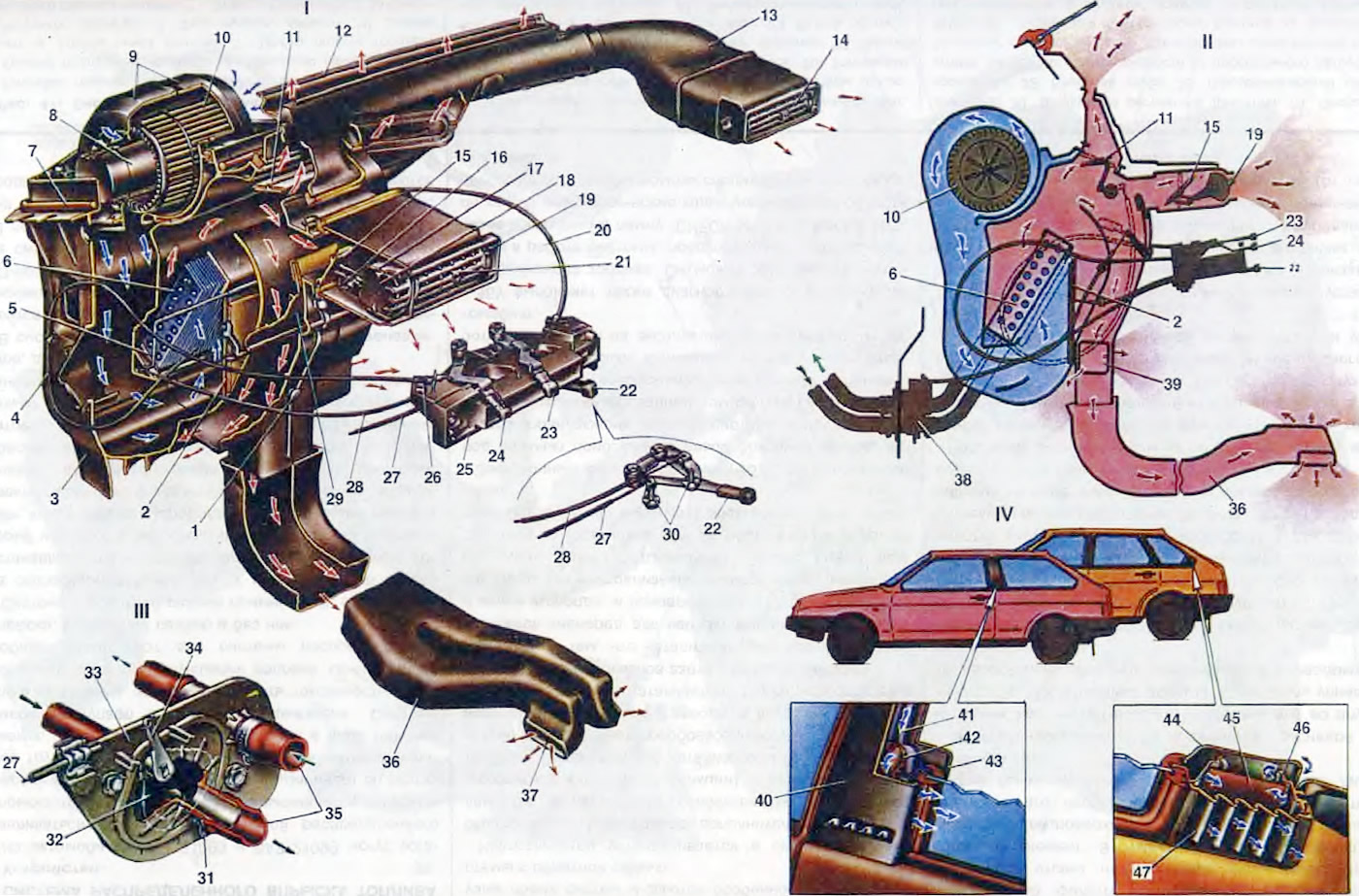
Figure 40. Heating and ventilation of the car interior: 1. Heater housing mounting bracket; 2. Heater control flap; 3. Left heater casing; 4. Foot warmer flap pull; 5. Radiator sealing gasket; 6. Radiator; 7. Heater sealing gasket; 8. Electric motor; 9 Fan shrouds; 10. Fan impeller; 11. Heating flap; 12. Windshield heating air duct; 13. Side nozzle air duct; 14. Side nozzle; 15. Central nozzle flap; 16. Blade pusher; 17. Axis of the scapula; 18. Shoulder blade; 19. Central nozzle shut-off lever; 20. Windshield heating flap pull; 21. Air flow direction change lever; 22. Air heating control handle, 23. Handle for air supply to the windshield; 24. Air supply handle to the legs; 25. Control lever bracket; 26. Thrust casing mounting bracket; 27. Crane control rod; 28. Heater control flap rod; 29. Foot warmer flap; 30. Air heating control lever axes; 31. Tightening screw clamp; 32. Heater tap valve; 33. Crane body, 34. Valve lever; 35. Hoses connecting the tap to the heater radiator; 36. Internal ventilation duct; 37. Rear passenger footwell heating windows; 38. Heater tap; 39. Driver's foot heating window; 40. Central pillar trim; 41. Inner cavity of the central pillar; 42. Exhaust ventilation duct; 43. Center pillar trim; 44. Facing of exhaust ventilation deflector; 45. Rubber valve; 46. Deflector housing; 47. Exhaust ventilation deflector; I. Heater; II. Heater operation diagram; III. Heater tap; IV. Exhaust ventilation of the passenger compartment of VAZ-2108 and VAZ-2109 cars.
The interior heating is provided by air heated in the radiator 6 of the heater, which is included in the engine cooling system parallel to the main radiator. The heater is attached in the interior under the instrument panel with four nuts to bolts welded to the air intake box. The air heated in the heater is directed to the interior through a system of air ducts, attached from below to the instrument panel, and through the air duct 36 of the internal ventilation. The air ducts are sealed with the heater with gaskets.
The heater consists of right and left 3 plastic heater casings, which are connected to each other along the perimeter with fastening brackets 1. To seal the casings, a special harness is placed in the grooves.
To supply forced air to the passenger compartment, an electric fan is attached to the top of the heater with two screws. The heater design allows the electric fan to be removed from the engine compartment.
The electric fan consists of two plastic casings 9, to which the electric motor 8 of type 45.3730 is attached. The working wheel 10 of the electric fan is mounted on the shaft of the electric motor. To obtain the required rotation speed of the working wheel, there is an additional resistor, which is fastened with a screw on the left side into the opening of the casing 3 of the heater. Two resistor spirals provide three speeds of rotation of the working wheel.
The air heating radiator 6 is installed in the heater casings, is secured with three screws to the right casing and is sealed with a polyurethane foam gasket 7. The heater radiator consists of two rows of tubes, cooling plates and two plastic tanks.
The material is posted on the website: www.VazBook.ru
The heater tap is connected to the cooling system with rubber hoses. The circulation of liquid through the radiator is performed by the cooling system pump. The tap consists of a body 33 with two pairs of pipes. In the tap body on the supply line on the axis, a plate valve 32 of the tap with an opening for passing the coolant is installed. The lever 34 of the valve is connected by a rod 27 to the lever of the handle 22 of the air heating control. When the lever 34 is turned, the opening in the valve 32 opens the line for the flow of liquid into the heater radiator.
The heater is controlled by three handles 22, 23, 24, the levers of which are mounted on the axes of the plastic bracket 25, which is fastened with four screws to the instrument panel. The handle 22 for controlling the air heating acts through the rod 27 and 28 on the lever 34 of the valve and the lever of the drive of the damper 2 of the heater control. When the handle 22 is completely moved to the right, the valve 38 and the damper 2 open, the air will be supplied by the electric fan through the radiator 6 of the heater, in which the heated coolant of the cooling system is driven. In the middle position of the handle 22, the valve and the damper 2 will be in intermediate positions, the air will pass both through the radiator and bypassing it. This more reliably ensures the required degree of air heating. When the handle 22 is in the extreme left position, the valve 38 and the damper 2 of the heater control are closed, and the air supplied to the passenger compartment will not be heated.
The upper left handle 24 for supplying air to the feet of the driver and passengers is connected by rod 4 to the damper lever 29. When the handle is moved to the left, the foot heating damper opens, air is directed from the heater casings to windows 39 on the left and right sides to the feet of the driver and passenger in the front seat, and also through the air duct 36 of the internal ventilation to the feet of passengers in the rear seat.
The handle 23 for supplying air to the windshield is connected by a rod 20 to the lever of the drive of the flap 11 of the windshield heating, which closes or opens the path of air through the air duct 12 to the glass (see heater operation diagram).
To supply air to the passenger compartment directly to the passengers and also to blow air onto the side windows of the car, the heater has left and right side nozzles 14 and two central nozzles. A flap 15 with polyurethane foam seals is installed in the body of each nozzle. By opening or closing the flap using lever 19, the ventilation intensity is changed. The direction of the air flow is changed by lever 21, which allows you to turn the nozzle with guides, as well as the blades, to the desired position.
The heater provides an average temperature in the cabin at an outside temperature of minus 20°C, in the maximum heating mode - plus 20°C, and in the foot area - plus 25°C. The cars have an exhaust ventilation that provides air suction from the car body. On VAZ-2108 cars, air is sucked into the gaps under the roof lining (mainly from the rear of the cabin) and enters the internal cavities 41 of the central pillars, then through the rubber air ducts 42 and the openings in the rear edges of the facings 40 comes out. The suction is carried out due to the vacuum that occurs when the car is moving at the rear edges of the facings of the central pillars of the body.
On VAZ-2109 cars, the exhaust ventilation is made behind the body openings for the side windows. Ventilation is also carried out due to the vacuum that occurs at the deflectors 47 when the car is moving. Air is sucked from the rear part of the passenger compartment under the linings 44 of the deflectors, presses the rubber valves 45 and goes out through the deflectors' openings. Rubber valves 45 prevent outside air from entering the passenger compartment during a crosswind.