




Open large image in new tab »
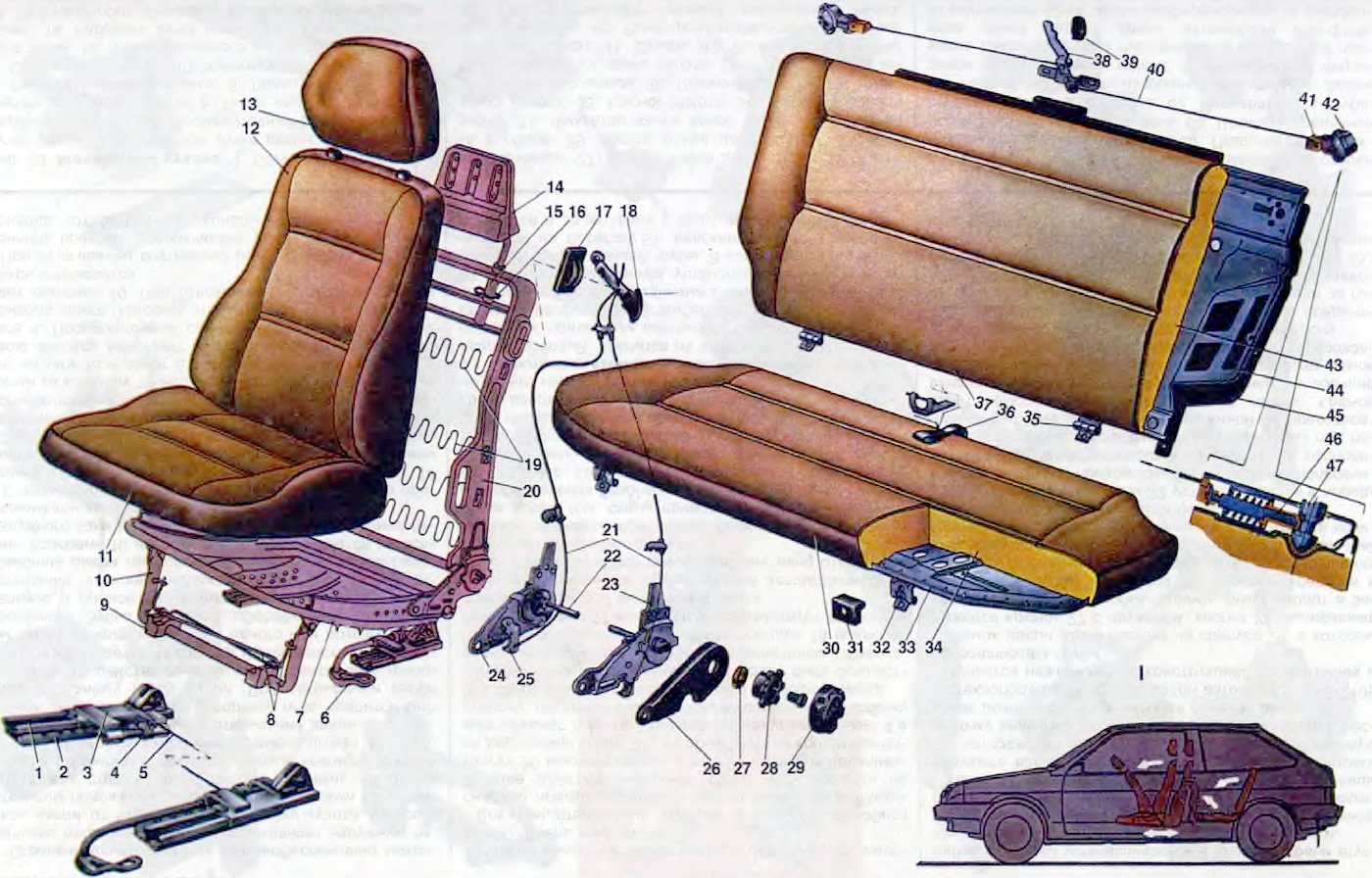
Figure 38. Seats: 1. Slide guide; 2. Lock of the internal slide movement mechanism; 3. Crawler; 4. Inner slide latch; 5. Latch pull; 6. Handle of the movement mechanism; 7. Pillow base; 8. Torsion bars; 9. Front bracket; 10. Base stand; 11. Front seat cushion; 12. Front seat back; 13. Headrest; 14. Headrest frame; 15. Headrest guide; 16. Cotter pin; 17. Backrest folding lever trim; 18. Backrest reclining mechanism handle; 19. Backrest base springs; 20. Backrest base; 21. Backrest folding mechanism rods; 22. Synchronizer; 23. Upper backrest tilt adjustment link; 24. Lower backrest tilt adjustment link; 25. Hook; 26. Backrest tilt adjustment mechanism lining; 27. Gasket; 28. Pen holder; 29. Backrest tilt adjustment mechanism handle; 30. Rear seat cushion; 31. Pillow loop trim; 32. Pillow loop; 33. Pillow base; 34. Pillow stuffing; 35. Back loop; 36. Airbag lock drive; 37. Backrest of the rear seat; 38. Backrest lock drive lever; 39. Backrest lock drive handle; 40. Lock rod; 41. Rod holder; 42. Backrest lock; 43. Back padding; 44. Backrest base; 45. Back panel; 46. The language of the castle; 47. Lock retainer; I. Scheme of changing the positions of the seat cushion and backrest.
The front seats are anatomical, separate, like chairs with headrests, with stepless adjustment of the backrest tilt. Each seat is installed on two runners and a rocking stand 10. The stand is hinged in the front brackets 9, which are attached to the body floor with studs. To facilitate the movement of the seat forward, the stands have two torsion bars 8, the lower ends of which are inserted into the holes of the brackets, the upper ends are inserted into the stops welded to the stand. The seat can move forward and backward by 119 mm.
The base 7 of the seat cushion 11 consists of strong steel frames and a cushion floor stamped from sheet steel. A reinforcement is welded to the floor. The backrest base is made of strong steel frames to which wire springs 19 are attached. To avoid squeaking, the ends of the springs are covered with a layer of polyamide resin. The backrest base is connected by a hinge with the base 7 of the cushion by the lower links 24 of the backrest tilt adjustment mechanism.
Guides 15 of headrest 13 are welded to base 20 of backrest. Frame 14 of headrest is stamped from sheet steel and is fastened with two stoppers in the form of clamps on round headrest pillar. Ends of headrest pillars have three stamped recesses for fixing headrest with cotter pins 16, each of which is pressed into one of recesses through slot in guides 15 of headrest.
Each of the front seats has mechanisms for moving the seat forward and backward, adjusting the backrest angle, and folding the backrest forward to allow passengers to sit in the back seat.
The seat movement mechanism has skids consisting of guides 1 and sliders 3, which are stamped from sheet steel. The guides are bolted to the rear brackets of the body. The sliders can move along the guides on two rollers each, inserted between the sliders and the guides. To prevent the rollers from falling out and coming together, the guides have stampings on the lower plane in the middle part and at the ends. The sliders have stampings on the rear ends. Rubber rings are installed in the annular grooves of the rollers. The upward and lateral displacement of the sliders is limited by the edges of the sliders and guides. The sliders are hingedly connected to the base 7 of the cushion.
The seat is fixed in the desired position by latches 4, each of which is pressed by a spring into one of the grooves of the comb-shaped latch 2 of the movement mechanism. The latches are welded to the guides. The levers of the latches of the inner and outer runners are connected to each other by a rod 5. The latch of the outer runners has a rod with a handle 6 of the seat movement mechanism.
The backrest tilt adjustment mechanism allows the backrest position to be changed by turning the handle 29 of the mechanism. The front seat backrest can be set to a comfortable position for the driver or passenger to rest. The maximum backrest tilt angle is 80° from the vertical. The mechanism consists of two pairs of upper 23 and lower 24 links. The upper links are welded to the base 20 of the backrest. The links are connected to each other by a hinge using two eccentrics and two toothed pairs of internal engagement.
When turning handle 29, both eccentrics rotate, ensuring the deflection of the upper links 23 and the back of the front seat as a whole.
The mechanism for folding the back of the front seat provides for the passengers to board the back seat. For boarding the passengers, the back is folded forward, for which purpose the lower links 24 are installed pivotally on the base 7 of the cushion. In the normal position, the lower links are fixed with hooks 25 by the fingers of the base 7 under the action of springs. The hooks are connected with rods 21 to the lever of the handle 18 of the folding mechanism. The rods are placed in polyamide shells, the guides of which are installed with their slots in the brackets welded to the base of the back 20. The handle lever is covered with lining 17.
Cushion 11, back 12 and headrest 13 have polyurethane foam padding, padding and upholstery. The upholstery is sewn as a composite of knitted material or caprovelour. The color of the upholstery is selected depending on the color of the car body.
The rear seat consists of cushion 30 and backrest 37. Their bases 33 and 44 are made of sheet steel. Soft polyurethane foam padding is installed on the bases and covered with upholstery, like the front seats. The upholstery is secured by bending the tongues stamped in the bases of the cushion and backrest.
To increase the area of the luggage compartment, the rear seat folds down, for which the cushion and backrest are attached to the body with hinges 32 and 35. The movable links of the hinges are welded to the bases of the cushion and backrest; each of the fixed hinges is secured to the body with a bolt. The cushion hinges 32 are covered with plastic facings 31. The seat back additionally has a plastic panel 45 at the rear, which is covered with a black carpet, common with the carpet of the luggage compartment floor. The carpet is made of lightweight non-woven material with a polyethylene base.
In the normal position, the cushion and backrest are fixed with locks. The locks 42 of the seat backrest are fastened with screws to the base 44 of the backrest. In the body of each lock there is a spring-loaded tongue 46, which is pressed into the groove of the retainer 47. The drive of the locks is carried out by a common handle 39.
In the VAZ-2109 car, the rear seat differs in the shape of the cushion and back padding, as well as the seat upholstery.