




Open large image in new tab »
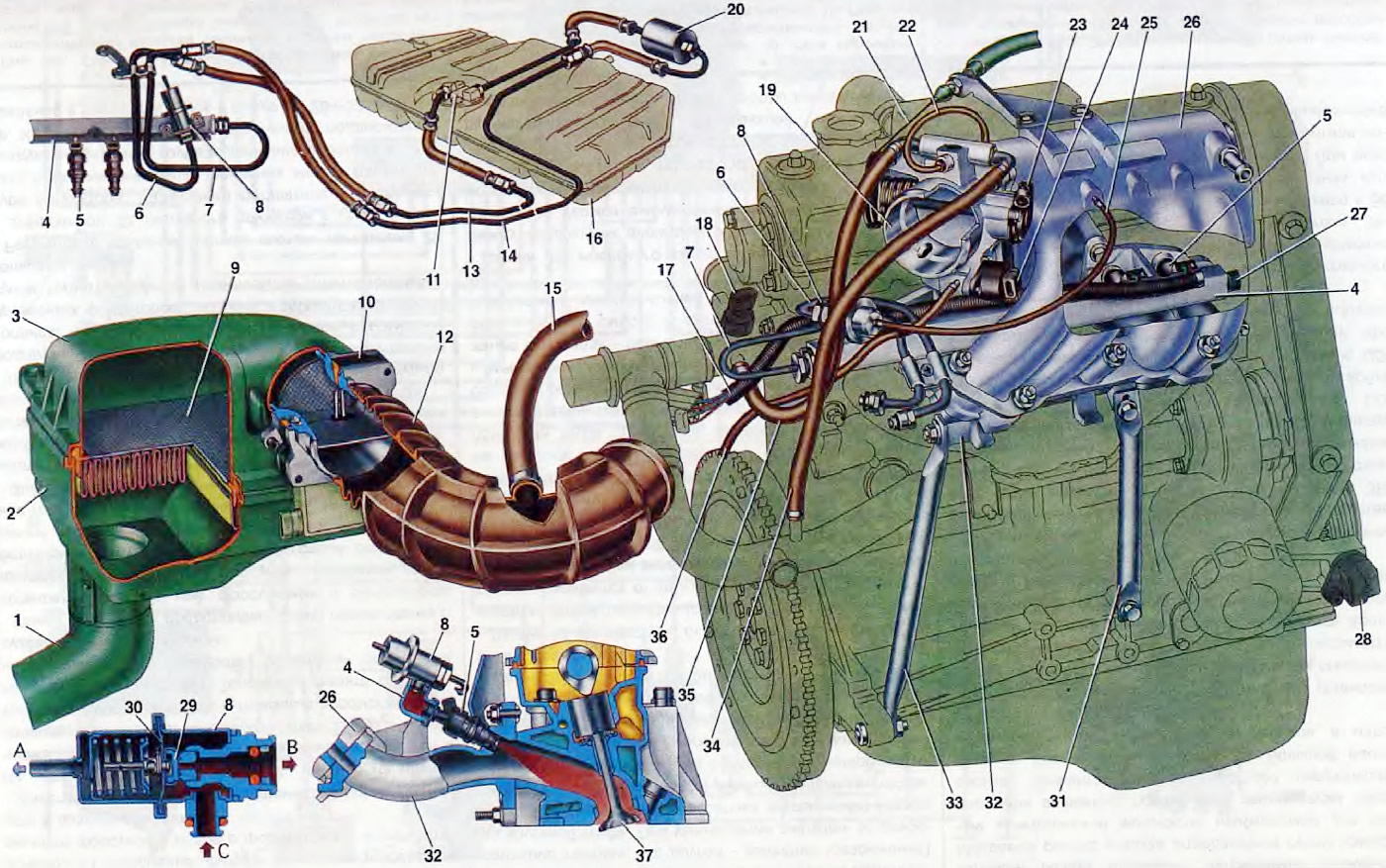
Figure 41. Distributed fuel injection system: 1. Air supply pipe; 2. Air filter housing; 3. Air filter cover; 4. Fuel frame; 5. Nozzle; 6. Fuel drain pipe; 7. Fuel supply pipe; 8. Pressure regulator; 9. Filter element; 10. Mass air flow sensor; 11. Electric fuel pump with fuel level sensor; 12. Inlet pipe hose (connects to the throttle body); 13. Fuel drain line; 14. Fuel supply line; 15. Crankcase gas supply hose from cylinder head cover; 16. Fuel tank; 17. Injector wiring harness; 18. Coolant temperature sensor; 19. Throttle body; 20. Fuel filter; 21. Throttle cable; 22. Crankcase exhaust hose at idle speed; 23. Throttle position sensor; 24. Idle speed control; 25. Vacuum supply hose to the pressure regulator; 26. Receiver; 27. Plug for connecting the pressure gauge; 28. Crankshaft position sensor; 29. Pressure regulator valve; 30. Pressure regulator diaphragm; 31. Support bracket; 32. Intake pipe; 33. Support bracket; 34. Throttle body fluid drain hose; 35. Throttle body heating fluid supply hose; 36. Hose for extracting gasoline vapors from the adsorber (installed in a closed-loop injection system); 37. Inlet valve; A. Air suction to the throttle pipe; B. Draining fuel into the fuel tank; C. Fuel supply from the fuel rail.
Open large image in new tab »
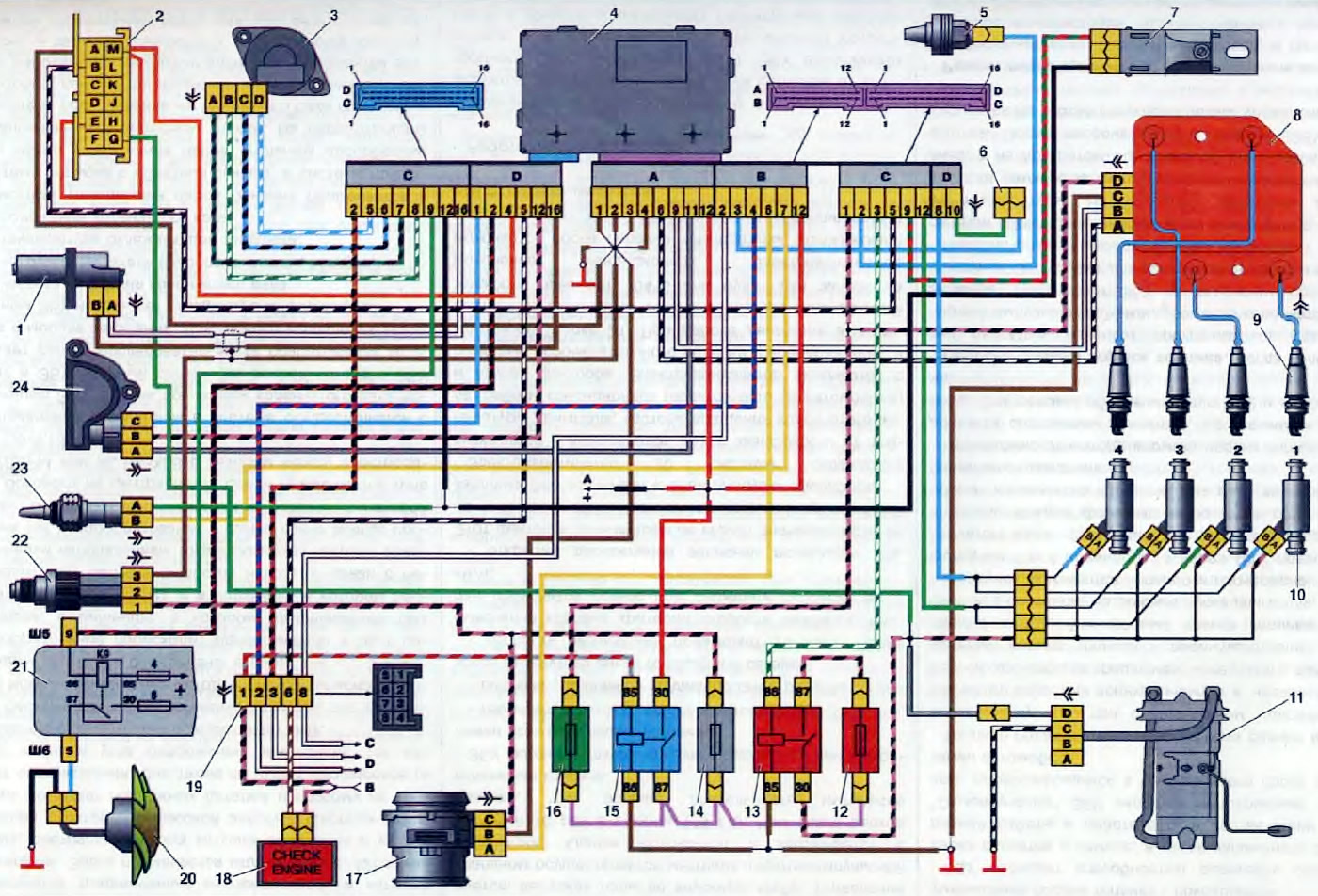
Figure 42. Electrical connection diagram of the distributed fuel injection system: 1. Crankshaft position sensor; 2. Diagnostic connector. 3. Idle speed control valve; 4. Electronic control unit (ECU); 5. Knock sensor; 6. Air conditioner connection block; 7. CO potentiometer; 8. Ignition module; 9. Spark plugs; 10. Nozzles; 11. Electric fuel pump with fuel level sensor; 12. Fuse for protection of the electric fuel pump, its relay and injectors; 13. Electric fuel pump relay; 14. Fuse for protecting the air speed and mass air flow sensors; 15. Ignition relay; 16. ECU and ignition module protection fuse; 17. Mass air flow sensor. 18. Panel with indicator lamp "CHECK ENGINE"; 19. Connector to instrument panel wiring harness; 20. Electric motor of the engine cooling system fan; 21. Mounting block; 22. Speed sensor; 23. Coolant temperature sensor; 24. Throttle position sensor; K9. Electric fan relay; A. To the battery terminal; B. To the ignition switch (to terminal "15/1"); S. To the tachometer; D. To the trip computer.
Device
VAZ 21093 and VAZ-21099 cars can be equipped with engines with a distributed fuel injection system, i.e. fuel is injected by four injectors (one injector per cylinder) into the intake pipe, to the intake valves. Here the fuel evaporates, mixes with air and enters the engine cylinders as a combustible mixture. The fuel injection system allows to reduce the toxicity of exhaust gases while improving the driving characteristics of the car. There are two distributed injection systems: with and without feedback.
The feedback system is used mainly on export cars. It has a neutralizer and an oxygen sensor installed in the intake system, which provides feedback. The sensor monitors the oxygen concentration in the exhaust gases, and the electronic control unit uses its signals to maintain the air/fuel ratio that ensures the most efficient operation of the neutralizer. Only unleaded gasoline should be used as fuel. The use of leaded gasoline will damage the neutralizer, oxygen sensor and cause the system to fail.
In the injection system without feedback, a neutralizer and oxygen sensor are not installed, and a CO potentiometer is used to regulate the concentration of CO in the exhaust gases. This system also does not use a gasoline vapor recovery system. Figures 41 and 42 show the design of this system, since it will be mainly used in cars sold in Russia. And the text below describes the components of both systems and gives the features of the system with feedback
The catalytic converter is installed in the exhaust system before the additional muffler. It contains two oxidation catalysts (chemical reaction accelerator) and one reducing. Oxidizing catalysts (platinum and palladium) promote the conversion of hydrocarbons into water vapor and carbon monoxide into carbon dioxide. The reducing catalyst (radium) promotes the conversion of nitrogen oxides into harmless nitrogen.
The information is posted on the portal: VAZBOOK.RU
Because the catalytic converter requires oxygen to neutralize hydrocarbons and carbon monoxide, and must simultaneously remove oxygen to neutralize nitrogen oxides, the air/fuel mixture balance must be maintained very strictly (approximately 14.7:1), entering the engine. This function is performed by the electronic control unit.
The electronic control unit (ECU), located under the instrument panel on the left side of the body, is the control center of the fuel injection system. It is a specialized computer. It continuously processes information from various sensors and controls systems that affect the toxicity of exhaust gases and the vehicle's performance.
The ECU also performs a diagnostic function for the fuel injection system. It can recognize malfunctions in the system, warning the driver about them through a warning lamp "CHECK ENGINE". In addition, it stores diagnostic codes that indicate areas of failure to assist technicians in making repairs.
The air filter is installed in the front part of the engine compartment on rubber clips. The filter element 9 is paper, with a large filtering surface area. When replacing the filter element, it must be installed so that the corrugations are located parallel to the center line of the car.
The throttle pipe 19 is fixed on the receiver. It doses the amount of air entering the intake pipe. The air supply to the engine is controlled by the throttle valve, connected to the accelerator pedal drive.
The throttle pipe includes a throttle position sensor 23 and an idle speed controller 24. In the flow part of the throttle pipe (before and after the throttle valve) there are vacuum extraction holes, which are necessary for the operation of the gasoline vapor recovery system. If the latter system is not used, then the nozzle for purging the adsorber is plugged with a rubber stopper.
The 24 idle speed controller regulates the crankshaft speed in idle mode by controlling the amount of air supplied bypassing the closed throttle valve. It consists of a two-pole stepper motor and a cone valve connected to it. The valve extends or retracts according to signals from the ECU.
The throttle position sensor 23 is mounted on the throttle body 1 and is connected to the throttle shaft. The sensor is a potentiometer, to one end of which a supply voltage of 5 V is supplied, and the other end is connected to the "ground". From the third output of the potentiometer (from the slider) the output signal goes to the ECU.
The fuel supply system includes an electric fuel pump 11, a fuel filter 20, fuel lines and a rail 4 of injectors assembled with injectors 5 and a fuel pressure regulator 8.
Electric fuel pump 11 is a two-stage rotary type, installed in the fuel tank. Fuel from the pump through the fine fuel filter 20 is supplied to the fuel rail under pressure of more than 284 kPa. The electric fuel pump is switched on using the auxiliary relay 13 (see figure 42). The fuel filter with a paper filter element is installed under the body floor behind the fuel tank.
The 4-nozzle rail is a hollow bar with the nozzles and fuel pressure regulator installed on it. The nozzle frame is secured with two bolts to the inlet pipe 32. On the right side of the nozzle rail there is a fitting for monitoring the fuel pressure, closed with a threaded plug 27.
Injector 5 is an electromagnetic valve. When a voltage pulse is sent to it from the ECU, the valve opens and fuel is injected through the atomizer in a finely atomized stream under pressure into the intake pipe onto the intake valve.
After the electrical impulse is stopped, the spring-loaded valve of the injector closes the fuel supply. The injectors are fixed to the ramp using spring clamps. The upper and lower ends of the injectors are sealed with rubber sealing rings.
Fuel pressure regulator 8 consists of valve 29 with diaphragm 30 pressed by a spring to the seat in the regulator body. The purpose of the regulator is to maintain a constant pressure difference between the air pressure in the intake pipe and the fuel pressure in the rail. With the engine running, the regulator maintains the pressure in the injector rail within 284-325 kPa.
The regulator diaphragm is exposed to fuel pressure on one side and pressure on the other (underpressure) in the intake pipe. When the pressure in the intake pipe decreases (the throttle valve closes) the regulator valve opens at lower fuel pressure, bypassing excess fuel through the drain line back to the tank. The fuel pressure in the rail decreases. When the pressure in the inlet pipe increases, (when opening the throttle valve) the regulator valve opens when the fuel pressure in the rail increases.
Coolant temperature sensor 18 is a thermistor (a resistor whose resistance varies with temperature). The sensor is screwed into the coolant outlet pipe on the cylinder head. At low temperatures, the sensor has a high resistance (100 kOhm at -40°C), and at high temperatures, it has a low resistance (177 Ohm at 100°C).
The oxygen concentration sensor is used in the closed-loop injection system and is installed on the exhaust pipe. The oxygen contained in the exhaust gases reacts with the oxygen sensor, creating a potential difference at the sensor output. It changes from approximately 0.1 V (high oxygen content - lean mixture) to 0.9 V (low oxygen - rich mixture). The sensor has a built-in heating element to increase its efficiency.
The air mass flow sensor 10 is located between the air filter and the hose 12 of the intake pipe. It is a hot-wire type. The sensor uses three sensitive elements. One of the elements determines the ambient air temperature, and the other two are heated to a preset temperature that exceeds the ambient air temperature. During engine operation, the passing air cools the heated elements. The air mass flow is determined by measuring the electrical power required to maintain a specified excess of the heated elements' temperature over the ambient air temperature. The sensor signal is frequency-based. A high air flow causes a high-frequency signal, and a low flow causes a low-frequency signal.
Vehicle speed sensor 22 (figure 42) is installed on the gearbox between the speedometer drive and the flexible shaft end of the speedometer drive. The sensor operates on the Hall effect. The sensor sends rectangular voltage pulses to the ECU with a frequency proportional to the rotation speed of the drive wheels.
CO potentiometer 7 (figure 42) is installed in the engine compartment on the wall of the air intake box and is a variable resistor. It sends a signal to the ECU, which is used to adjust the composition of the air-fuel mixture in order to obtain a standardized level of carbon monoxide (CO) concentration in the exhaust gases at idle. The CO potentiometer is similar to the mixture quality screw in carburetors. Adjustment of the CO content using a CO potentiometer is performed only at a service station using a gas analyzer.
The crankshaft position sensor 28 is of the inductive type and is mounted on the oil pump cover opposite the timing disk on the generator drive pulley. The timing disk is a toothed wheel with 58 equally spaced (6°) depressions. To create a synchronization pulse, two teeth are missing. When the crankshaft rotates, the teeth change the magnetic field of the sensor, inducing AC voltage pulses.
Ignition system
The ignition system does not use a traditional distributor and ignition coil. Module 8 is used here (figure 42) ignition system, consisting of two ignition coils and high-energy control electronics. The ignition system has no moving parts and is therefore maintenance-free. It also has no adjustments (including ignition timing), since the ignition is controlled by the ECU.
The ignition system uses a spark distribution method called the "idle spark" method. The engine cylinders are paired 1-4 and 2-3 and the new formation occurs simultaneously in two cylinders: in the cylinder in which the compression stroke ends (working spark), and in the cylinder in which the exhaust stroke occurs (idle spark). Due to the constant direction of current in the windings of the ignition coils, the spark current of one spark plug always flows from the central electrode to the side one, and of the second one - from the side one to the central one. The spark plugs used are of the A17DVRM or AC.R43XLS type with a gap between the electrodes of 1.0-1.13 mm.
Ignition control in the system is performed by the ECU. The crankshaft position sensor sends a reference signal to the ECU, based on which the ECU calculates the sequence of operation of the coils in the ignition module. For precise ignition control, the ECU uses the following information:
- crankshaft speed;
- engine load (mass air flow);
- coolant temperature;
- crankshaft position.
The gasoline vapor recovery system is used in the closed-loop injection system. The system uses a method of vapor recovery by a carbon adsorber installed in the engine compartment. When the engine is not running, gasoline vapors from the fuel tank are fed to the adsorber, where they are absorbed by activated carbon. When the engine is running, the adsorber is blown with air, and the vapors are sucked to the throttle pipe and then into the intake pipe for combustion during the working process.
The ECU controls the purge of the adsorber, turning on the electromagnetic valve located on the adsorber cover. When voltage is applied to the valve, it opens, releasing vapors into the intake pipe. The valve is controlled by the pulse-width modulation method. The valve turns on and off at a frequency of 16 times per second (16 Hz). The higher the air flow, the longer the duration of the valve activation pulses.
The ECU turns on the purge valve of the canister when all of the following conditions are met:
- coolant temperature above 75°C;
- the fuel supply management system operates in closed loop mode (with feedback);
- the vehicle speed exceeds 10 km/h. After the valve is turned on, the speed criterion changes. The valve will turn off only when the speed drops to 7 km/h;
- the throttle valve opening exceeds 4%. This factor does not matter further if it does not exceed 99%. When the throttle valve is fully opened, the ECU turns off the purge valve of the adsorber.
Electric fan 20 of the cooling system is switched on and off by the ECU depending on the engine temperature, crankshaft speed, and air conditioner operation (if it is on the car) and other factors. The electric fan is switched on using auxiliary relay K9. located in mounting block 21. When the engine is running, the electric fan is switched on if the coolant temperature exceeds 104°C or a request is given to switch on the air conditioner. The electric fan is switched on after the coolant temperature drops below 101°C, after the air conditioner is switched off or the engine is stopped.
Operation of the injection system
The amount of fuel supplied by the injectors is regulated by an electrical pulse signal from the electronic control unit (ECU). The ECU monitors engine condition data, calculates fuel requirements and determines the required duration of fuel supply by the injectors (pulse duration), to increase the amount of fuel supplied, the pulse duration is increased, and to decrease the fuel supply, it is shortened.
The ECU has the ability to evaluate the results of its calculations and commands, as well as remember the experience of recent work and act in accordance with it. The "self-learning" of the ECU is a continuous process that continues throughout the entire service life of the vehicle.
Fuel is supplied by one of two different methods: synchronous, i.e. at a certain position of the crankshaft, or asynchronous, i.e. independently or without synchronization of the crankshaft rotation. Synchronous fuel injection is the predominantly used method. Asynchronous fuel injection is used mainly in engine start mode.
The injectors are switched on in pairs and alternately: first the injectors of cylinders 1 and 4, and after 180° of crankshaft rotation - the injectors of cylinders 2 and 3, etc. Thus, each injector is switched on once per crankshaft revolution, i.e. twice per complete engine working cycle.
Regardless of the injection method, fuel supply is determined by the engine condition, i.e. its operating mode. These modes are provided by the ECU and are described below.
Initial fuel injection. When the engine crankshaft starts to rotate with the starter, the first pulse from the crankshaft position sensor causes a pulse from the ECU to turn on all the injectors at once. This serves to speed up the engine start.
The initial fuel injection occurs each time the engine is started. The duration of the injection pulse depends on the temperature. When the engine is cold, the injection pulse increases to increase the amount of fuel, and when the engine is warm, the pulse duration decreases. After the initial injection, the ECU switches to the appropriate injector control mode.
Engine start mode. When the ignition is turned on, the ECU turns on the electric fuel pump relay, and it creates pressure in the fuel supply line to the fuel rail. The ECU checks the signal from the coolant temperature sensor and determines the correct air/fuel ratio for starting.
After the crankshaft starts to rotate, the ECU will operate in the starting mode until the speed exceeds 500 rpm or the "flooded" engine purge mode occurs.
Engine purge mode. If the engine is "flooded with fuel" (i.e. the fuel wet the spark plugs), it can be started by fully opening the throttle valve while simultaneously cranking the crankshaft. In this case, the ECU does not send injection pulses to the injectors, and the engine must "clean up". The ECU maintains this mode as long as the engine speed is below 500 rpm, and the throttle position sensor shows that it is almost fully open (more than 75%).
If the throttle valve is held almost completely open when attempting to start a normal "unflooded" engine, the engine may not start, since when the throttle valve is completely open, injection pulses are not sent to the injector.
Fuel supply control operating mode. After starting the engine (when the speed is more than 500 rpm) The ECU controls the fuel supply system in the operating mode. In this mode, the ECU calculates the pulse duration to the injectors based on signals from the crankshaft position sensor (rotation frequency information), mass air flow sensor, coolant temperature sensor and throttle position sensor.
The calculated injection pulse duration may result in an air/fuel ratio different from 14.7:1. An example would be a cold engine condition, since a rich mixture is required to ensure good driving characteristics.
Operating mode for closed loop injection system. In this system, the ECU first calculates the pulse width to the injectors based on signals from the same sensors as in the open-loop injection system. The difference is that in the closed-loop system, the ECU also uses the signal from the oxygen sensor to adjust and fine-tune the calculated pulse in order to precisely maintain the air/fuel ratio at 14.6...14.7:1. This allows the catalytic converter to operate at maximum efficiency.
Enrichment mode during acceleration. The ECU monitors sudden changes in the throttle position (by the sensor, throttle position) and the signal from the mass air flow sensor and provides additional fuel supply by increasing the injection pulse duration. The enrichment mode during acceleration is used only to control fuel supply in transient conditions (when moving the throttle valve).
Power enrichment mode. The ECU monitors the throttle position sensor signal and engine speed to determine when the driver requires maximum engine power. To achieve maximum power, a rich fuel mixture is required, and the ECU changes the air/fuel ratio to approximately 12:1. In a closed-loop injection system, the signal from the oxygen concentration sensor is ignored in this mode, since it would indicate a rich mixture.
Lean mode during braking. When braking a vehicle with the throttle valve closed, emissions of toxic components into the atmosphere may increase. To prevent this, the electronic control unit monitors the decrease in the throttle valve opening angle and the signal from the mass air flow sensor and promptly reduces the amount of fuel supplied by reducing the injection pulse.
Fuel supply shutdown mode during engine braking. When braking with the engine with the gear and clutch engaged, the ECU can completely disable the fuel injection pulses for short periods of time. The fuel supply is switched off and on in this mode when certain conditions are met for the coolant temperature, crankshaft speed, vehicle speed, and throttle opening angle.
Supply voltage compensation. When the supply voltage drops, the ignition system may produce a weak spark, and the mechanical movement of "opening" the injector may take longer. The ECU compensates for this by increasing the energy accumulation time in the ignition coils and the duration of the injection pulse.
Accordingly, when the battery voltage increases (or voltage in the vehicle's on-board network) The ECU reduces the energy accumulation time in the ignition coils and the injection duration.
Fuel shut-off mode. When the ignition is off, the fuel is not supplied by the injector, which eliminates the possibility of spontaneous combustion of the mixture when the engine is overheated. In addition, fuel injection pulses are not supplied if the ECU does not receive reference pulses from the crankshaft position sensor, i.e. this means that the engine is not running.
The fuel supply is also cut off when the maximum permissible engine crankshaft speed of 6510 rpm is exceeded to protect the engine from over-revving.