




Open large image in new tab »
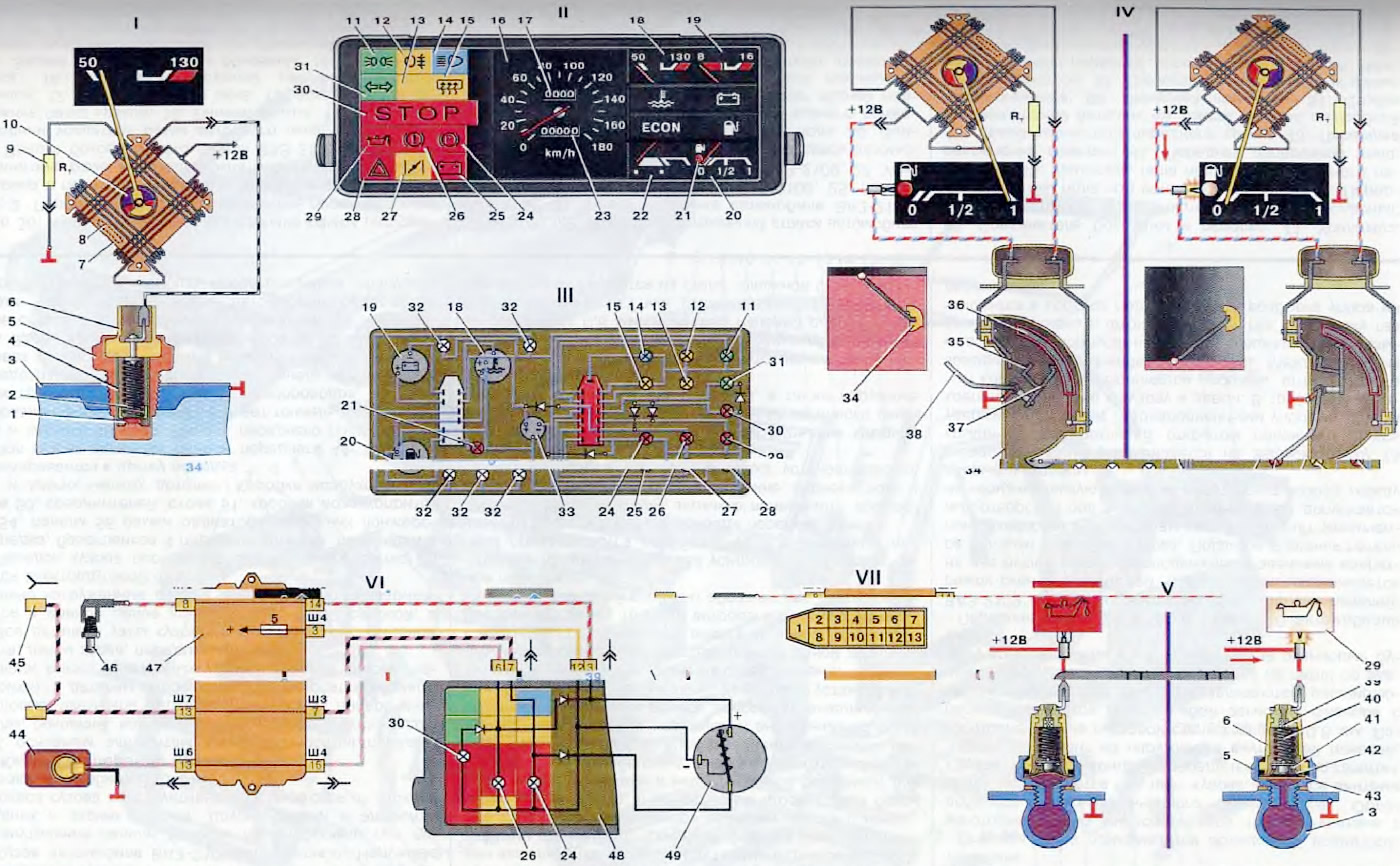
Figure 35. Control devices: 1. Thermistor; 2. Contact spring; 3. Cylinder head; 4. Paper insulating cartridge; 5. Sensor housing; 6. Sensor cover; 7. Frame with pointer coils; 8. Magnet for returning the pointer to the beginning of the scale; 9. Temperature compensation resistor; 10. Permanent magnet; 11. External lighting indicator lamp; 12. Fog light indicator lamp; 13. Backup indicator lamp; 14. High beam indicator lamp; 15. Rear window heating indicator lamp; 16. Speedometer; 17. Daily distance counter; 18. Coolant temperature gauge; 19. Voltmeter; 20. Fuel level indicator; 21. Fuel reserve indicator lamp; 22. Econometer; 23. Totalizer of the distance traveled; 24. Parking brake indicator lamp. 25. Low battery indicator lamp; 26. Brake fluid level indicator light; 27. Carburetor air damper indicator lamp, 28. Hazard warning indicator lamp; 29. Oil pressure warning light; 30. Control lamp - "Stop" sign; 31. Direction indicator lamp; 32. Instrument cluster illumination lamp; 33. Socket for installing the parking brake indicator lamp relay-interrupter; 34 Fuel level and reserve indicator sensor; 35. Fuel reserve alarm contact; 36 Sensor rheostat; 37. Rheostat moving contact; 38. Lever with float; 39. Oil pressure sensor air filter; 40. Spring of the moving contact; 41. Movable contact of the sensor; 42. Fixed contact (connected to ground); 43. Diaphragm; 44. Brake fluid level sensor; 45. Wire tips to brake pad wear sensors; 46. Parking brake indicator lamp switch; 47. Mounting block; 48. Instrument cluster; 49. Parking brake indicator lamp relay-interrupter; I. Coolant temperature gauge; II. Instrument cluster. III. Instrument cluster wiring diagram (view from the back side); IV. Fuel level indicator; V. Oil pressure indicator lamp. VI. Circuit diagram for connecting the brake system indicator lamps. VII. Order of conventional numbering of plugs in the instrument cluster sockets.
All control devices and control lamps of the car are combined into a single unit - a combination of devices of the 22.3801 type. The combination of devices combines a speedometer 16, an economizer 22, a voltmeter 19, a fuel level indicator 20 and a coolant temperature indicator 18. In addition, control lamps are located on the left in a separate section. Electrical connections between devices, control lamps and output plugs are made by the printed wiring method on a board made of foil-clad getinax.
The speedometer 16 is attached to the instrument cluster housing with two screws. It has a pointer speed indicator and two counters: a totalizer 23 and a daily 17 counter of the distance traveled, the readings of which can be set to zero by a handle located on the instrument panel. The speedometer mechanisms are driven by a flexible shaft from a drive installed on the clutch housing. One revolution of the flexible shaft corresponds to 1 m of the distance traveled.
The economizer installed in the instrument cluster serves to roughly determine fuel consumption in a given engine operating mode. It is a vacuum gauge that measures the vacuum in the engine intake pipe, which is directly related to fuel consumption. The less the throttle valves are open in the carburetor, the greater the vacuum in the intake pipe, and the lower the fuel consumption. Conversely, under heavy engine loads, the throttle valves open almost completely, the vacuum drops (the economizer needle moves into the yellow zone of the scale), and fuel consumption increases.
The coolant temperature gauge works in tandem with the TM-106 sensor. The device mechanism consists of a plastic detachable frame 7, on which the coils are wound, and an axis with an arrow and a disk permanent magnet 10. In the rear half of the frame there is a small magnet 8, which returns the disk magnet with the arrow to the beginning of the scale.
The coils have three windings, one of which is wound perpendicular to the other two. Thus, three magnetic fluxes created by three windings act on the disk magnet. Depending on the resistance of the sensor, the magnitude of the current in the coil windings changes and therefore the direction and magnitude of the total magnetic flux acting on the disk magnet change. The poles of this magnet are located along the direction of the total magnetic flux and, accordingly, the arrow deflects at a certain angle.
If the sensor resistance is 640-1320 Ohm, the arrow should be at the beginning of the scale; with a resistance of 77-89 Ohm, it should be at the beginning of the red zone; and with a sensor resistance of 40-50 Ohm, it should deviate to the end of the red zone of the scale.
The TM-106 temperature gauge sensor is screwed into the cylinder head from the rear side of the engine. The sensitive element in the sensor is the thermistor 1, which changes its resistance when the temperature changes. The thermistor is pressed by a spring to the bottom of the housing, i.e. one side of it is connected to the "ground" through the housing. The other side is connected through a spring to a plug fixed in the plastic cover 6.
The original can be found on the website vazbook.ru
The fuel level indicator has the same design as the temperature indicator. It differs in winding data, mounting points to the printed circuit board and the mutual arrangement of the disk magnet and the pointer. The indicator is used in a pair with a sensor of type 24.3827, which is installed in the fuel tank. This sensor also turns on the control lamp 21 of the fuel reserve when 4-6.5 liters remain in the tank.
The sensor has a wire rheostat 36, along which the contact 37, controlled by the float, slides. Depending on the fuel level, the float rises or falls and moves the movable contact of the rheostat, changing the resistance of the sensor. With a sensor resistance of 285-335 Ohm, the pointer of the indicator should be at the beginning of the scale, at 100-135 Ohm - in the middle of the scale, and at 7-25 Ohm - at the end of the scale.
The voltmeter operates on the same principle as the devices described above. When the ignition is on and the engine is not running, the voltmeter shows the voltage at the battery terminals, and after the engine is started, the voltage generated by the generator. If, when the engine is running, the arrow is in the red zone at the beginning of the scale (8-11 V), this indicates a discharged battery due to weak tension of the generator drive belt or a malfunction of the generator itself. The red zone at the end of the scale corresponds to 15-16 V. If the arrow is in this zone, the generator voltage regulator is faulty. Intermediate position of the arrow (between the red zones) indicates that the generator is operating normally.
The oil pressure indicator lamp 29 is switched on by the MM-120 type sensor, which is screwed into the engine cylinder head from the side of the intake and exhaust pipelines. If the pressure in the lubrication system is below 0.2-0.6 kgf/cm², then the moving contact 41 of the sensor is pressed by the spring to the fixed contact 42, the power supply circuit of the indicator lamp is closed, and the lamp lights up. As soon as the oil pressure exceeds 0.2-0.6 kgf/cm², it bends the diaphragm 43 and, overcoming the resistance of the spring, presses the moving contact away from the fixed contact with the pusher. The power supply circuit of the indicator lamp is opened, and the lamp goes out.
Brake system warning lights
The parking brake indicator lamp 24 starts to "blink" when the switch 46 located under the parking brake lever is closed. In this case, the current flows from the plug "12" of the white block of the instrument cluster along two circuits. One circuit closes to "ground" along the path: plug "12" of the white block - indicator lamp 24 - plug "L" of the flasher relay 49 and through the closed contacts to the plug "+" - along the brown wire with a blue stripe to switch 46 and to "ground". The other circuit closes to "ground" along the path: plug "12" of the white block - the plug winding of the flasher relay and through its closed contacts to the plug "+" - switch 46 - "ground".
The current flowing through the winding of the relay-breaker heats it up. The bimetallic plate of the relay-breaker bends from heating, and the contacts of the relay-breaker open. The current in both circuits is interrupted, and lamp 24 goes out. The bimetallic plate cools down and takes its previous shape. The contacts of the relay-breaker close again, turning on the control lamp, and the described cycle is repeated with a frequency of 60-120 times per minute, causing the parking brake control lamp to flash.
Since 1995, the parking brake indicator lamp relay-interrupter has not been used on cars and there are no plugs for connecting the relay-interrupter. Now the conductors that were previously connected to the "+" and "L" relay plugs are short-circuited.
At the same time as the control lamp 24, the lamp 30 "Stop" also flashes, the current through which goes from the plug "12" of the white block, through the diodes to the plug "3" of the white block, and then along the brown wires with a blue stripe to the switch 46 and to the "ground".
The brake fluid level indicator lamp 26 is switched on by the sensor 44, located in the reservoir of the main cylinder of the brake hydraulic drive, when the fluid level becomes the minimum permissible. In this case, the current goes along the circuit: plug "12" of the white block of the instrument cluster - lamp 26 - along the pink wires with a blue stripe to the sensor 44 - "ground". At the same time, the lamp 30 "Stop" lights up, the current through which goes along a parallel circuit through the diode.