




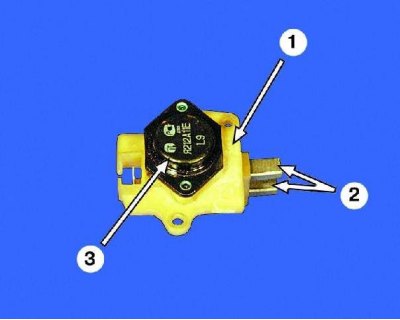
1 – brush holder; 2 – brushes; 3 – voltage regulator
Attention! When checking with 220 V, be careful - do not touch the live parts of the generator with your hands.
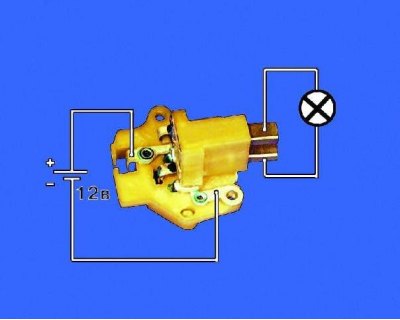
1. Check the voltage regulator for proper operation. Connect a 12 V test lamp to the brushes. Apply 12 V: "+" to the terminal and "-" to the brush holder "ground". The test lamp should light up.
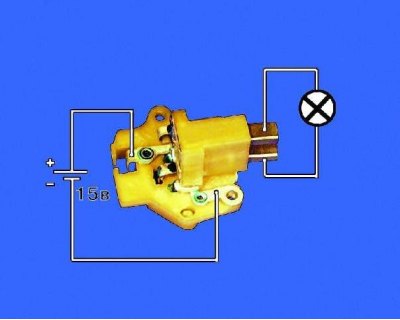
2. Increase the voltage to 15-16 V - the lamp should go out. If the lamp does not go out or does not light at 12 V, replace the regulator with the brush holder.
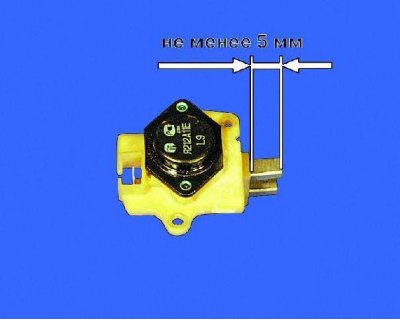
3. Check the ease of movement of the brushes in the brush holder and their protrusion. If the brushes protrude from the brush holder by less than 5 mm, replace the voltage regulator with the brush holder. If chips or cracks are found on the brushes, replace the regulator.
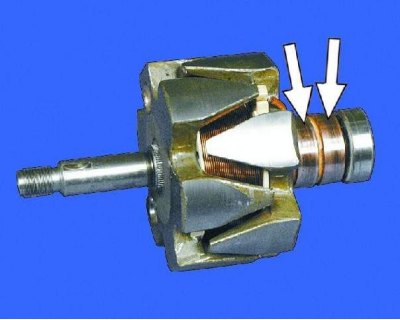
4. Inspect the contact rings. If they have burrs, scratches, marks, wear marks from brushes, etc., the rings must be ground. If the damage to the rings cannot be removed with sandpaper, turn the rings on a lathe, removing a minimum layer of metal, and then grind.
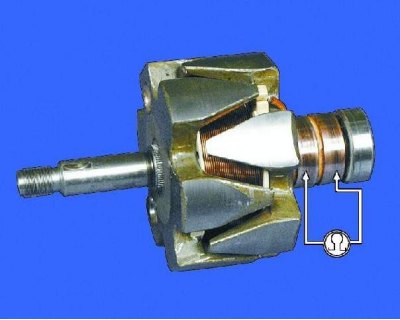
5. Check the rotor winding resistance with an ohmmeter (tester) by connecting it to the contact rings. If the ohmmeter shows "∞", then there is a break in the windings and the rotor needs to be replaced.
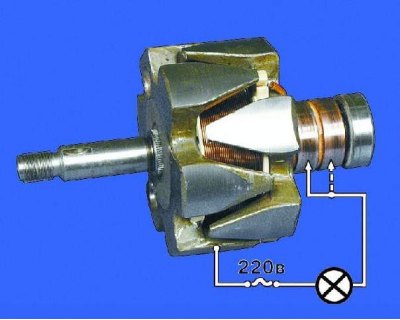
6. Check with a test lamp whether there is a short circuit between the winding and the rotor housing. Plug the test lamp into a 220 V AC network (you can use a battery and a 12V lamp). Connect one of the wires to the rotor body, and the second one to each ring in turn. In both cases, the lamp should not light. If the lamp lights up, the winding is shorted: the rotor must be replaced.
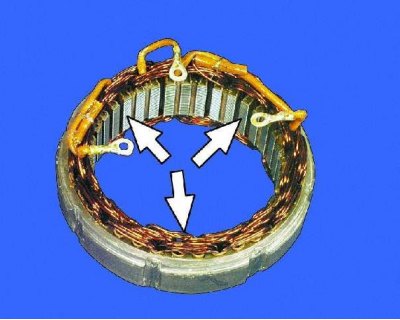
7. Inspect the stator. There should be no traces of the anchor touching the stator on the inner surface of the stator. If there is wear, the bearings or generator covers should be replaced.
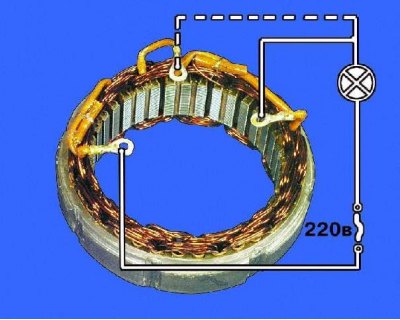
8. Check for a break in the stator winding. To do this, connect the test lamp to the 220 V AC network (you can use a battery and a 12V lamp). Connect the test lamp between all winding terminals one by one. In all three cases, the lamp should light. If the lamp does not light, there is a break in the winding. Replace the stator or winding.
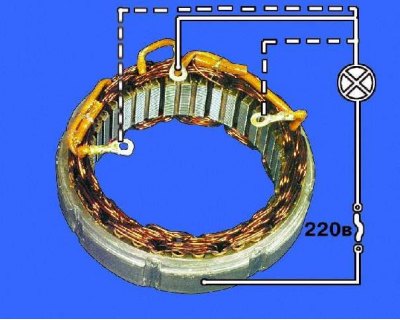
9. Check if there is a short circuit between the stator windings and the housing. To do this, connect the test lamp to the 220 V AC network (you can use a battery and a 12V lamp). Connect the lamp to the stator winding terminal, and the wire from the power source to the stator housing. If the lamp lights up, there is a short circuit: the stator or winding must be replaced.
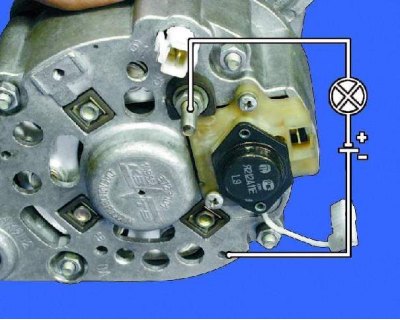
10. Check the rectifier block diodes with a 12 V test lamp and a battery. To check for a short circuit in the positive and negative diodes, connect the "+" of the battery through the test lamp to the "30" terminal of the generator, and the "-" of the battery to the generator body. If the lamp lights up, there is a short circuit in the diodes and the block must be replaced.
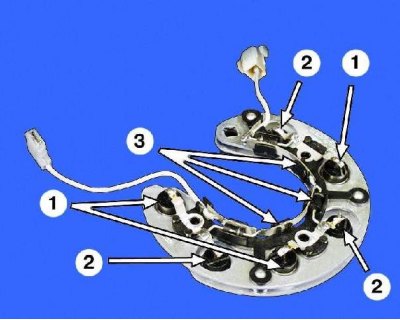
Rectifier block: 1 - positive diodes; 2 - negative diodes; 3 – additional diodes
The source is on the website (VAZBOOK)
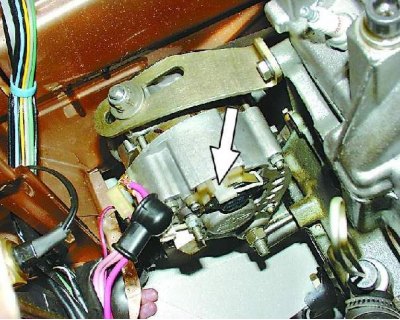
Note. You can check the rectifier unit without removing the generator from the car. To do this, disconnect the wires from the battery and generator, and remove the connector with the wire from the voltage regulator terminal. Check the rectifier unit as described in item 10.
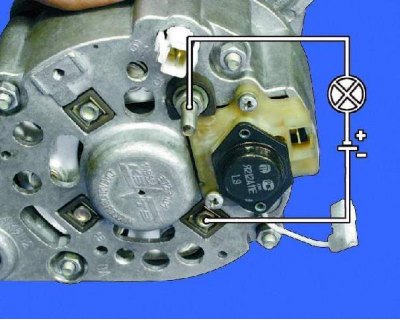
11. To check the positive diodes, connect the "+" of the battery via a test lamp to the "30" terminal of the generator, and the wire coming from the "-" of the battery to one of the rectifier unit mounting bolts. If the lamp lights up, there is a short circuit in the positive diodes: the unit must be replaced.
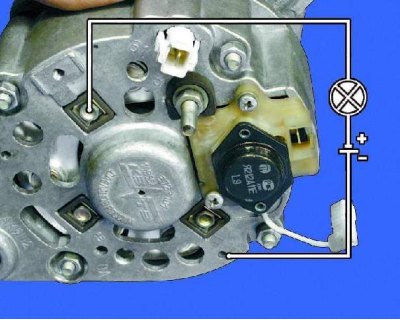
12. To check the negative diodes, connect the "+" of the battery via a test lamp to one of the rectifier unit mounting bolts, and the wire coming from the "-" of the battery to the generator housing. If the lamp lights up, there is a short circuit in the negative diodes: the unit must be replaced.
A burning lamp when checking negative diodes may also indicate a short circuit of the stator winding to the generator housing, but such a malfunction occurs much less frequently than a short circuit of the diodes.
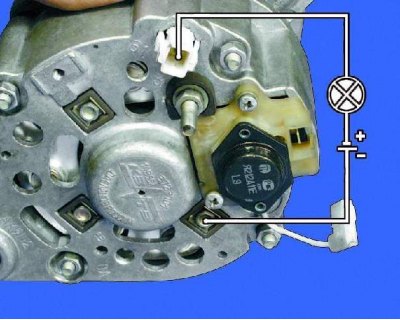
13. To check the additional diodes, connect the "+" wire from the battery through the test lamp to the "61" terminal of the generator, and the wire coming from the "-" of the battery to one of the rectifier unit mounting bolts. If the lamp lights up, there is a short circuit in the additional diodes. The unit must be replaced.
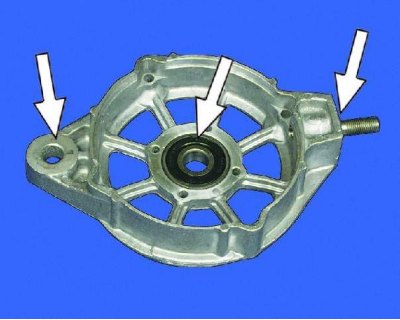
14. Inspect the drive-side alternator cover. If there are cracks, especially where the alternator is mounted, replace the cover. Measure the diameter of the bearing seat in the drive-side cover. If the bearing hole is deformed or its diameter exceeds 42 mm, replace the cover.
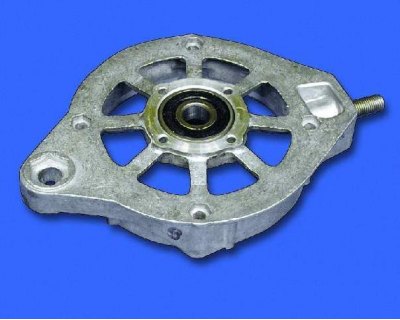
15. Check the ease of rotation of the bearings. If there is play between the rings, rolling or jamming of the rolling elements when the bearings rotate, the bearings must be replaced. Also replace bearings with damaged protective rings or traces of grease leakage.
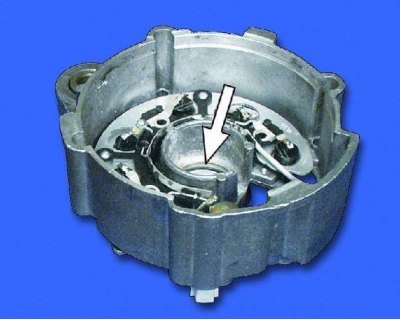
16. Inspect the generator cover from the contact ring side. If there is damage or the bearing seat ring is worn, replace the cover.
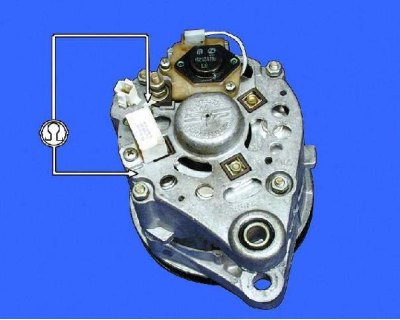
17. The capacitor's serviceability can be checked with a megohmmeter or a tester (on a scale of 1–10 MOhm). Connect one tester probe to the capacitor's contact, and the other to the generator's body. Before connecting, the device shows "Ґ". At the moment of connection, the resistance should decrease and then return to its previous position: in this case, the capacitor is serviceable. A faulty capacitor should be replaced.