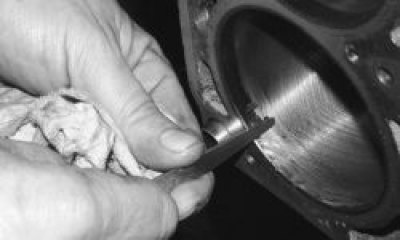

1. Clean the piston head from carbon deposits. If the piston has scoring, burn marks, deep scratches, cracks, replace the piston. Clean the grooves for the piston rings. It is convenient to do this with a piece of an old ring.
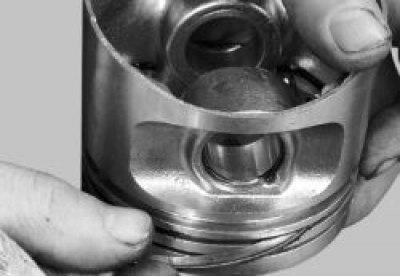
2. Clean the oil drain holes with a suitable piece of wire.
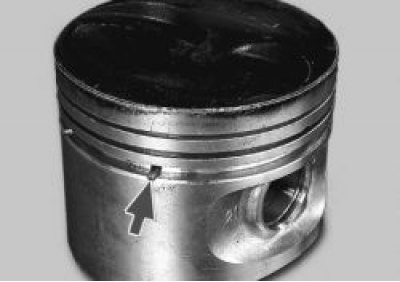
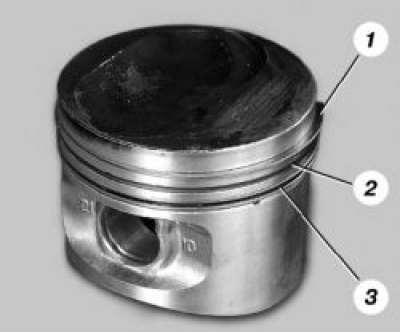
3. Check the clearances between the rings and the grooves on the piston.
Nominal clearance, mm:
- upper compression ring 1…..0.04–0.075
- lower compression ring 2…..0.03–0.065
- oil scraper ring 3…..0.02–0.055
The maximum permissible gap for all rings is 0.15 mm.
4. The most accurate way to determine the clearances is to measure the rings and grooves on the piston. To do this, use a micrometer to measure the thickness of the rings in several places around the circumference…
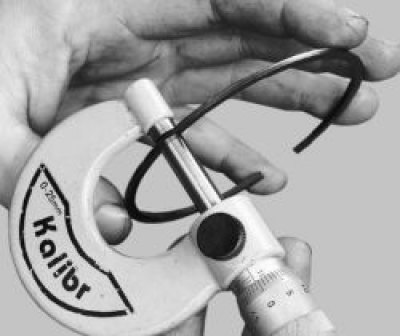
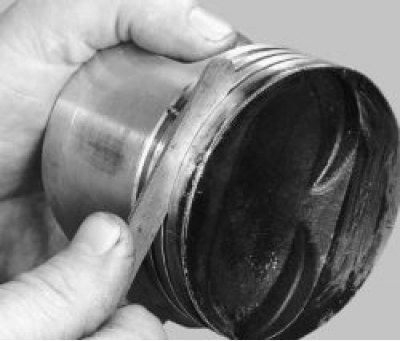
5. …then use a set of feeler gauges to measure the groove widths in several places around the circumference. Calculate the average gap values (difference between ring thickness and groove width). If at least one of the gaps exceeds the maximum permissible value, replace the piston with rings.
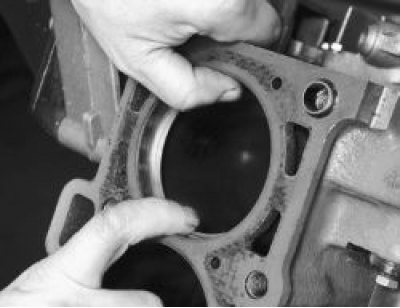
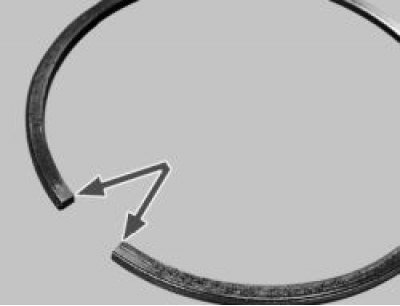
6. Measure the gaps in the ring locks by inserting the ring into a special mandrel. If there is no mandrel, insert the ring into the cylinder (in which it worked), use the piston as a mandrel to push the ring into the cylinder so that it fits in evenly, without any distortions..
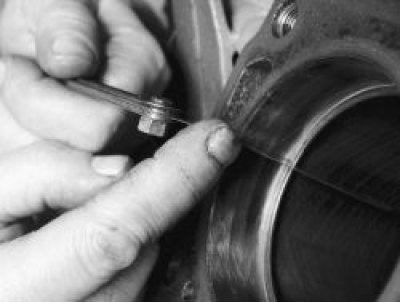
7. …and use a feeler gauge to measure the gap in the ring lock. The nominal gap should be 0.25–0.45 mm, the maximum permissible (as a result of wear and tear) – 1.0 mm. If the gap exceeds the maximum permissible value, replace the ring.
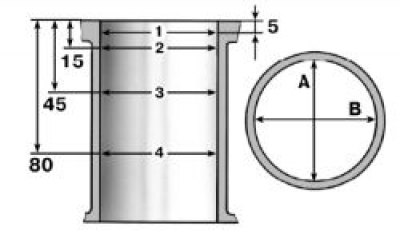
4.15. Cylinder measurement locations
8. If the gap is less than 0.25 mm, carefully file down the ends of the ring.
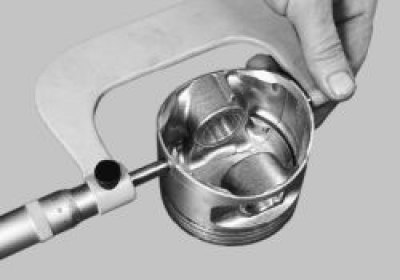
9. Check the clearances between the pistons and cylinders. The clearance is defined as the difference between the measured diameters of the piston and cylinder. The nominal clearance is 0.025–0.045 mm, the maximum allowable is 0.15 mm. If the clearance does not exceed 0.15 mm, you can select pistons from the following classes so that the clearance is as close to the nominal as possible. If the clearance exceeds 0.15 mm, bore the cylinders to the next repair size and install pistons of the corresponding repair size. Measure the piston diameter at a distance of 55 mm from its bottom in a plane perpendicular to the piston pin.
10. Then measure the diameters of the cylinder in two perpendicular planes (fig. Cylinder measurement locations) (along B and across A of the cylinder block) and in four belts (1, 2, 3 and 4). For this, a special device is needed - a bore gauge.
11. When replacing connecting rod and piston group parts, it is necessary to select pistons for cylinders by class and one group by weight, as well as piston pins for pistons by class and connecting rods by weight. To select pistons for cylinders, calculate the gap between them.
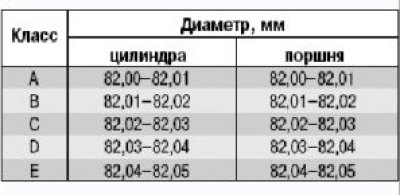
12. For ease of selection of pistons for cylinders, pistons and cylinders are divided into five classes depending on their diameters: A, B, C, D, E (table Nominal dimensions of cylinders and pistons).
Spare parts are supplied with pistons of nominal size of three classes A, C, E and two repair sizes. The first repair size is increased by 0.4 mm, the second by 0.8 mm.
According to weight, pistons are divided into three groups: normal, increased by 5 g and decreased by 5 g. Pistons of one group must be installed on the engine.
For pistons of repair sizes, rings of repair sizes increased by 0.4 mm and 0.8 mm are supplied as spare parts. The rings of the first repair size are stamped with the number "40", the second - "80".
Nominal dimensions of cylinders and pistons
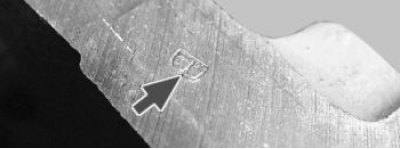
13. On the cylinder block, the cylinder group is stamped on the lower plane of the block (mating surface under the oil pan) opposite each cylinder.
14. The following data is stamped on the piston bottom:
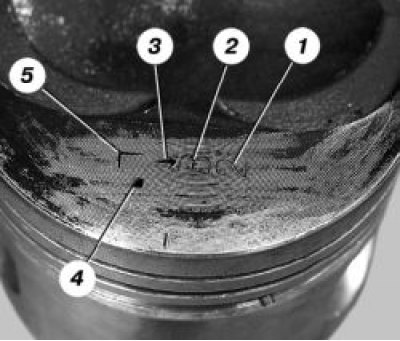
- 1 – piston class according to the pin hole;
- 2 – piston class by diameter;
- 3 – arrow showing the direction of piston installation;
- 4 – repair size (1st repair – triangle, 2nd repair – square);
- 5 – group by weight (normal – "G", increased by 5 g – "+", decreased by 5 g – "–").
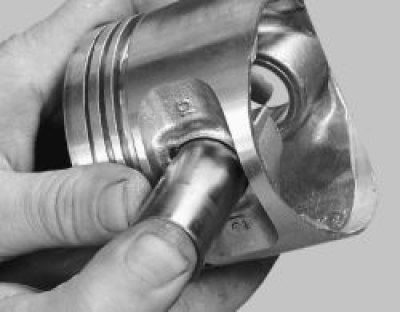
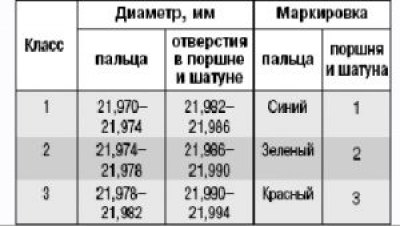
15. Replace cracked pins. The pin should easily enter the piston with the force of the thumb. Insert the pin into the piston. If there is play when you swing the pin, replace the piston. When replacing the piston, select a pin according to the class (table. Classes of piston pins, pistons and connecting rods). Piston pins are divided by diameter into three classes (1, 2, 3) through 0.004 mm. The pin class marking is applied to its end with paint. The piston class by pin is stamped on the piston bottom, the connecting rod class by pin is on the connecting rod cover.
Classes of piston pins, pistons and connecting rods
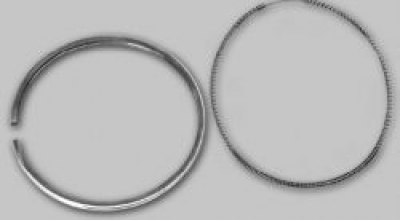
16. Replace broken rings and oil scraper ring expander.
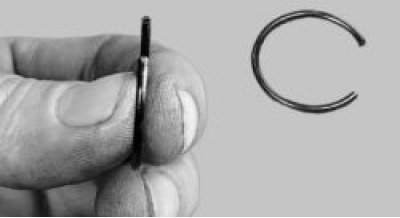
17. Replace broken or cracked retaining rings holding the piston pin. The ends of the retaining rings must be in the same plane. Replace bent rings.
The material is posted on the online resource: VazBook.ru
18. Replace bent connecting rods. Replace the connecting rod if there are burrs and deep scratches in the bushing 1 of the upper head. Replace the connecting rod if, during disassembly of the engine, it was found that the connecting rod bearings had turned in the connecting rod.
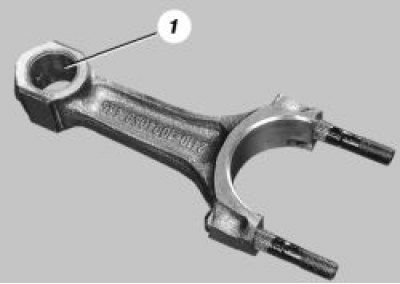
Warning! The connecting rods are processed together with the caps, so they cannot be disassembled.
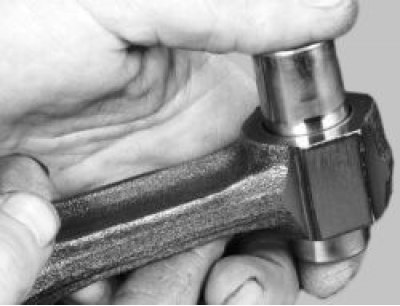
19. Insert the pin into the upper head of the connecting rod. If there is any play when you wiggle the pin, replace the connecting rod. Connecting rods with caps are divided into classes by the weight of the upper and lower heads (table. Connecting rod class by weight of upper and lower heads).
Connecting rod class by weight of upper and lower heads
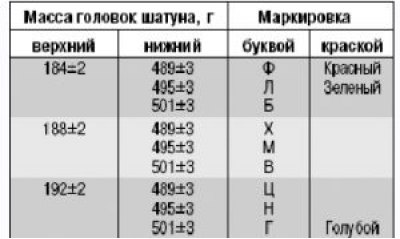
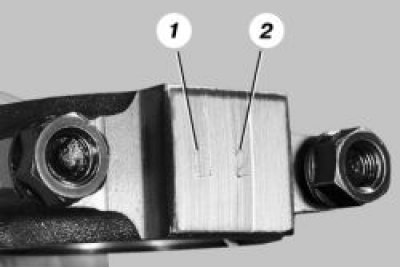
20. Connecting rods of the same class must be installed in the engine. The connecting rod marking is applied to its cover: 1 – connecting rod class by weight (letter or paint); 2 – connecting rod class according to the pin.
21. If there are deep grooves, scratches, nicks on the surfaces on which the seals operate, the crankshaft must be replaced.
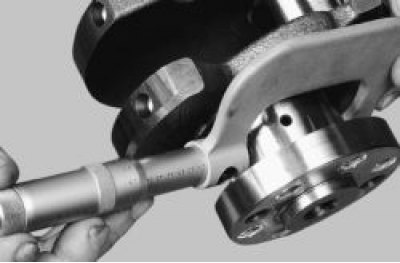
22. Measure the main and connecting rod journals of the crankshaft.
Nominal diameters of crankshaft journals, mm:
- indigenous…..50,799–50,819
- connecting rod…..47,830–47,850
If the wear of the journals and the ovality of the journals exceed 0.03 mm, they must be ground to the nearest repair size.
There are four repair sizes with a reduction in neck diameter:
- 1st – 0.25 mm;
- 2nd – 0.5 mm;
- 3rd – 0.75 mm;
- 4th – 1.00 mm.
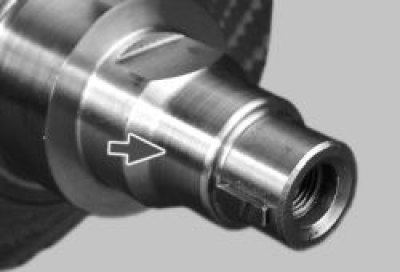
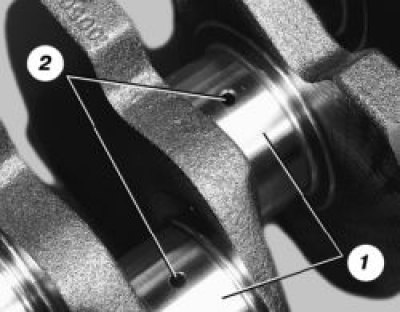
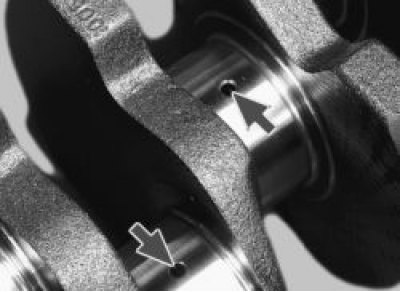
23. If there are minor burrs, scratches or notches on the main and connecting rod journals 1, they must be ground to the nearest repair size. It is recommended that this work be performed in a specialized workshop. Then polish the journals and blunt the sharp edges of the chamfers of the oil channels 2 with an abrasive cone. Wash the crankshaft and blow out the oil channels with compressed air. The ovality and taper of all journals after grinding must not exceed 0.005 mm. After grinding the journals, install liners of repair sizes.
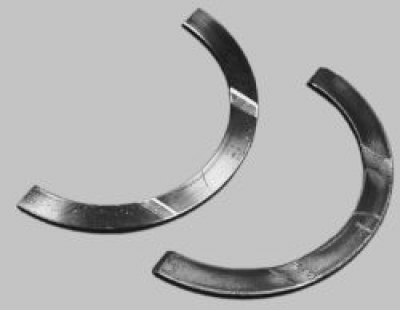
24. If there are burrs, scratches and delaminations on the working surfaces of the thrust half rings, replace the half rings. It is prohibited to carry out any adjustment work on the half rings.
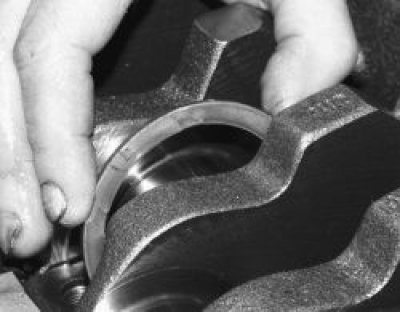
25. Measure the axial clearance of the crankshaft. To do this, install the crankshaft and thrust half rings in the cylinder block and tighten the main bearing cap bolts.
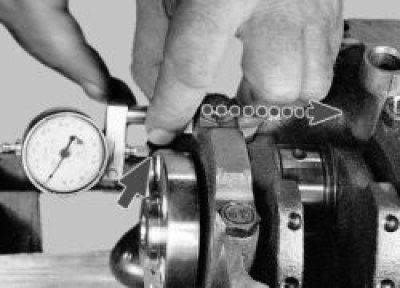
26. Install the indicator so that its leg rests against the shaft flange. Move the crankshaft as far as it will go from the indicator and set the indicator arrow to zero. Move the shaft in the opposite direction. The indicator will show the clearance value. The nominal axial clearance of the crankshaft is 0.06–0.26 mm, the maximum allowable is 0.35 mm. If the clearance exceeds the maximum allowable, replace the thrust half rings. Thrust half rings of two sizes are supplied as spare parts: nominal – 2.31–2.36 mm and repair (increased by 0.127 mm) – 2.437–2.487 mm.
27. Inspect the connecting rod and main bearings. If there are cracks, scoring, or chipping, replace the bearings. It is prohibited to carry out any adjustment work on the bearings.
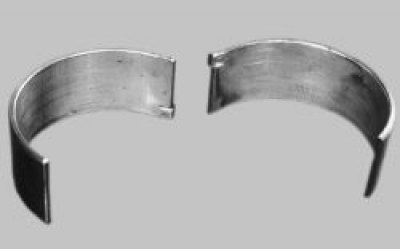
Nominal thickness of liners, mm:
- indigenous…..1,824–1,831
- connecting rod…..1,723–1,730
The liners are supplied as spare parts in four repair sizes of increased thickness:
- 1st - 0.25 mm;
- 2nd - 0.5 mm;
- 3rd - 0.75 mm;
- 4th - 1.00 mm.
28. Check the clearances between the main bearing shells and the crankshaft journals. It is recommended that this work be performed in a specialized workshop. Measure the diameters of the journals and main bearings by installing the caps with the shells on the block and tightening them to the appropriate torques. Calculate the clearance.
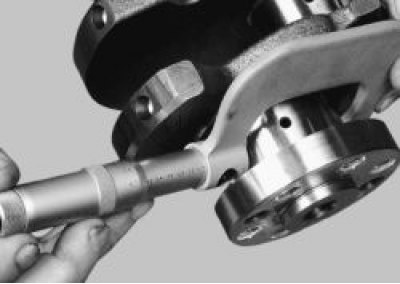
Clearances between the liners and the crankshaft journals for the main bearings:
- nominal – 0.026–0.073 mm, maximum permissible – 0.15 mm.
Clearances between liners and crankshaft journals for connecting rod bearings:
- nominal – 0.02–0.07 mm, maximum permissible – 0.1 mm.
If the clearance exceeds the maximum permissible value, the crankshaft must be ground to the next repair size.
In a specialized workshop, you can measure the runout of the crankshaft journals. The runout should be:
- main journals and seating surface for the drive gear of the oil pump - no more than 0.03 mm;
- landing surface for flywheel - no more than 0.04 mm;
- the seating surface for pulleys and seals is no more than 0.05 mm.
29. Thoroughly clean and flush the crankshaft oil passages.
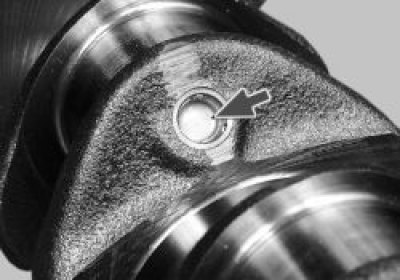
30. When performing the work, it is not recommended to press out the plugs yourself; for this, contact a specialized workshop.
31. Carefully clean the cylinder block surfaces from the remains of old sealing gaskets. Carefully inspect the block. If you find cracks, the block must be replaced as an assembly with the main bearing caps.
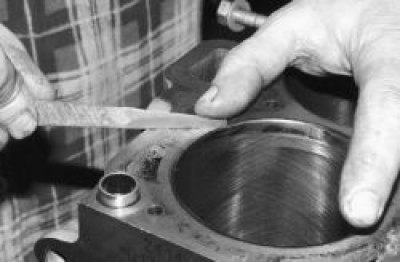
32. Check the tightness of the cylinder block cooling jacket. To do this, plug the hole under the water pump (installing the pump with a gasket) and pour Tosol-A40 into the cooling jacket. If a leak is visible in any place, it means the block is not sealed and needs to be replaced.
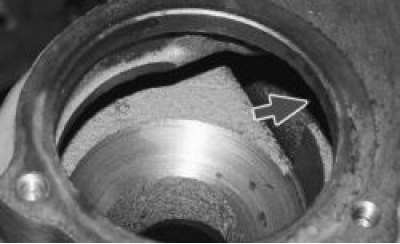
33. Inspect the cylinders. If there are scratches, burrs, or cavities on the cylinder surface, bore the cylinders to the repair size (it is recommended that this work be carried out in a specialized workshop) or replace the cylinder block. If there are various defects deeper than 0.8 mm, the block cannot be repaired and must be replaced.
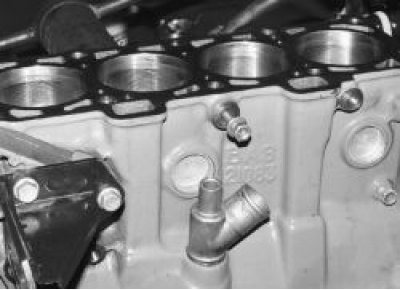
34. Clean the carbon deposits from the top of the cylinders. If a belt has formed there due to cylinder wear, remove it with a scraper. Check the wear of the cylinders by measuring their diameters.