




Open large image in new tab »
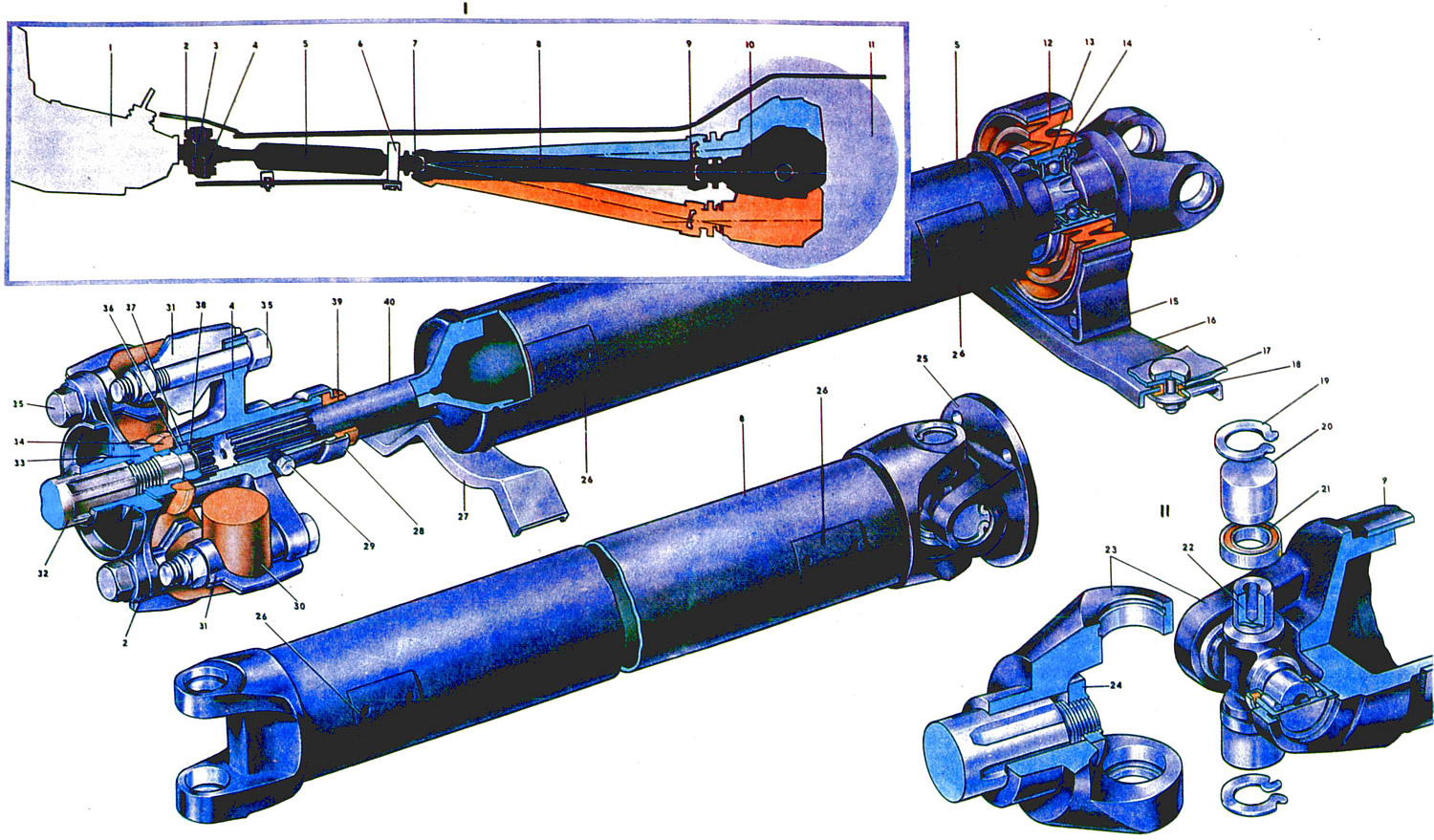
Fig. 20: 1. Gearbox. 2. Secondary shaft flange. 3. Flexible coupling of the cardan transmission. 4. Flange of the elastic coupling. 5. Front cardan shaft. 6. Intermediate support. 7. Front cardan joint. 8. Rear cardan shaft. 9. Rear cardan joint. 10. Rear axle. 11. Car wheel. 12. Support cushion. 13. Cardan shaft support housing. 14. Cardan shaft support bearing. 15. Support bracket. 16. Intermediate support crossmember. 17. Spacer sleeve. 18. Rubber sleeve. 19. Needle bearing retaining ring. 20. Needle bearing. 21. Needle bearing oil seal. 22. Universal joint crosspiece. 23. Universal joint yoke. 24. Universal joint yoke fastening nut. 25. Universal joint yoke flange. 26. Balancing plate. 27. Front propeller shaft safety bracket. 28. Oil seal cage. 29. Spline lubrication hole plug. 30. Elastic element of elastic coupling. 31. Metal insert of elastic coupling. 32. Secondary shaft of gearbox. 33. Nut. 34. Centering ring seal. 35. Elastic coupling-to-flange fastening bolts. 36. Centering ring. 37. Centering sleeve. 38. Retaining ring. 39. Oil seal. 40. Front propeller shaft splined tailpiece. I - Cardan transmission diagram. II - Cardan joint.
The torque from the secondary shaft of the gearbox is transmitted to the rear axle mechanisms by a cardan transmission, which operates under conditions of a changing angle of torque transmission due to the elastic suspension of the rear axle. At the same time, the distance between the fixed gearbox and the swinging rear axle changes. Therefore, the cardan transmission has elements that shorten or lengthen it, as well as break at a certain angle. Such elements are: a splined connection of an elastic coupling 3 and three cardan joints - two rigid 7 and 9 and one elastic 3.
The cardan transmission is two-shaft with an intermediate support 6, which significantly reduces its vibration and beating. The cardan shafts are connected to each other and to the main transmission gear by rigid cardan joints 7 and 9, and to the secondary shaft of the gearbox by an elastic joint 3 (coupling). The elastic coupling significantly reduces noise and vibration of the cardan transmission and allows the transmission of torque at an angle.
The coupling consists of six rubber elements 30, between which metal inserts 31 are located. The elastic rubber elements of the coupling are vulcanized to the inserts and form a single whole. The elastic coupling is located between two flanges 2 and 4, which are connected to the coupling by bolts 35. In this case, the projections of the inserts enter the grooves of the flanges, centering the elastic coupling on the flanges. Self-locking nuts with nylon inserts are screwed onto the coupling fastening bolts.
To ensure a gap-free connection of the coupling with the flanges and to create a constant tension in the fastening bolts, the holes in the elastic coupling for the fastening bolts are made from the center on a larger diameter than in the flanges. Therefore, before connecting the coupling to the flanges, it is compressed with a special clamp until the holes in the coupling and flanges coincide, and then the fastening bolts are installed. After removing the clamp, the gaps are eliminated, and tension is created in the fastening elements. The same clamp is used when removing the coupling.
The front propeller shaft 5 is made of a thin-walled pipe, to the ends of which splined tips are welded. On the splines of the front tip 40, a flange 4 of an elastic coupling is located. The rear tip rests on a ball bearing 14 of the intermediate support 6. The bearing is located in a steel housing 13 and fixed in it with a retaining ring. On the shaft, the bearing is clamped with a nut 24 between the flange of the tip and the fork 23 of the cardan joint. The bearing is of a closed type, with seals that reliably hold the grease placed in it during assembly. Additionally, the bearing is protected by two mud deflectors. To dampen vibrations of the cardan transmission, the bearing housing is located in a rubber cushion 12, which is vulcanized to the metal surfaces of the bearing housing 13 and the bracket 15 of the intermediate support. The configuration of the cushion is such that the front propeller shaft can have some axial movement. The bracket 15 of the intermediate support is attached to the crossmember with two bolts and nuts, and the crossmember of the intermediate support is secured with two bolts welded to the body floor. Metal spacer bushings 17 and rubber bushings 18 are installed on the fastening bolts, which isolate the crossmember from the body floor.
For the safety of the vehicle, a safety bracket 27 is installed under the front propeller shaft, preventing the shaft from falling if the elastic coupling is destroyed.
The rear cardan shaft 8 differs in its design from the front cardan shaft in that the ends of the shaft pipe are welded not to the tips, but to the forks of the cardan joints. Using the cardan joints, the rear cardan shaft is connected at one end to the front cardan shaft, and at the other to the main gear pinion.
The cardan joint consists of two forks 23, a crosspiece 22, four needle bearings 20, seals 21 and retaining rings 19.
The crosspiece connects two forks together in a hinged manner; the crosspiece pins enter the fork holes. Needle bearings are installed on the pins, the housings of which are pressed into the fork holes with a force of 8000 N (800 kgf). During assembly, the bearings are lubricated with FIOL-2U grease. To retain the grease in the needle bearings and to seal them, a steel collar is pressed onto each crosspiece pin, in which the seal 21 is located. It seals the cavity of the needle bearing.
The bearings are held in the fork holes by retaining rings 19. These rings are available in five thickness sizes. By selecting the rings by thickness, the axial clearance of the crosspiece is set within 0.1-0.4 mm. This clearance is necessary for centering the crosspiece in the forks.
Each ring is painted in its own color. The color of the ring depends on the thickness: a ring with a thickness of 1.62 mm is yellow, 1.59 is black, 1.56 is blue, 1.53 is dark brown, 1.50 is natural. The selection of retaining rings is carried out using a special gauge, which has four feeler gauges with a thickness of 1.53; 1,56; 1.59 and 1.62 mm.
After pressing one of the needle bearings into the fork hole, install a 1.56 mm thick retaining ring into the groove and then press the other bearing until it stops against the end of the crosspiece (in this case, there is no axial clearance of the crosspiece). The distance between the bearing housing and the end face of the annular groove is measured with noise. Depending on the measured distance, taking into account the gap of 0.1-0.4 mm, a second retaining ring of the corresponding thickness is inserted. For example, if a 1.56 mm thick feeler gauge fits, a 1.53 mm thick ring should be installed. If the thinnest feeler gauge (1.53 mm) does not fit into the groove, the previously installed ring should be replaced with a 1.50 mm thick ring. If a 1.62 mm thick feeler gauge fits into the groove with a gap, the previously installed ring should be replaced with a new 1.62 mm thick ring.
After installing the retaining rings, you need to hit the bearings with a hammer with a plastic striker. Under the impact and elastically compressed seals, the gap between the bottoms of the bearing housings and the retaining rings is selected and gaps appear between the bearing housings and the ends of the crosspieces. After assembly, the cardan joint forks should rotate easily, without jamming.
The text is taken from the online resource: VAZBOOK.ru
After assembly, the cardan transmission is balanced on special balancing stands. The imbalance is eliminated by welding metal plates 26 to the cardan shaft pipes. In order not to disturb the factory balance during disassembly caused by replacing worn or damaged parts, it is necessary to apply marks to the parts to be separated before disassembly and install them in their original places during assembly. Any imbalance causes vibrations and rapid wear of the vehicle transmission.
Noise and vibrations of the cardan transmission appear when the bolts and nuts of its parts and units are loosened, when the crosspiece bearings and intermediate support are worn out, and when the cardan shafts are deformed. Due to wear or damage to the seals, grease leaks from the crosspiece bearings or from the splined connection, which leads to their intensive wear.
In order to increase the service life of cardan joints, a new cardan transmission with new joints of increased durability has been manufactured since 1988. Cardan joints of the new design have improved sealing of needle bearings and their better dirt protection, which is achieved by using radial-face seal seals.
The cardan transmission operates in the most adverse conditions: in the zone of environmental influence (dirt, moisture) and under constantly changing loads. In order to prevent intensive wear of the joints in these conditions, in addition to improving the design of the bearing seals, it is important to monitor the tightness of the crosspiece bearings and the intermediate support and to prevent the beating of the cardan transmission, which can occur when the shafts are deformed due to contact with road obstacles or loosening of the bolts fastening the joint forks or the intermediate support. Imbalance is possible if the rules for assembling the cardan transmission are not followed during its repair.
After long-term use of the car (over 100,000 km mileage) it is recommended to remove the cardan transmission and check the cardan joints for ease and smoothness of fork rotation and for the absence of axial and radial clearances in the crosspiece bearings and intermediate support. It is also necessary to make sure that there are no traces of contact with road obstacles on the cardan shafts.
If the forks rotate smoothly, there are no jams or noticeable radial and axial clearances in the bearings and circumferential clearances in the splined joint, and lubricant is not ejected through the crosspiece seals, then the cardan transmission is suitable for further use. Otherwise, it is repaired.