

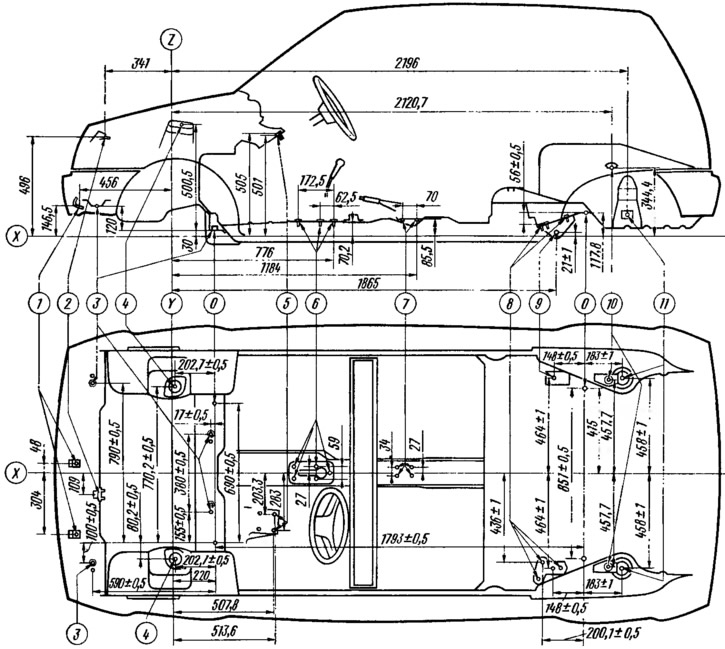
Pic. 179. The main reference dimensions of the points of attachment of units and components of the car: x, y, z - base lines; O - four base holes with a diameter of 15 mm; 1 - lower radiator supports; 2 — the top support of a radiator; 3 - fastenings of the subframe of the power unit; 4 - centers of the upper hinges of the racks; 5 — fastenings of an arm of a steering; 6 — fastenings of the gear lever; 7 — fastenings of an arm of the lever of a parking brake; 8 - fastening the bracket of the left arm of the rear suspension; 9 - the center of fastening of the right rear suspension arm; 10 - the centers of the upper supports of the rear suspension shock absorbers; 11 - centers for attaching compression buffers.
Damage to the car body can be very different. Therefore, the repair rules in each individual case should be their own, most suitable for these damages. At the same time, the possibilities of straightening damaged panels are used to the maximum. Thermal exposure of the metal should be avoided whenever possible so as not to disturb the factory welding and anti-corrosion protection of the body. In many cases, it is necessary to remove face pieces to locate damage, straighten or inspect the frame. In cases of significant damage to the body, it is recommended to remove all easily removable interior upholstery to facilitate the measurement, control and installation of hydraulic or screw jacks to eliminate distortion and damage to the body. Editing restores the original linear dimensions and locations of the bearing elements, the wind window, the hood openings, the tailgate.
The protrusion of the front surfaces and removable parts relative to neighboring ones is made by fitting or adjusting them.