

The elimination of simple deformations is carried out using a straightening tool and straightening devices, as well as the installation of repair overlays made at the site of damage. The dimensions of the repair pads must exceed the dimensions of the damaged area by at least 30 mm. Before installing the overlays, they clean the place with a metal brush to the metal. Welding is performed with a continuous seam, followed by welding cleaning and restoration of the anti-corrosion coating.
To correct complex deformations, an installation for control and editing is used. The body is installed on the support brackets of the installation at the base points and mounted on matching brackets. To align the rest of the controlled points with the corresponding brackets, the deformed sections are drawn and straightened using a hydraulic straightening device.
When straightening damage, all easily removable inner upholstery parts are removed to facilitate measurement, control and installation of hydraulic or screw jacks to eliminate distortions and deflections.
The main dimensions for checking the attachment points of the units are shown in fig. 173.
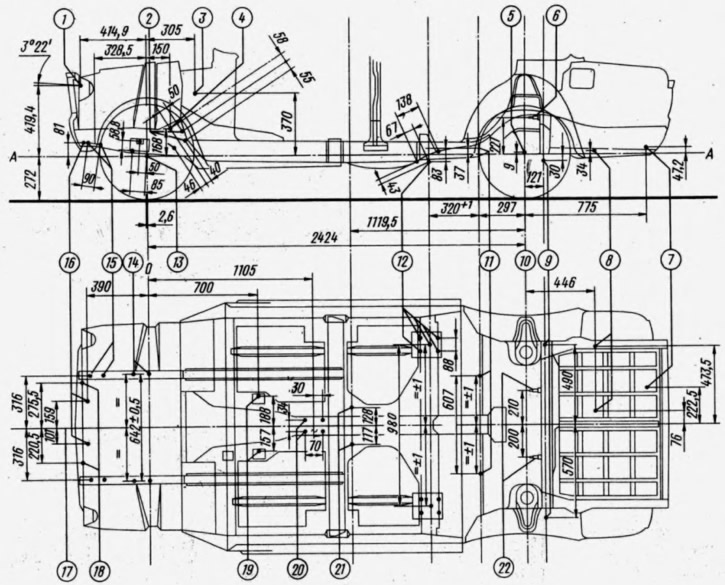
Pic. 173. The main dimensions for checking the attachment points of the units:
0 - baseline; 1 - upper radiator mount; 2 - fastening of the crankcase of the steering mechanism and the pendulum lever; 3 - axis of the brake and clutch pedals; 4 - the center of the steering mechanism; 5 - center of the rear wheel; 6 - fastening of shock absorbers of the rear suspension; 7 - rear silencer mount; 8 - front mounting of the muffler; 9 - fastening of the transverse rod of the rear suspension; 10 - axle of the rear wheels; 11 - fastening of the upper longitudinal rods of the rear suspension; 12 - fastening of the lower longitudinal rods of the rear suspension; 13 - center of the front wheel; 14 - attachment points of the front suspension cross member; 15 - mounting of the anti-roll bar; 16 - lower radiator mount; 17 - vehicle axle; 18 - upper radiator mount; 19 - rear mount of the power unit; 20 - hand brake mount; 21 - fastening of the cardan shaft support;
The diagonal dimensions of the openings of the front and rear doors must correspond to the dimensions shown in fig. 174.
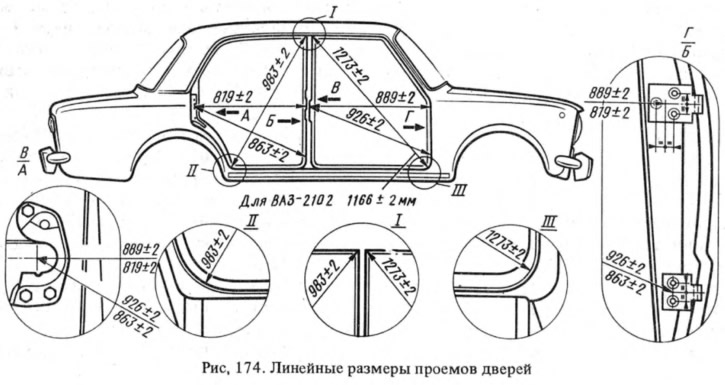
The diagonal dimensions of the tailgate opening of cars 2102 and 21021 must be equal (1380±2) mm; dimensions of the opening in height in the middle part (925±2) mm.
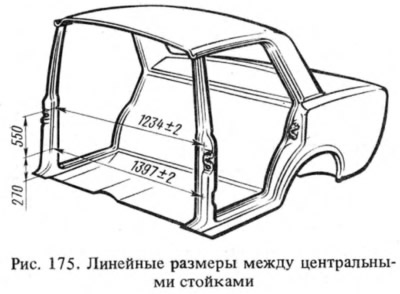
Distance between B-pillars (without upholstery) shown in fig. 175.
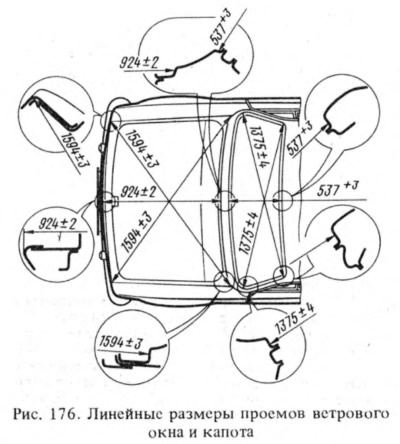
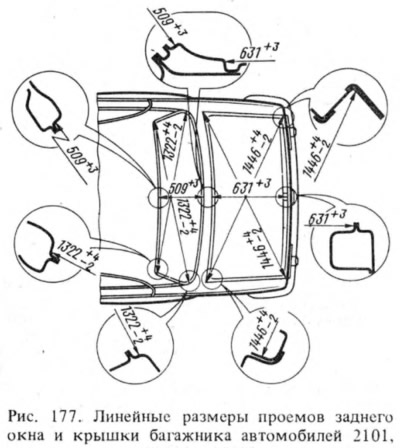
The dimensions of the openings of the wind and rear windows, the openings of the hood and trunk lid are shown in fig. 176 and 177. The difference in the diagonal dimensions of the said openings of one body must not exceed 2 mm.
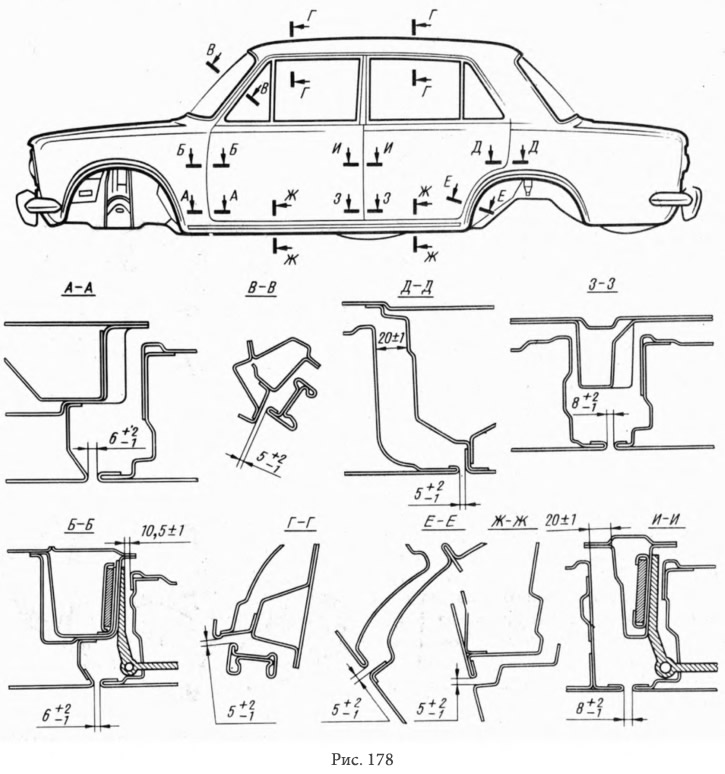
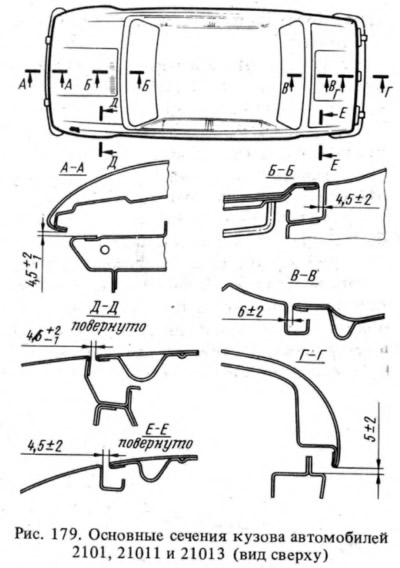
When repairing the body, it is necessary to restore the external gaps along the contours of the doors, hood and trunk lid (pic. 178 and 179). Uneven gaps are allowed no more than 1.5 mm; protrusion of the front movable surfaces relative to the fixed ones - no more than 2 mm.
Most often, when repairing a body, it is necessary to replace wings, front and rear panels, door sills, roof panels. Methods for replacing and repairing these parts can be taken as a basis for repairing other parts. In this case, it is necessary to know the location of the welds.