
Telescopic stand
All parts are washed with kerosene or technical detergents and dried. Carefully check the compliance of the parts with the following requirements:
- the disks of the compression and recoil valves, as well as the bypass valve plate, must not be deformed; non-flatness of the bypass valve plate is allowed no more than 0.05 mm;
- the working surfaces of the piston, piston ring, rod guide, cylinder and valve parts must be free of scoring, dents and wear marks that could affect the normal operation of the rack;
- sealing lips must be free of damage or wear;
- risks, scoring and delamination of the fluoroplastic layer at the guide bushing of the suspension strut rod are not allowed;
- the springs of the recoil and compression valves must be intact and sufficiently elastic;
- the inner surface of the rack body must be clean, without marks, damage, the thread must be in good condition, the rack body, bracket, spring cup must not have deformations and destruction;
- The compression stroke buffer and protective cover must not be damaged or damaged.
Welding (welding) racks are not allowed, as this may affect the change in wheel alignment and the performance of the rack.
Suspension arms
The deformation of the suspension arms is determined by a special device. The suspension arm with ball joint is installed so that the centering mandrel articulates with the taper of the ball joint pin, and the locating pins of the tool go into both holes of the arm.
A sign of deformation is the impossibility of inserting the locating fingers into the lever hole without force or poor articulation of the mandrel along the cone of the hinge pin.
Ball joints
Make sure that the protective covers of the hinges are intact. Tears, delamination of rubber from metal fittings, traces of lubricant leakage through the cover are unacceptable. A slight extrusion of grease through the sprue hole in the body of the ball joint, located in the upper part of the body, is allowed.
Check for wear on the working surfaces of the ball joints by manually turning the ball pin. Significant (over 0.7 mm) free movement of the finger or its jamming is unacceptable.
An accurate check of the state of the ball joint by the size of the radial and axial clearances is carried out on fixtures 02.8701.9502. To do this, install a ball joint 1 (pic. 108, a) into the socket of the device and clamp it with a screw. Indicator 2 is installed in the fixture bracket so that its leg rests against the side surface of the hinge body, and the indicator needle is at zero.
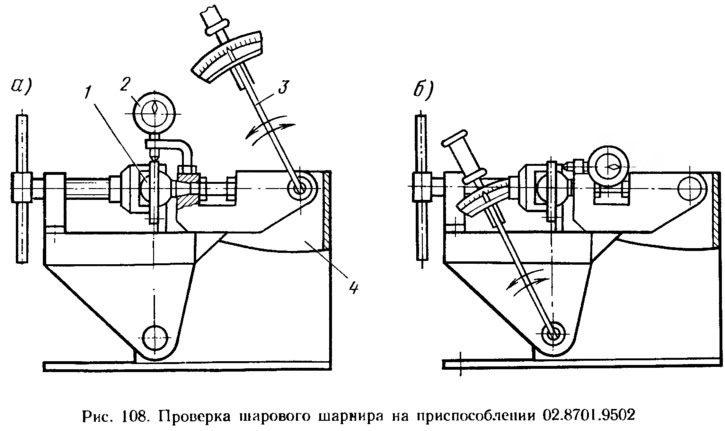
A torque wrench 3 is installed in the upper socket of the fixture 4 and, applying a torque of 196 Nm to it alternately in both directions, the total radial clearance in the ball joint is determined by the indicator. If it exceeds 0.7 mm, replace the hinge.
Similarly, the axial clearance in the ball joint is checked, after changing its fastening in the fixture, as shown in Fig. 108b. Axial clearance in the hinge is allowed no more than 0.7 mm.
Roll Stabilizer
Check whether the rod is deformed and whether its ends are in the same plane; if the deformation is insignificant, then the rod is straightened; if the deformation is significant, the rod is replaced. Check the condition of the pillows in the boom brackets. If the pads are worn or damaged, replace them. Check the deformation of the stabilizer struts with a caliber; if the gauge pins do not fit into the rack holes, replace it.
Suspension springs
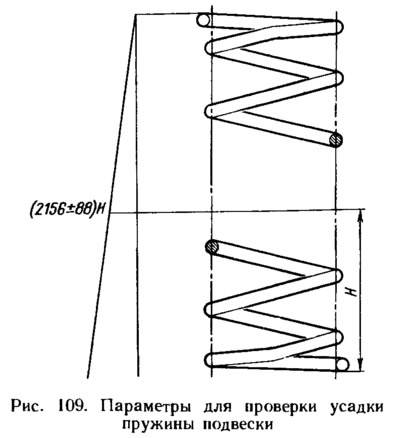
Check the springs carefully. If cracks or deformation of the coils are found, replace the spring with a new one. To check the draft of the spring, squeeze it three times until the coils touch. Then force is applied to the spring (2156±88) H. Spring height H (pic. 109) under such a load should be 210 mm, the compression of the spring is carried out along the axis of the spring; the supporting surfaces must match the surfaces of the cups of the telescopic pole. If the yellow marked spring (class A) has a length of less than 210 mm, change its marking to green (class B).
Stretch marks
The deformation of stretch marks is determined visually. With a significant deformation, the stretching is replaced with a new one, if it is possible to straighten it, they are edited.
Rubber-metal hinges
The signs by which the need to replace the hinges is determined are described above (see sect. «Determining the condition of suspension parts on a car»).
Top support of the telescopic pole
Check the condition of the upper support and plain bearing. Detachment of rubber from the support body, its gusts, cracks and deformation of the support body or wear of the support clips are not allowed. In case of wear or destruction of the support washer or sleeve of the plain bearing of the upper support, replace them.
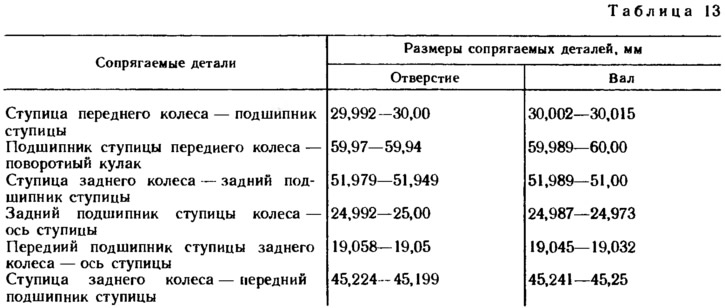
The dimensions of the main mating parts are given in table. 13.