




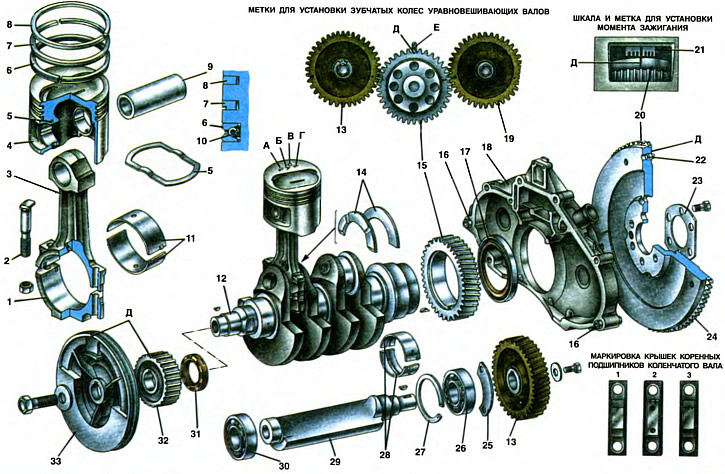
1. Connecting rod cap. 2. Connecting rod cap fastening bolt. 3. Connecting rod. 4. Piston. 5. Piston temperature control plate. 6. Oil scraper ring. 7. Lower compression ring. 8. Upper compression ring. 9. Piston pin. 10. Expansion spring (expander). 11. Connecting rod bearing shells. 12. Crankshaft. 13. Left balance shaft gear. 14. Thrust half rings. 15. Balance shaft drive gear. 16. Centring sleeve. 17. Crankshaft rear oil seal. 18. Rear oil seal holder. 19. Right balance shaft gear. 20. Flywheel. 21. Scale on rear oil seal holder 18. 22. Clutch dowel pin. 23. Flywheel mounting bolt washer. 24. Flywheel toothed rim. 25. Bearing thrust half ring. 28. Rear bearing. 27. Retaining ring. 28. Main bearing shells. 29. Left balance shaft. 30. Front bearing. 31. Front crankshaft oil seal. 32. Timing pulley of camshaft drive.
A. Marking of piston category by piston pin bore
B. Marking of piston class by outer diameter
B. Marking of piston repair size
G. Directional arrow
D. Piston TDC mark
E. Mark on the cylinder block
The slider-crank mechanism is used to convert the reciprocating motion of the piston into the rotary motion of the crankshaft. The mechanism consists of a piston 4 with piston rings 6, 7 and 8 and a pin 9, a connecting rod 3, a crankshaft 12 and a flywheel 20. The parts of the slider-crank mechanism are located and operate in the cylinder block. The crankshaft is the main power part of the engine, which perceives the loads of gases and the inertial forces of reciprocating moving parts and transmits them through the flywheel to the vehicle transmission converted into torque.
The piston group parts and other parts of the crank mechanism are exposed to significant mechanical and thermal loads. The selection of materials for the piston, pin, piston rings and their design ensure reliable sealing of the combustion chamber and cylinder cavities, effective heat dissipation, minimum friction coefficient, high strength and reliability with low mass of parts.
Piston
Piston 4 is cast from a high-strength aluminum alloy. The aluminum piston is light and conducts heat well to the cooled cylinder walls. But aluminum has a high temperature coefficient of linear expansion. Therefore, to impart the desired direction of temperature deformation of the piston when heated and to eliminate the risk of the piston jamming in the cylinder, a temperature-regulating steel plate 5 is cast in the piston head above the piston pin hole.
To ensure the set clearance between the cylinder mirror and the piston, pistons and cylinders are sorted into five classes by mating diameter: A, B, C, D and E. The piston class (letter) is stamped on its bottom. The letters indicate the following dimensions (in mm) of the piston diameter: A-75.965...75.975; B-75,975...75,985; C-75,985...75,995; D-75,995...76,005; E-76,005...76,015.
To determine the class, the piston diameter must be measured in a plane perpendicular to the piston pin at a distance of 51.5 mm from the bottom. In other places, the piston diameter differs from its nominal diameter, since the outer surface of the piston has a complex shape. In cross section, it is oval (piston head ovality from 0.1 mm, and skirt up to 0.55 mm), and the smaller axis of the oval coincides with the axis of the piston pin. In height, both the skirt and the piston head have a conical shape and, in addition, the diameter of the head is 0.5 mm less than the diameter of the skirt. This shape of the piston at room temperature provides the most favorable shape of the piston when working in the engine cylinder.
The outer surface of the piston skirt is not smooth, but has a number of annular microgrooves up to 14 µm deep. Such a surface promotes better running-in of the piston and reduces friction between the piston and the cylinder, since oil is retained in the microgrooves. The piston bottom is flat, with an oval recess for the combustion chamber and small recesses for the valves. In the lower part of the piston pin bosses, there are holes for the passage of oil to the piston pin. To improve lubrication conditions, two longitudinal grooves 3 mm wide and 0.7 mm deep are made in the upper part of the pin holes, in which oil is retained. In the area of the bosses, the height of the skirt is reduced to prevent the crankshaft counterweights from touching the piston.
The axis of the hole for the piston pin is shifted by 1.2 mm from the diametrical plane of the piston towards the engine valves. Due to this, the piston is shifted within the gap between the skirt and the cylinder mirror when changing the direction of movement in the area of the top dead center at the beginning of the working stroke practically without impact. However, this requires the installation of the piston in the cylinder during assembly so that the arrow G on its bottom is directed towards the front of the engine.
The pistons in the engine must be identical in mass to reduce vibrations due to differences in the masses of the reciprocating parts. Therefore, during manufacturing, the piston mass is maintained with a maximum deviation of ±5 g.
By weight, pistons are sorted into three groups: normal, increased by 5 g and decreased by 5 g. These groups correspond to markings on the piston bottom: "G", "+" and "-". All pistons on the engine must be of the same group by weight.
Spare parts are supplied with pistons of nominal size of only three classes: A, C and E. This is sufficient for selecting a piston for any cylinder during engine operation, since pistons and cylinders are divided into classes with some overlapping sizes. For example, a piston of class C can fit cylinders of classes B and D. The main thing when selecting a piston is to ensure the necessary installation clearance between the piston and the cylinder of 0.025...0.045 mm.
In addition to nominal size pistons, spare parts also include repair pistons with an outer diameter increased by 0.4 and 0.8. These pistons are intended for installation in repaired cylinder blocks, in which the cylinders are bored and honed to the next repair size. The bottoms of the repair pistons are marked B in the form of a square or triangle. The triangle corresponds to an increase in the outer diameter by 0.4 mm, and the square - by 0.8 mm.
There are three annular grooves on the piston head: compression rings 7 and 8 are installed in the two upper ones, and an oil scraper ring 6, equipped with a release spring 10, is installed in the lower one. The groove of the oil scraper ring communicates with the internal cavity of the piston by four radial holes, through which the oil, compressed by the ring from the cylinder mirror, passes into the piston and flows into the engine crankcase.
Piston pin
Piston pin 9, which pivotally connects the piston to the upper head of the connecting rod, is made of steel with an internal hole, is pressed into the upper head of the connecting rod with an interference fit of 0.010...0.042 mm and rotates freely in the piston bosses (gap 0.008 - 0.016 mm).
The pins by the outer diameter, as well as the pistons by the diameter of the hole for the pin, are sorted by 0.004 mm into three categories. The categories are designated by a number (1, 2, 3) on the piston bottom and paint on the end of the pin: blue color - the first category, green - the second, red - the third. The assembled pin and piston must belong to the same category, such selective assembly guarantees the necessary clearance. The correct mating can be checked by inserting an oiled pin into the piston. The pin should be easily inserted into the piston by pressing with your hand and not fall out of the piston under the action of its own weight.
Piston rings
Piston rings 6, 7 and 8 provide the necessary cylinder sealing, remove part of the heat absorbed by the piston bottom to the cylinder wall and distribute the oil film on the surfaces of the skirt and cylinder, preventing oil from entering the combustion chamber. The rings are made of cast iron, they are pressed against the cylinder wall by their own elasticity and gas pressure, and ring 6 is additionally pressed by spring 10.
The upper compression ring 8 operates under conditions of high temperature, aggressive impact of combustion products and insufficient lubrication, therefore, to increase wear resistance, the outer surface is chrome-plated and has a barrel-shaped generatrix to improve running-in.
The lower compression ring 7 has a groove at the bottom to collect oil during the piston's downward stroke, performing the additional function of an oil-scraping ring. The surface of the ring is phosphated to increase wear resistance and reduce friction against the cylinder walls.
The oil scraper ring 6 has an annular oil collection groove on the working surface between two chromed support belts and four holes in it for draining the oil removed from the cylinder walls. The ring thus has two scraping edges. The scraping action is enhanced by using an expansion spring 10, which increases the radial pressure of the ring on the cylinder. This spring, acting on the ring, increases the uniformity of the radial pressure on the cylinder, without impeding the freedom of movement of either the ring or the piston.
Rings of repair sizes are manufactured (the same as pistons) with an outer diameter increased by 0.4 and 0.8.
Connecting rod
Connecting rod 3 is a part that connects the piston to the crankshaft. When the engine is running, the connecting rod is subject to alternating loads from inertia forces and gas pressure. Dynamic loads on the connecting rod at the moment of ignition of the working mixture in the combustion chamber require that with a minimum weight, the connecting rod has high rigidity, resistance to impact loads, and sufficient fatigue strength.
For this purpose, the connecting rod is made of forged steel and consists of an I-section rod, an upper non-separable head and a lower separable head. In the lower head of the connecting rod with cover 1, liners 11 of the connecting rod bearing are installed, mating with the connecting rod journal of the crankshaft. The diametrical clearance between the journal and the liners of the connecting rod bearings is 0.02... 0.07 mm.
The connecting rod lower head cover is secured with two bolts 2 with self-locking nuts. To ensure the centering of the bolts, their outer surface and the hole in the connecting rod are machined with high precision, and the bolt head has a belt with which the bolt is pressed into the hole. To ensure accuracy, the hole for the liners in the connecting rod lower head is machined together with the cover. To avoid mixing up the connecting rod covers during assembly, the connecting rod and the corresponding cover have stamps with the number of the cylinder in which they are installed. During assembly, the numbers on the connecting rod and cover must be on the same side. Until 1997, at the point where the connecting rod lower head transitions to the rod, there was a hole through which oil was sprayed onto the cylinder walls.
When assembling the connecting rod and piston group, the connecting rods with the mentioned hole must be positioned so that the hole on the connecting rod and the arrow on the piston bottom are directed in the same direction. Connecting rods without a hole can be connected to the piston in any position.
To ensure vibration-free operation of the engine, the mass of both connecting rods assembled with the caps is adjusted by removing metal from the side bosses on the upper head of the connecting rod and from the boss on the cap so that the mass of the upper heads of the connecting rods differs by no more than ±2 g, and the lower ones by no more than ±3 g.
Crankshaft
Crankshaft 12 is cast from high-grade special cast iron and consists of connecting rod and main ground journals, cheeks and counterweights. To reduce shaft deformations during engine operation, it is made three-bearing and with a large overlap of the main and connecting rod journals. High fatigue strength of the crankshaft material is provided by structurally smooth transitions between the journals and cheeks and careful processing of stressed areas. High wear resistance of the shaft journals is achieved by their large diameter, which reduced specific loads in the bearings, and surface hardening of the journals with high-frequency currents to a depth of 2... 3 mm.
The diameter of the crankshaft main journals is 50.799...50.819 mm, the diameter of the connecting rod journals is 47.83...47.85 mm.
To reduce the load from centrifugal forces on the main bearings and reduce engine vibration, the shaft is equipped with counterweights cast in one piece with it. The counterweights partially balance the centrifugal forces acting on the crankpins from the movements of the connecting rod with the piston that occur during engine operation. With the help of dynamic balancing of the crankshaft, the imbalance value in the plane passing through the middle of the first main journal is 19782±50 g mm, and the third - 21376±50 g mm.
The shaft body has drilled channels connecting the 1st and 3rd main journals with the connecting rod journals. Oil is supplied through these channels to lubricate the connecting rod bearings. The technological outlets of the channels are closed with cap steel plugs, which are pressed into the channels and calked at three points. The oil outlet for lubricating each connecting rod bearing is carried out in two places through a horizontal through channel in the corresponding journal, which contributes to uniform wear of the journals around the circumference.
The diametrical clearance between the main journal and the main bearing shells is 0.026...0.073 mm.
It is possible to regrind the crankshaft journals during repairs with a reduction in diameter.
At the front end of the shaft, equipped with an oil seal 31, the toothed pulley of the camshaft drive 32 and the pulley of the generator drive 33 are secured with a bolt on the key. At the rear end of the shaft, equipped with an oil seal 17, the gear of the balance shaft drive 15 is mounted on the key, and at the end with bolts through a washer 23, the flywheel 20 with the toothed rim 24 is secured. The flywheel is equipped with clutch mounting pins 22, and on the outer surface has a mark of the TDC of the pistons (mark D). The rear shaft oil seal is fixed in the holder of the rear oil seal 18, which is centered on the block by centering bushings 16.
Balancing mechanism
The balancing mechanism consists of two balancing shafts 29 located in the cylinder block on both sides of the crankshaft. The shafts are cast from cast iron and have an imbalance equal to 5679.9±50 g mm in the plane of the front support and 4906±50 g mm in the plane of the rear support. This imbalance value is achieved by drilling holes from the outer surface of the balancing shaft during its dynamic balancing.
The shafts rotate in two ball bearings 26 and 30, installed in the cylinder block sockets. The drive of the left and right shafts is carried out from the leading gear 15, installed on the key on the rear end of the crankshaft. The driven gears 13 and 19 of the shafts are also installed on keys.
For the balance shafts to work effectively, it is necessary that the inertial forces from the piston masses with connecting rods and from the unbalanced masses of the balance shafts be directed in opposite directions and mutually compensate each other. This is ensured by the precise installation of the balance shafts relative to the crankshaft using the marks on the gears.