




Contents: Carter ↓ Back cover ↓ Primary shaft ↓ Secondary shaft ↓ Synchronizer ↓ Reverse intermediate gear ↓
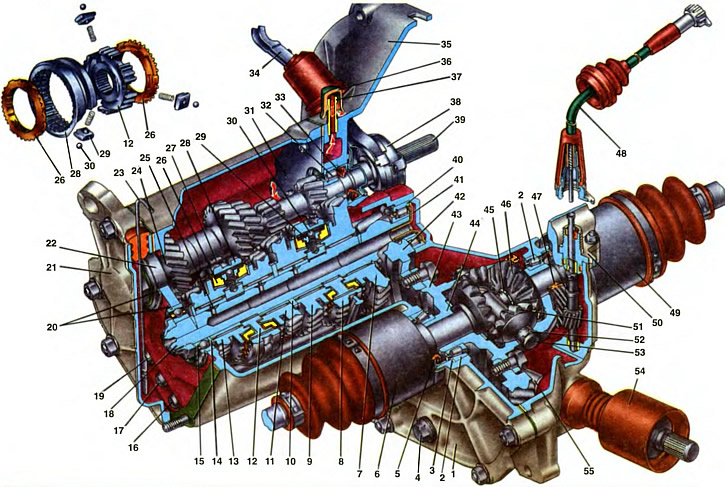
1. Gearbox housing. 2. Differential tapered roller bearing. 3. Adjusting ring. 4. Drain plug. 5. Axle shaft seal (wheel drive joint housings). 6. Left front wheel drive. 7. 1st gear toothed wheel on secondary shaft. 8. 1st, 3rd and reverse synchronizer clutch. 9. 2nd gear toothed wheel on secondary shaft. 10. Thrust ring. 11. 3rd gear toothed wheel on secondary shaft. 12. 3rd and 4th gear synchronizer hub. 13. 4th gear toothed wheel on secondary shaft. 14. Thrust washer of 4th gear toothed wheel. 15. Secondary shaft ball bearing. 16. 1st and 2nd gear engagement fork rod. 17. 3rd and 4th gear engagement fork rod. 18. Secondary shaft. 19. Reverse gear engagement fork rod. 20. Bearing mounting ring. 21. Gearbox rear cover. 22. Primary shaft ball bearing. 23. Oil dipstick. 24. Primary shaft fourth gear pinion. 25. Pinion needle bearing. 26. Third and fourth gear synchronizer locking ring. 27. Third and fourth gear synchronizer sliding clutch fork. 28. Third and fourth gear synchronizer sliding clutch. 29. Retainer cracker. 30. Retainer ball. 31. Plate. 32. Primary shaft roller bearing. 33. Primary shaft seal. 34. Clutch release fork. 35. Clutch housing. 36. Breather cap. 37. Breather. 38. Clutch release bearing sleeve. 39. Gearbox primary shaft. 40. Secondary shaft roller bearing. 41. Oil sump. 42. Main gear driven gear. 43. Differential case. 44. Axle gear support washer. 45. Axle gear circlip. 46. Axle gear. 47. Speedometer drive driving gear. 48. Speedometer drive cable assembly. 49. Right front wheel drive. 50. Speedometer drive housing. 51. Satellite. 52. Satellite shaft circlip. 53. Satellite shaft. 54. Gear shift joint protective cover. 55. Gear selection rod.
To change the magnitude and direction of torque transmitted from the engine to the drive wheels of the vehicle, a two-shaft, four-speed gearbox with helical engagement of gear wheels is used. The gearbox is combined with the main gear and differential and is characterized by the following gear ratios: first gear - 3.7; second gear - 2.06; third gear - 1.27, fourth gear - 0.9; reverse gear - 3.67; main gear - 4.54. All forward gears are synchronized.
The selected gear ratios provide good vehicle dynamics, high average speed and economical engine operation. Helical gears of constant engagement and synchronizers on all forward gears provide silent operation of the gearbox, reliability and durability of its operation.
The gearbox is attached to the clutch housing 35 using studs, with a load bolt installed under one of the mounting nuts to support the power unit when removing or installing it. The second load bolt is installed on the engine cylinder head.
In the gearbox housing 1 there is a primary shaft 39, a secondary shaft 18 with driven gear wheels and two synchronizers, an axis of the intermediate reverse gear wheel, the main gear, a differential and a gear shift drive. The housing is closed by a rear cover 21.
Carter
The housing 1 is cast from an aluminum alloy. It contains seats for bearings 22, 15 and 2 of the primary and secondary shafts and differential, three seats for gearshift rods 16, 17, 19, perpendicular to which the seats of the rod locks are located. Balls 11 (see chapter 20) with springs 13, which are closed with threaded plugs. The opposite ends of the rods enter the sockets of the housing 21 of the gear selection mechanism, which is attached to the clutch housing with four bolts. Between these sockets are located crackers 3 of the locking device.
There is a drain hole in the lower part of the gearbox housing for releasing used oil. The drain hole is closed with a threaded plug 4 (see chapter 19).
To prevent pressure from being created in the crankcase when the gear wheels rotate and oil is splashed, the gearbox crankcase cavity communicates with the atmosphere through breather 37. The breather tube is pressed into the opening of the clutch housing. A rubber cap 36 is placed on top of the tube. To prevent oil from being ejected through the breather, the breather cavity is isolated from the gearbox cavity by plate 31, which is screwed to the clutch housing.
Back cover
The ball bearings of the primary and secondary shafts are covered by the rear cover 21, in which a channel for the oil measuring ruler 23 is located. The ruler has marks indicating the maximum and minimum oil levels in the gearbox. The ruler is sealed in the hole of the cover with a rubber plug.
On the outside, in the upper part of the cover, there is a lug in which a socket is made for the rubber bushings of the clutch cable damper.
Primary shaft
The primary shaft 39 of the gearbox is made in the form of a block of leading gear wheels rotating in two bearings. Roller bearing 32 is pressed into the clutch housing 35, ball bearing 22 — into the gearbox housing. It fixes the primary shaft from axial displacement and is fastened to the shaft with a nut, and in the housing socket with an adjusting ring 20. After tightening, the nut is calked. The adjusting ring of the bearing is pressed against the housing wall by the rear cover.
At the outlet from the clutch housing, the primary shaft is sealed by seal 33, the working edge of which is pressed against the polished belt of the shaft. The shaft passes through the guide sleeve of the clutch release coupling 38, which is fastened with its flange with three bolts to the clutch housing. The block of gear wheels includes the leading gear wheels of the first, second, third, fourth gears and reverse gear. The reverse gear wheel, unlike other gear wheels, is straight-toothed.
Secondary shaft
The secondary shaft 18 is manufactured together with the leading gear wheel of the eye transmission. Four belts are machined on the surface of the shaft to accommodate the gear wheels and splines are cut in two places to fasten the synchronizer hubs. In order to reduce friction losses and increase the efficiency of the gearbox, the gear wheels on the secondary shaft are mounted on needle bearings 25 of the same size with a solid plastic separator. The secondary shaft is stepped, which made it possible to maintain optimal gaps between the teeth of the gear wheels. In order to ensure the assembly of synchronizers and gear wheels on the shaft with such a shaft shape, the size of the needle bearings is selected according to the shaft belt of the largest diameter. Therefore, the remaining bearings are located on bushings of the same size as the shaft belt for gear wheel 7 of the first gear.
A thrust ring 10 is installed between the needle bearings and the gear wheels of the 2nd and 3rd gears, and a thrust washer is installed between the driving gear wheel of the main gear and the gear wheel of the 1st gear.
To improve lubrication of the needle bearings, an axial channel and radial holes are drilled in the secondary shaft, and internal annular grooves are machined in the bearing bushings, coinciding with the radial holes of the shaft, as well as holes along the radius in the bearing area. The tailpiece of the oil collector 41 is installed in the axial channel from the end of the secondary shaft.
When the shaft rotates, the oil is splashed by the gear wheels and through the guide channel in the clutch housing enters the oil chamber behind the front bearing 40 of the secondary shaft and then through the oil collector 41 into the axial channel of the shaft and, due to centrifugal forces, is thrown out through the radial holes to the bearings of the gear wheels.
The secondary shaft rotates in roller bearing 40 and ball bearing 15. The latter is pressed into the gearbox housing, and a thrust washer 14 is installed between it and the bearing sleeve of the fourth gear toothed wheel. Ball bearing 15 is fixed in the housing seat and on the shaft in the same way as ball bearing 22 of the primary shaft, by mounting ring 20. Roller bearing 40 is pressed into the clutch housing together with the oil collector.
The secondary shaft gear wheels are designed identically and differ from each other in size. Each wheel has two rims: a helical rim for engagement with the primary shaft drive gear wheel and a straight rim of the synchronizer. In front of the synchronizer rim, a conical belt is made on the gear wheel, on which the synchronizer locking ring 26 is located.
Synchronizer
The synchronizer ensures shock-free gear engagement. It consists of a hub 12, a clutch 28, crackers 29, springs and two blocking rings 26. The synchronizer hub is mounted on the secondary shaft splines and clamped: for the synchronizer of the 3rd and 4th gears between the needle bearing bushings, for the synchronizer of the 1st and 2nd gears - between the needle bearing bushing and the secondary shaft flange.
The hub has six grooves, three of which have holes drilled for the locking springs. Crackers 29 with locking balls are located in these grooves. Splines are cut along the outer diameter of the hub 12, along which the sliding sleeve 28 of the synchronizer can move. It has holes inside for the locking balls, and an annular groove outside for the gear shift fork 27.
On both sides of the coupling there are bronze blocking rings 26, each having six projections that enter the grooves of the hub. In this case, three short projections enter the grooves in which the locks are located, and the longer and wider ones enter other grooves. These projections are installed in the grooves with a lateral clearance equal to half the thickness of the coupling (hub) tooth. When this clearance is selected, the angle of rotation of the blocking ring relative to the hub is limited. With such a connection, the hub rotates together with the blocking rings. The conical part of the blocking rings is located on the conical belts of the secondary shaft gear wheels. When the gear is engaged, these conical surfaces contact. To increase the friction forces, threads are cut and longitudinal grooves are made on the contact surfaces of the rings. As a result, the oil film is ruptured at the point of contact and the frictional properties of the conical surfaces increase. The blocking ring has a toothed crown, the teeth of which are beveled at a certain angle. The sliding clutch is connected to the toothed ring of the locking ring when the gear is engaged.
The sliding clutch 28 has an internal crown, which it is located on the hub teeth. The ends of the clutch teeth are beveled at the same angle as the teeth of the locking rings and synchronizer crowns. To prevent self-disengagement of gears under load, the teeth of the synchronizer crown of the gear are made conical, and the teeth of the sliding clutch have undercuts.
Reverse intermediate gear
Intermediate gear wheel 8 reverse (see chapter 20) is located on a tubular axle 4, the ends of which rest in the holes of the clutch housing and gearbox. The toothed wheel rotates on the axle on a bronze bushing. The toothed rim of the wheel is straight-toothed, chamfered at a slight angle from the end for better engagement of the toothed wheels when reverse gear is engaged. An annular groove is made on the toothed wheel for the reverse fork 7. In order to prevent self-disengagement of the reverse gear under load, the teeth on all the reverse toothed wheels are made with a reverse taper in the direction of the tooth. When reverse gear is engaged, the intermediate toothed wheel 8 connects the toothed wheel 54 of the primary shaft with the toothed rim of the clutch 53 of the synchronizer of the 1st and 2nd gears. At the same time, the reverse fork presses the rod of the control lamp switch, and the lamp circuit is closed.
The main transmission consists of a pair of helical cylindrical gear wheels. The driving gear wheel is made together with the secondary shaft, the driven 42 (see fig.) is made in the form of a crown, which is bolted to the flange of the differential box 43.
The differential is conical with two satellites 51, mounted on the axle 53, which is held in the differential box by retaining rings 52. Grooves are cut on the axle seating belts to improve the lubrication conditions of the contact surfaces of the satellites and the axle.
The toothed wheels of the semi-axles 46 rest with their ends on bronze washers 44, the selection of the thickness of which regulates the axial movement of each toothed wheel; it should be no more than 0.1 mm. Each toothed wheel of the half-shaft is mounted on the sprockets of the housing of the joint of the drive wheel 49 and is held on it by a retaining ring 45. At the exit from the housings of the clutch and gearbox, the housings of the inner joints (half-shafts) are sealed with seals 5.
The differential box rotates in two tapered roller bearings 2, the preload in which is adjusted by selecting the thickness of the adjusting ring 3. A plastic drive gear 47 of the speedometer drive is pressed onto the differential box.
The driven gear wheel of the speedometer drive rests with its shaft on two metal-ceramic bushings: one is pressed into the clutch housing, the second into the speedometer drive housing.
At the exit from the housing, the toothed wheel shaft is sealed with a cuff. The speedometer drive 50 in assembly is attached to the clutch housing using a nut and stud, sealed in it with a rubber ring and sealed. The union nut for fastening the cable 48 is screwed onto the speedometer drive housing.
To capture wear particles, a permanent magnet is installed in the lower part of the gearbox housing.