




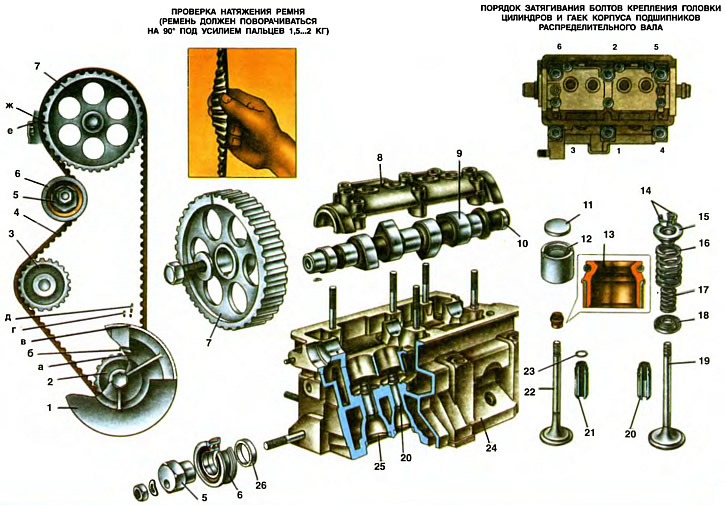
1. Alternator drive pulley. 2. Toothed pulley of camshaft drive. 3. Coolant pump pulley. 4. Toothed belt of camshaft drive. 5. Eccentric shaft of tension roller. 6. Tension roller. 7. Camshaft pulley. 8. Camshaft bearing housing. 9. Camshaft. 10. Eccentric on camshaft for driving fuel pump. 11. Adjusting washer. 12. Valve tappet. 13. Oil deflector cap. 14. Valve cotters. 15. Valve spring plate. 16. Outer valve spring. 17. Inner valve spring. 18. Spring support washer. 19. Inlet valve. 20. Inlet valve guide sleeve. 21. Exhaust valve guide. 22. Exhaust valve. 23. Retaining ring. 24. Cylinder head. 25. Valve seat. 26. Spacer ring.
a - TDC mark of the pistons on the toothed pulley
b - installation mark on the oil pump cover
in — mark in. m t pistons on the generator drive pulley
g - ignition advance mark at 5° on the front timing belt cover
d — ignition advance mark ka 0° on the front cover of the toothed belt
e — installation mark (antenna) on the rear cover of the toothed belt
f — timing mark on the camshaft pulley
Gas distribution mechanism
The valve timing mechanism ensures that the engine cylinders are filled with a fresh charge of combustible mixture and exhaust gases are released in accordance with the requirements of the working process in each of the engine cylinders. This mechanism is characterized by the upper in-line arrangement of the valves.
The camshaft 9, which controls the opening and closing of the valves, is located in the cylinder head 24 and is driven from the crankshaft by an elastic toothed belt 4, which has 111 teeth. The valves 19 and 22 are driven directly by the camshaft cams through cylindrical valve tappets 12, without intermediate levers. In the tappet seat there is an adjusting washer 11, by selecting which the clearance in the valve drive mechanism is adjusted.
The toothed belt also drives pulley 3 of the coolant pump. Tension roller 6 serves to tension the belt. It rotates on the eccentric axis 5 of the tension roller, attached to the stud to the cylinder head through the spacer ring 26. By turning axis 5 relative to the fastening stud, the belt tension is changed. The belt tension is considered normal if in the middle part of the branch between the pulleys of the camshaft and crankshaft the belt is twisted by 90° with a finger force of 1.5...2 kgf. If the force is below the norm, loosen the fastening nut of the tension roller, turn its axis by the hex head by 10...15° counterclockwise and tighten the axis fastening nut. By turning the crankshaft clockwise by the fastening bolt of the generator drive pulley by two turns, check the belt tension. If the tension is insufficient, repeat the belt tensioning operation. The tension roller axle mounting nut is tightened to a torque of 4 kgf·m. Avoid excessive belt tension, as this will significantly reduce its service life.
Since 1989, instead of a toothed belt with semicircular teeth, a belt with grooves on the tops of the teeth has been used (trapezoidal teeth). The profile of the grooves on the toothed pulleys has changed accordingly. These belts are completely interchangeable, i.e. a belt with grooves on the teeth can be installed on pulleys with semicircular grooves and vice versa.
Since 1996, a tension roller 6 with a plastic rim has been installed. Moreover, it is installed without the axis 5 directly on the stud, and the distance ring has other dimensions (outer diameter 28 mm, inner - 10.1 mm and thickness 7±1 mm). When adjusting the belt tension, the roller is turned with a special key with two pins that enter two holes on the inner ring of the roller.
Pulley 7 of the camshaft drive and pulley 3 of the coolant pump are made by pressing from metal ceramics. Toothed pulley 2 of the camshaft drive (leading) has 21 teeth, is fastened with a key on the front end of the crankshaft. Pulley 7 of the camshaft (driven) has 42 teeth, is installed on a key on the front end of the camshaft and is secured with a bolt and washer.
Due to a certain orientation of the keyways in the leading 2 and driven 7 pulleys relative to the teeth and their corresponding engagement with the toothed belt, the required valve timing is ensured. The correct mutual arrangement of the drive pulleys is checked as follows: the crankshaft is turned clockwise to a position in which the piston of the first cylinder is at TDC of the compression stroke (both valves are closed, and the TDC mark of the pistons on pulley 1 of the crankshaft generator drive is aligned with the mark "b" on the oil pump cover). In this case, the mark "zh" should coincide with the mark "e" on the rear cover of the toothed belt, and the mark on the flywheel should be opposite the middle division of the scale on the holder of the rear crankshaft oil seal (see chapter 9).
If the marks do not match, then loosen the belt with a tension roller, remove pulley 7 from the camshaft, adjust the position of this pulley, put the belt on the pulley again and slightly tighten it with a tension roller. Again check the coincidence of the installation marks by turning the crankshaft two turns clockwise.
The crankshaft should be turned only with the camshaft drive belt installed and only by the generator drive pulley mounting bolt in the direction of tightening the bolt (clockwise). Do not turn the crankshaft by the camshaft pulley or its mounting bolt.
When placing the camshaft in the bearings of the cylinder head 24, the position of the cams of the camshaft 9 of the first cylinder must correspond to the closed state of both valves, and the crankshaft must be in the TDC position of the compression stroke of the first cylinder (mark a is aligned with mark 6).
When installing the pulley 7, also make sure that the mark "w" on the pulley is located approximately opposite the installation mark "e" on the rear protective cover of the gear belt. The permissible mismatch is not more than two teeth of the pulley, otherwise the valves of the fourth cylinder will rest against the piston. For this reason, it is also forbidden to turn and rotate the camshaft and crankshaft before installing the belt.
Camshaft
The camshaft 9, cast from cast iron, has three bearing journals with a diameter of 24.931...24.915 mm, which rotate in the seats. Made in the cylinder head 24 and the housing 8 of the camshaft bearings. The holes for the camshaft supports with a diameter of 25.000...25.025 mm are machined in the cylinder head assembled with the housing of the camshaft bearings, which ensures high accuracy, the correct geometric shape of the holes and their alignment. There is an eccentric 10 of the fuel pump drive on the camshaft. The rear end of the camshaft has a groove for connection with the spark timing sensor of the engine ignition system.
The camshaft is held from axial movements by a thrust flange of the shaft, located between the end of the rear support of the shaft and the housing of the auxiliary units. A gap of 0.15...0.53 mm between the thrust flange of the shaft in the rear bearing seat and the end of the seating belt of the housing of the auxiliary units, determined by the difference in the thickness of the flange and the depth of the groove in the rear support covered by the housing, ensures free rotation of the shaft.
To increase wear resistance, the working surfaces of the cams of the eccentric and the surface of the camshaft journal under the oil seal are bleached. The depth of the bleached layer is not less than 0.2 mm. The hardness of the cams and eccentric is not less than 50 units on the Rockwell C scale (HRC > 50).
Valves
Valves (inlet 19 and outlet 22), serving for periodic opening and closing of the holes of the intake and exhaust channels, are located in the cylinder head at an angle in one row. The head of the intake valve has a larger diameter for better filling of the cylinder, and the working chamfer of the exhaust valve, operating at high temperatures in an aggressive environment of exhaust gases, has a surfacing of heat-resistant alloy. In addition, the exhaust valve is made of composite: the rod is made of chromium-nickel-molybdenum steel with better wear resistance to friction and thermal conductivity for heat removal from the valve head to its guide sleeve, and the head is made of heat-resistant chromium-nickel-manganese steel. The intake valve is made of chromium-silicon steel.
The diameter of the valve stems is 7.985...8.00 mm, the working chamfer angle is 45°30'.
The outer diameter of the inlet valve head is 35 mm (37 mm for engine 11113), and the exhaust one is 31.5 mm.
Guide bushings
The guide bushings of the inlet 20 and outlet 21 valves are made of cast iron, pressed into the head with an interference fit of 0.063...0.108 mm and are held against possible falling out by retaining rings 23. The holes in the bushings are finally machined together with the cylinder head, which ensures a small tolerance on the diameter of the hole and the accuracy of its location in relation to the working chamfers of the seat and valve.
The guide bushings have spiral grooves for lubrication in their bores. The 20 inlet valve bushings have grooves cut to half the bore length, and the 21 outlet valve bushings have grooves cut along the entire bore length.
The outer diameter of the bushings is 14.040...14.058 mm, the inner diameter is 8.022...8.040 mm for the intake valve bushing and 8.029...8.047 for the exhaust valve bushing.
On top of the guide bushings, oil-deflecting caps 13 made of fluororubber with a steel reinforcement ring are placed, which cover the valve stem and serve to reduce the penetration of oil into the combustion chamber through the gaps between the guide bushing and the valve stem.
Springs
Springs (outer 16 and inner 17) press the valve to the seat and do not allow the valve tappet to come off the drive. The lower ends of the springs rest on the support washer 18 of the springs. The upper support plate 15 of the valve springs is held on the valve stem by two crackers 14 of the valve, which have the shape of a truncated cone when folded. The crackers have three internal flanges that fit into the corresponding grooves on the valve stems. This design ensures both a reliable connection and the ability to rotate the valves during operation, due to which they wear more evenly.
Pushers
The tappets 12 valves are designed to transmit force from the camshaft cams to the valves. The tappets are made in the form of cylindrical cups with a diameter of 35.275...35.295 mm and are placed in the guide sockets of the cylinder head with a gap of 0.025...0.070 mm. An adjusting washer 11 of a certain thickness is placed in the end recess of the tappet, providing the necessary gap between the camshaft cam and the tappet with the washer. Washers 11 are made of 20X steel and subjected to nitrocarburization, which provides a surface hardness of 58 units on the Rockwell C scale (58 HRC).
When the engine is running, due to the displacement of the contact zone with the cams by 1 mm relative to the axis, the tappets rotate around their axes, which ensures uniform wear along the outer diameter.