
- remove the rear wheels and disconnect the propeller shaft from the main gear drive flange;
- disconnect the hydraulic brake hose from the steel tube mounted on the bridge, and take measures to prevent leakage of fluid from the brake system (for example, put screw plugs);
- disconnect the parking brake rear cable bracket from the body, remove the front cable release spring and, by unscrewing the lock nut and adjusting nut, release the rear branch of the cable;
- disconnect the pressure regulator drive rod from the bracket on the bridge beam and disconnect the upper ends of the shock absorbers;
- placing a hydraulic jack under the beam, disconnect the longitudinal and transverse rods from the brackets on the body and, lowering the jack, remove the bridge. Then, shock absorbers and longitudinal and transverse rods are disconnected from the brackets of the rear axle beam.
The installation of the rear wheel suspension is carried out in the reverse order of removal. In this case, springs of the same group should be installed on the suspension, then on the front suspension. In exceptional cases, when group A springs are installed on the front suspension (with yellow marking), and for the rear suspension there is no such group of springs, it is allowed to install group B springs on the rear suspension (with green marking).
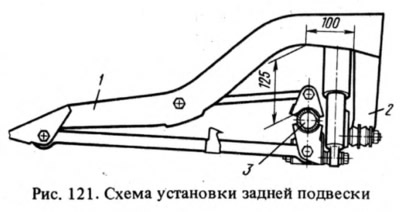
To correctly tighten the elastic bushings of the hinges of the rods and shock absorbers, load the rear of the car so that the distance from the beam 3 to the side member 1, measured in 100 mm from the bracket 2 of the transverse rod (pic. 121), was 125 mm. After that, tighten, with a torque wrench, the nuts on the bolts for attaching the longitudinal and transverse rods, as well as on the fingers for attaching the shock absorbers to the axle beam and to the body.