




The fenders of the car are in the same position as the bottom. Moreover, the fenders also have pockets where dirt and moisture collect and accumulate. Even a new car needs to have its wheels removed before use and the quality of the bitumen mastic applied to the inner surface of the fenders, especially where the headlights are located, must be carefully inspected. It happens that the factory makes a mistake and such a fender becomes a victim of corrosion.
No less vulnerable are the internal cavities of the thresholds, bases of the central pillars, and side members. Although they are processed at the factory, the probability of defects is not excluded.
The thresholds find themselves in a particularly difficult situation if the drainage holes intended to drain water that has penetrated the thresholds are clogged.
Applying additional anti-corrosion protection to a newly purchased car is not a difficult task. You only need the material and the tool for applying it. It is much more difficult to perform this operation on a car that has already been used. Here, the lion's share of time and physical effort should be spent on preparing the surface. There is no point in postponing this dirty, labor-intensive, inconvenient and responsible operation for later. Start treating the car, having prepared a metal brush, a wooden scraper, sandpaper, a brush, white spirit, a rust converter, anti-corrosion mastic and a rag.
When starting work, remember that the work and money will not be wasted only if the surface is well prepared. It should be free of dirt, old destroyed coating, and all kinds of fats. Only on a clean, degreased surface will the adhesion of the mastic to the metal be reliable. It is best to thoroughly wash the surfaces being prepared with a powerful stream of water under pressure. Having gotten rid of the dirt, you will be able to see the condition of the old coating. If it has started to peel off, it should be removed with a metal brush and scraper. A metal brush is a reliable tool for cleaning loose and layered rust. After completing the rough work, the surfaces cleaned with sandpaper are degreased with white spirit. Chemists have invented one very effective composition - a rust converter. In a short time, such a composition, applied to a rusty surface, will work a small miracle. The reddish deposits will turn greyish, and the rust itself will transform into a more stable and harmless compound. The surfaces treated with the converter are ready for applying anti-corrosion materials to them. Depending on their viscosity, mastics and pastes can be applied with a brush, spatula or hand in a glove. The main condition is that there should be no bare spots.
Prepare materials and tools
Bitumen mastics are the most technologically advanced for manual application. They resist moisture and salt well, but are not resistant enough to sand and gravel, and also have low frost resistance. At low temperatures, the coating becomes brittle and a stone blow is enough for the mastic to start crumbling. Wax compounds are often used for short-term protection of the bottom and fenders. They have their advantages and disadvantages. Thus, they penetrate well and fill pores, cracks, flanges and pockets, but they do not withstand impacts. After thinking about it, inventive car enthusiasts decided to apply wax compounds over bitumen ones, which ensured their lesser brittleness at low temperatures.
As noted above, all parts with a box-shaped cross-section are particularly susceptible to corrosion. And this is no accident. Cavities are always damp due to insufficient ventilation. Water and dirt will find their way into the gaps between the welding points, and if we consider that it is not always possible to properly treat these cavities with anti-corrosion materials, it will become clear why these places are particularly susceptible to corrosion. Until the 1950s, hidden cavities were practically not treated. Only the significant thickness of the metal saved them. The so-called ML method of combating corrosion (from the first letters of the name of the company "Motorman Laurin"), discovered in Sweden, made it possible to consciously control the process of aging and wear of box-shaped structures. Naturally, the new method required appropriate materials that could be delivered to hidden cavities and sprayed in an even thin layer over the entire surface. Special equipment was also required to ensure the delivery and spraying of materials.
Domestic preparations developed specifically for application to hidden cavities include "Movil" and "Rezistin-ML". The preparations are interesting in that they can be applied to surfaces previously coated with liquid oil and affected by corrosion. This is important, since it is not always possible to clean the inner surfaces of box-shaped structures from old coatings.
Considering that Movil and Rezistin-ML are the only domestic preparations that provide a noticeable effect in protecting hidden cavities from corrosion, they are used both at the plant and at service stations, and by car owners.
Individual owners have to solve serious problems, primarily related to the lack of equipment for applying the preparation. In order to somewhat ease the task for those who, having no other option, decided to treat the bodywork themselves, we recommend using the experience already accumulated in this area. The necessary equipment for this is very simple, operating on the basis of air spraying under a pressure of 400-600 kPa, quite sufficient for spraying the preparations.
One of the simplest designs is shown in Fig. 2. A Moscow car enthusiast used a nozzle from a regular cologne sprayer 4, drilling out the rot by 1.2 mm in the tip 9. He soldered a brass tube 7 to the inner wall of the tube 8, through which the preservative is supplied. Pump 1 (it can be more powerful) hose 2 is connected to tube 8, and hose 2 is connected to sprayer 4. To supply the preservative, polyvinyl chloride tube 5 is used in tube 7, lowered into vessel 6.
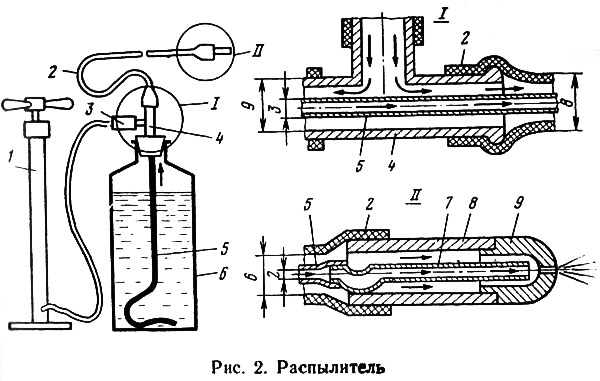
A sprayer of this design provides a torch of sprayed Movil with a diameter of up to 0.2 m with a constant air supply.
Prepare the body
To ensure that the sprayer reaches the required area:
- remove the rubber seals under the front fenders, headlight bezels and the headlights themselves (for car models VAZ-21013 and VAZ-2102);
- open the trunk and remove the spare wheel, jack and mat for the VAZ-21013 and the trunk trim for the VAZ-2103, VAZ-2107 and VAZ-2106;
- open the rear door of the station wagon (VAZ-2102) and remove the trunk mat, side trim, spare wheel cover and the spare wheel itself;
- remove the front door open alarm lights from VAZ-2103 and -2106 vehicles and the reversing light from VAZ-2103 vehicles.
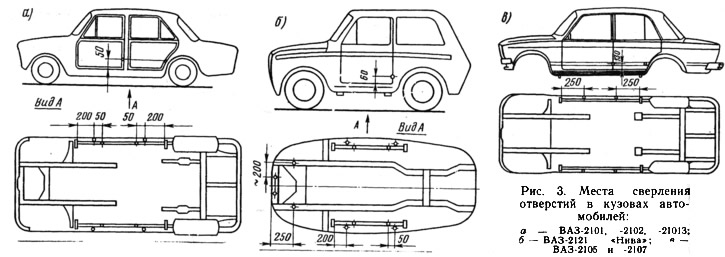
Of course, it is difficult to raise a hand to your own car, but the technology requires it. Armed with an electric drill, drill (Fig. 3) holes with a diameter of 9 mm in the inner and outer thresholds, and for the models VAZ-21013, VAZ-2102, VAZ-2121 and VAZ-2105 also at the ends of the front and rear doors.
The places where the anti-corrosion material is applied under the hood and in the luggage compartment at service stations are washed with water before the procedure of applying the anti-corrosion material. At home, where drying opportunities are limited, washing can be replaced by thorough wiping with a damp cloth. The most convenient way to process the body is on a lift. At home, everyone arranges as much as their ingenuity allows. Only one thing is clear: the majority of the processed points are located in the bottom area.
To get inside the thresholds, to the spare wheel niche and the crossbar under the front seats, it is necessary to remove special rubber plugs, located two pieces on each side under the front wing, one piece on each side in the rear wheel arch, in the center of the recess under the spare wheel, one piece on each side in the crossbar under the front seats. You should also clean the drainage holes of the thresholds.
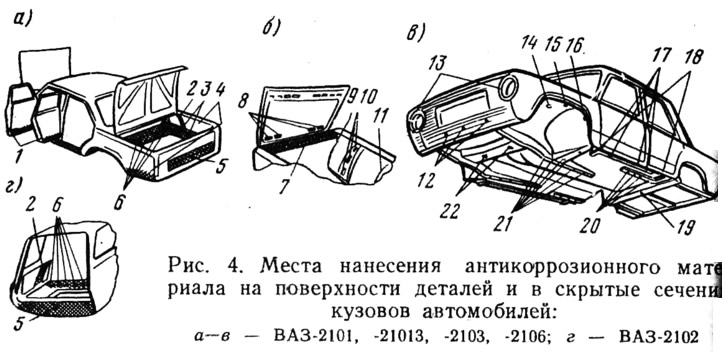
Although it is difficult to dry a car in a garage, the bottom, wheel arches and hard-to-reach hidden cavities must still be thoroughly washed under pressure, otherwise all the work done will be a waste of time. It is good if you have compressed air at hand. With its help, you can dry the washed areas of the body much faster. To keep the wheels out of the way, it is advisable to remove them, placing the car on supports, and wrap the disks, brake drums, rear axle, cardan shafts and gearbox in paper. All that remains is to open the doors, hood, trunk lid and you can begin processing. The preparation must be applied to hidden cavities and to the surfaces of body parts of VAZ-2101, -21013, -2102, -2103, -2106 cars (Fig. 4) in the following sequence.
(The article is copied from the website: vazbook.ru)
First in the cavity: 1 door; 2 between the rear fenders and wheel arches; 3 rear side members; 5 and 6 rear crossbars; 7 and 12 front crossbars; 10 stock mudguards; 17 rapids; 19 crossbars between the rear wheel arches; 20 rear side members; 21 front side members; 22 — front suspension cross members.
Then: into recesses 4 under the fuel tank and spare wheel; in the hood pockets 8; in the places where panel 9 and shield 11 are connected to the sides of the front wings; in niches 13 headlights; in brackets 14 front suspension buffers in junction box 15; in pockets 16 front wings; into brackets 18 under the jack.
To make the work easier for the owners of the VAZ-2121 "Niva", we will remind them of the order of operations for preparing and applying anti-corrosion material on this car. The following are removed from the car: the radiator grille, headlight rims and the headlights themselves, the upholstery of the rear fenders, the shields covering the pockets of the front fenders, two rubber plugs in the crossmember between the arches of the rear wheels from the bottom side and two plugs in the lower rear crossmember. The cavities of the side members, crossmembers and thresholds are washed with a stream of water under pressure.
It is necessary to wash until clean water starts to flow out of numerous drilled holes. Drying of cavities is obligatory. Compressed air is a good assistant in this matter. Anti-corrosion material is applied to body parts and into hidden sections of the VAZ-2121 "Niva" car (Fig. 5) in the following sequence.
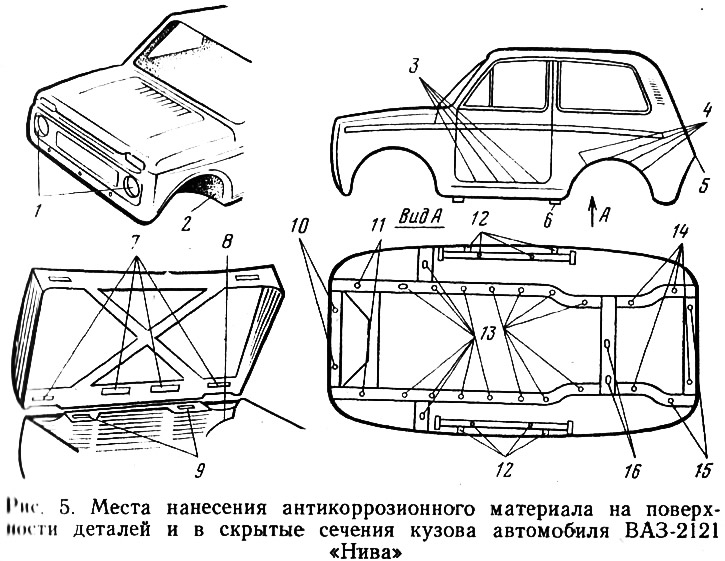
First in the cavity: 3 doors; 4 rear wheel arches; 5 Upper cross members of the rear body panel; 9 Front crossmember tops; 10 lower front and cross body; 11 front side members; 12 thresholds; 13 longitudinal members of the body floor and their reinforcements; 14 rear side members; 15 lower rear cross member; 16 crossbars between the rear wheel arches.
Then: into the niches of 1 headlights; in the pockets of the 2 front wings; in brackets 6 under the jack; in pockets 7 hood; and the joints of the 8th panel with the sides of the front wings.
To apply anti-corrosion material to cars VAZ-2105 and VAZ-2107 necessary:
- remove all parts that interfere with access to the cavities being processed, i.e. the shields under the front wings, the spare wheel, the trunk mat, the side linings. To perform these preparatory operations, you will need a 10 mm socket wrench, pliers, and a screwdriver;
- close the oval openings of the thresholds at the base of the front pillars with some plugs, otherwise, when washing the cavities subject to anti-corrosion treatment, water will get inside the body interior;
- wash all areas where the anti-corrosion coating was applied with a jet of water under pressure, but first: remove the rubber plugs in the rear wheel arch (one on each side), in the beam connecting the rear wheel arches, in the crossbar under the front seat (one on each side), in the recess under the spare tire; clean drainage holes in side members, sills and doors; blow out all cavities and areas to be treated with compressed air; dry all washed areas before processing; apply the anti-corrosion material, following Fig. 6 in the following sequence.
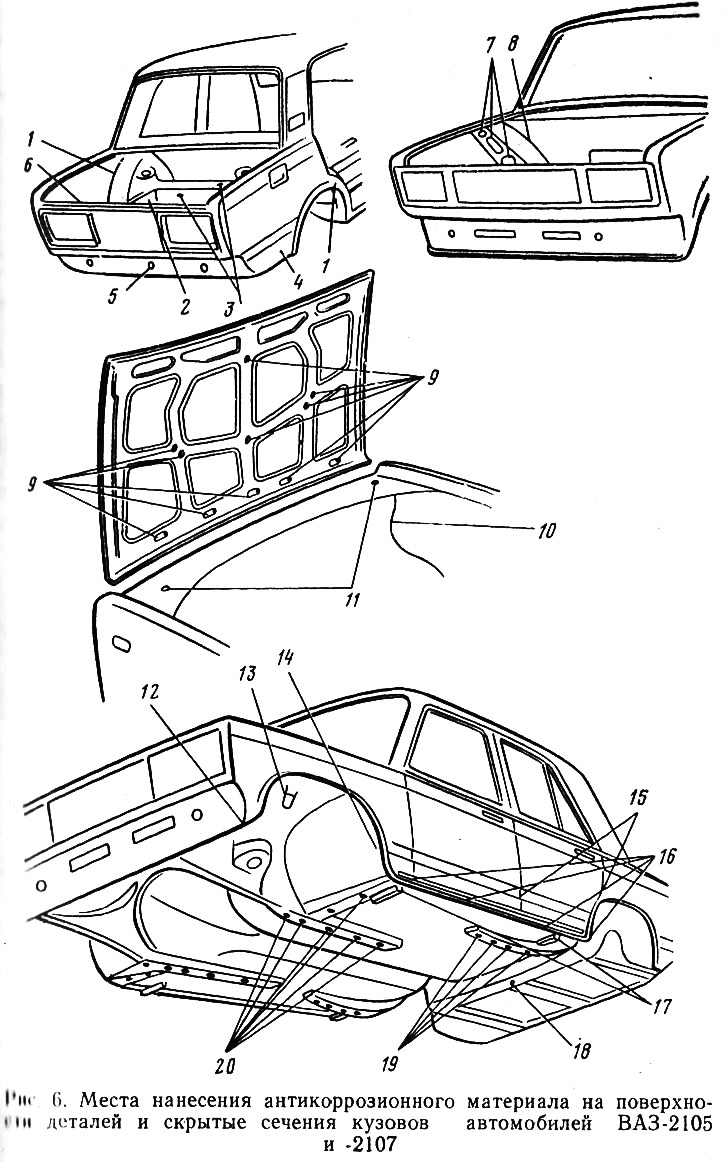
First in the cavity: 1 between the rear wing and the wheel arch; 2 rear side members; 3 rear floor crossbars; 5 lower rear cross member; 7 mudguard posts; 11 upper front cross member; 12 lower front cross member; 15 doors; 16 thresholds; 18 crossbars between the rear wheel arches; 19 rear side members; 20 front side members and their reinforcements.
Then: into recess 4 under the fuel tank; in recess 6 under the spare wheel; in the connection 8 of the front shield with the side of the wing; in pockets 9 hood; in the connection of 10 front panel with the side of the wing; in brackets 13 front suspension buffers; in pockets 14 front fenders; into the jack bracket 17.
After finishing the bodywork, it is necessary to remove traces of anti-corrosion material using a swab soaked in white spirit or kerosene, and then install all dismantled parts in place.
It should be noted that many experienced car enthusiasts often show completely unjustified conservatism when choosing an anti-corrosion material for their car. They forget that when creating a particular material, such a factor as compatibility is also taken into account. Often, especially in port cities, you can see that thresholds, wheel arches, and the bottom of cars are treated with such a common material as red lead. Practice shows that red lead in this case causes peeling of the coating or accelerated development of under-film corrosion, therefore, when choosing a non-standard anti-corrosion material, it is advisable to consult with specialists.
To finish with the body and start servicing the engine and other units of the car, you should pay attention to the glass, decorative parts and upholstery. Almost every new model of VAZ cars improves the quality characteristics of the glass or increases the glazing area. Improving the quality of glass and improving the technology of its manufacture improves the optical properties. But no matter how perfect the glass is, transparency, and therefore visibility, depend primarily on its condition. The highest quality glass can be ruined if you do not know how to handle it.
It has long been known that the more complex and expensive an item is, the more attention it requires. The windshield of VAZ cars (and the rear window on cars VAZ-2105, VAZ-2106 and VAZ-2107) complex in design, expensive and absolutely not protected from environmental influences. Dirt, oil, fat, resin residues, particles of silicone and wax products, insects, various vapors and gases - all this gets on the surface of the glass and leaves traces there. These traces are especially visible when the car is moving at night and cause a lot of trouble for the driver. In order to wash the glass from so many different sources of dirt, detergents must have truly universal properties. They must wash the glass from almost everything, must not damage the shine and optical properties and must not interact with metal, paints and varnishes and rubber.
For those car enthusiasts who appreciate clean, high-quality glass, we strongly recommend that you always have "Auto Glass Cleaner" in your car. After wetting the glass, as well as the headlights and radiator trim, any dirt can be washed off with clean water in 1-2 minutes.
If your car seats are covered with covers, this does not mean that they are reliably protected from dust and dirt. The upholstery of the seats, doors, ceiling, dashboard - all these are synthetic materials, leatherette and films. Over time, they age, lose elasticity, fade. Such aging is natural, and it is difficult to fight it. But it is possible to fight dirt, oil and other contaminants that contribute to the aging and destruction of the upholstery.
Summing up the preventive work on the body, it should be emphasized that the body is the basis of the car, it is 50% of its cost, it is the main object of the owner's concerns.