




Contents: Wiper ↓ Windshield washer ↓ Windscreen wiper motors ↓ Windscreen wiper relay ↓ Windshield wiper operation ↓ Windscreen Washer Pumps ↓
Open large image in new tab »
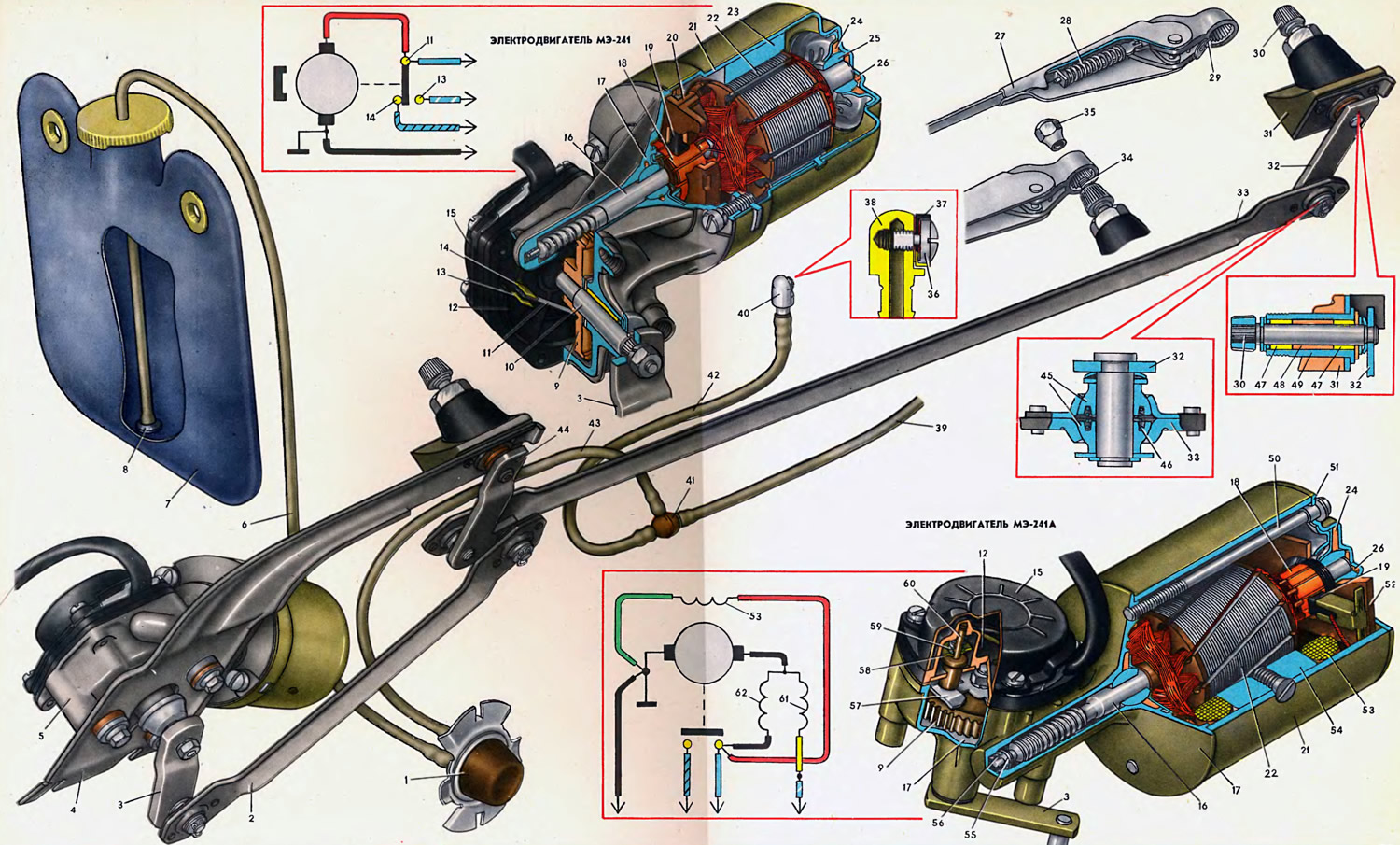
1. Windshield washer pump. 2. Connecting rod. 3. Crank. 4. Bracket. 5. Electric motor. 8. Tube from reservoir to pump. 7. Windshield washer reservoir. 8. Filter. 9. Gearbox pinion. 10. Gear shaft. 11. Spring plate. 12. Panel. 13, 14. Contact posts. 15. Cover. 16. Armature shaft. 17. Gearbox housing cover. 18. Collector. 19. Brush. 20. Brush holder. 21. Housing. 22. Armature core. 23. Permanent magnet. 24. Felt ring. 25. Bushing. 26. Thrust bearing. 27. Windscreen wiper arm SL-191A. 28. Lever spring. 29. Lever mounting spring. 30. Windscreen wiper arm shaft SL-191A. 31. Inner equalizer. 32. Arm. 33. Intermediate rod. 34. Windscreen wiper arm shaft SL-191B. 35. Lever mounting nut. 36. Jet mounting screw. 37. Sprayer. 38. Jet housing. 39. Tube from tee to right jet. 40. Left jet. 41. Tee. 42. Tube from tee to left jet. 43. Tube from pump to tee. 44. Arm. 45. Inserts. 46. Spacer spring. 47. Bushings. 48. Felt. 49. Driver bracket. 50. Tightening screw. 51. Rear cover. 52. Crossmember. 53. Stator winding shunt coil. 54. Stator pole. 55. Front thrust bearing. 56. Thrust bearing spring. 57. Cam. 58. Contact disk. 59. Pusher spring. 60. Pusher. 61. Stator winding brake coil. 62. Stator winding series coil.
Wiper
On VAZ-2101 and VAZ-2102 cars, the SL-191A and SL-191B windshield wipers are used, which have different attachments for the wiper arms. On the SL-191A, they are attached with a spring plate 29, and on the SL-191B, with a nut 35. The SL-191A windshield wipers use an ME-241 electric motor, and on the SL-191B, an ME-241 or ME-241A electric motor.
The VAZ-2103 cars use SL-193 windshield wipers. They differ from the VAZ-2101 windshield wipers in the profile of the equalizers 31, the brush levers and the brushes themselves. These windshield wipers are equipped with ME-241 electric motors.
The windscreen wipers are installed under the hood in the air intake box. The lower part of the bracket 4 with the electric motor is attached with two studs to the bracket on the bottom of the box, and the upper part of the bracket and the bracket 49 of the leash are attached to the panel of the windshield frame using plastic spacer equalizer bushings, between which the panel is clamped after tightening the nut.
The rotation of the crank 3 by the rod 2 is converted into the swinging of the rods 44 and 32, connected by the rod 33. The frequency of the swinging of the levers is 50-70 double strokes per minute. The axes of the rods rotate each in two metal-ceramic bushings 47, separated by a felt insert 48. The bushings and felt are impregnated with oil. Rods 2 and 33 are connected to the rods and the crank by spherical hinges, in which there are two hemispherical metal-ceramic inserts 45, impregnated with oil, which also fills the space between the inserts. The inserts are unclenched by spring 46. The levers of the brushes have springs 28, by which the brushes are pressed against the glass.
Windshield washer
The windshield washer consists of a supply tank 7, a pressure pump 1, two spray nozzles and connecting plastic tubes with a tee. The tank is installed in the engine compartment and is attached to the left wheel mudguard with two hooks. The nozzles are installed in the openings of the windshield frame panel using elastic plastic bushings placed on the nozzle body.
The tank is welded from two sheets of PVC film, to which a plastic neck is welded, and has two ears in the upper part for hanging the tank on hooks. The holes in the ears are reinforced with a metal edging. The capacity of the tank of the VAZ-2101 car is 0.75 l, and of the VAZ-2103 car - 1 l. Liquid from the tank through a mesh filter 8, which is located at the end of tube 6, is sucked in by the pump, fed to the jets and through the slots in the sprayers 37 is sprayed onto the glass.
The jets consist of a body 38 and a sprayer 37 with a fastening screw 36 and gaskets. The direction of the washing stream is adjusted by turning the body of the jet in the plastic sleeve and turning the sprayer 37 after loosening the fastening screw 36.
The original is available on the online resource VAZBOOK.RU
Windscreen wiper motors
Technical specifications:
- Nominal voltage, V — 12
- Maximum effective torque on the gearbox shaft*, kgf·m — 0.20 (0.19**)
- Current consumption at a torque of 0.10 kgf·m*, A — ≤2.8 (3.5**)
- Speed of rotation of the gearbox shaft at a torque of 0.10 kgf·m*, rpm — ≥50 (52**)
* At 14V and 25°C
** For electric motor ME-241A.
Windscreen wipers use two-brush, two-pole direct current electric motors ME-241 with excitation from permanent magnets or ME-241 A with electromagnetic excitation. A worm gear is combined into one unit with the electric motor.
The ME-241 electric motor has a stamped steel housing 21, inside which two permanent magnets 23 are secured with spring holders, forming a stator together with the housing. The steel shaft 16 of the anchor has a longitudinal knurling on the middle part, and a single-thread worm on the front end. The core 22, assembled from plates of electrical steel, is pressed onto the knurled part of the shaft. The wave winding of the anchor is laid in the grooves of the core, insulated with cardboard, the terminals of the sections of which are soldered to the copper plates of the collector 18. The collector, having a plastic base, is pressed onto the shaft from the worm side. The anchor shaft rotates in two metal-ceramic bushings secured with steel collars, one in the housing, and the other in the cover 17. The outer surface of the bushings is spherical. Felt rings 24 impregnated with oil are placed around the bushings. The axial force acting on the anchor shaft from the worm gear is perceived by a textolite thrust bearing 26, against which the rear end of the shaft rests. The electric motor housing is closed by a cover 17, which is also the gearbox housing. The cover is cast from an aluminum alloy and is fastened to the housing with two screws. A plastic brush holder 20 with two brushes is riveted to the cover on the inside, and a plastic brush holder 22 with two brushes is riveted to the outside (in the gearbox housing) there is a plastic worm gear 9 with a cam. The gear is pressed onto the axle 10. The other end of the axle has a conical knurled surface onto which the crank 3 is put on and secured with a nut. The axle rotates in a metal-ceramic bushing pressed into the cover 17.
The gear ratio of the reducer is 51:1. The reducer housing is closed with a plastic panel 12 and a cover 15. A sealing gasket is installed between the panel and the housing. In the panel there are contact posts to which wires are soldered and a spring plate with contacts of the switch is attached, which ensures stopping the electric motor at the moment when the brushes are in the lower position. The contacts of the spring plate are pressed against the post 14 connected to the power source. When the projection of the gear cam is against the plate, it presses it away from the post 14 and presses it against the post 13 connected to the ground.
The ME-241A electric motor has a number of features associated with the use of electromagnetic excitation. Inside the housing, two steel poles 54 with stator winding coils are fixed with screws. The excitation of the electric motor is mixed, so one coil (62 series) connected in series with the armature winding, and the other (53 shunt) — parallel to it. In addition, there is another coil — the brake coil 61, located together with the series coil on one pole. It is switched on only when the electric motor is switched off, creates a magnetic flux directed towards the flux of the series coil, and thus ensures a quick stop of the anchor. The anchor grooves are spiral, and the collector is located on the side of the rear cover. Axial movement of the anchor shaft is eliminated using a nylon thrust bearing 55 with a spring 56.
The anchor worm is a two-way worm, and the gear ratio of the gearbox is 34:1. The crank is riveted to the pinion shaft, and the torque from the pinion to the shaft is transmitted through a stamped steel cam 57.
The electric motor switch consists of a pusher 60 with a contact disk 58 and a spring 59 and two contacts riveted to the panel 12. The contact disk is pressed against the contacts by a spring and closes them. When the cam presses the pusher, the contact disk moves away and opens the contacts.
Windscreen wiper relay
On Zhiguli cars, to achieve intermittent operation of the windshield wiper, a relay of the RS-514 type is used, installed under the instrument panel on the left side.
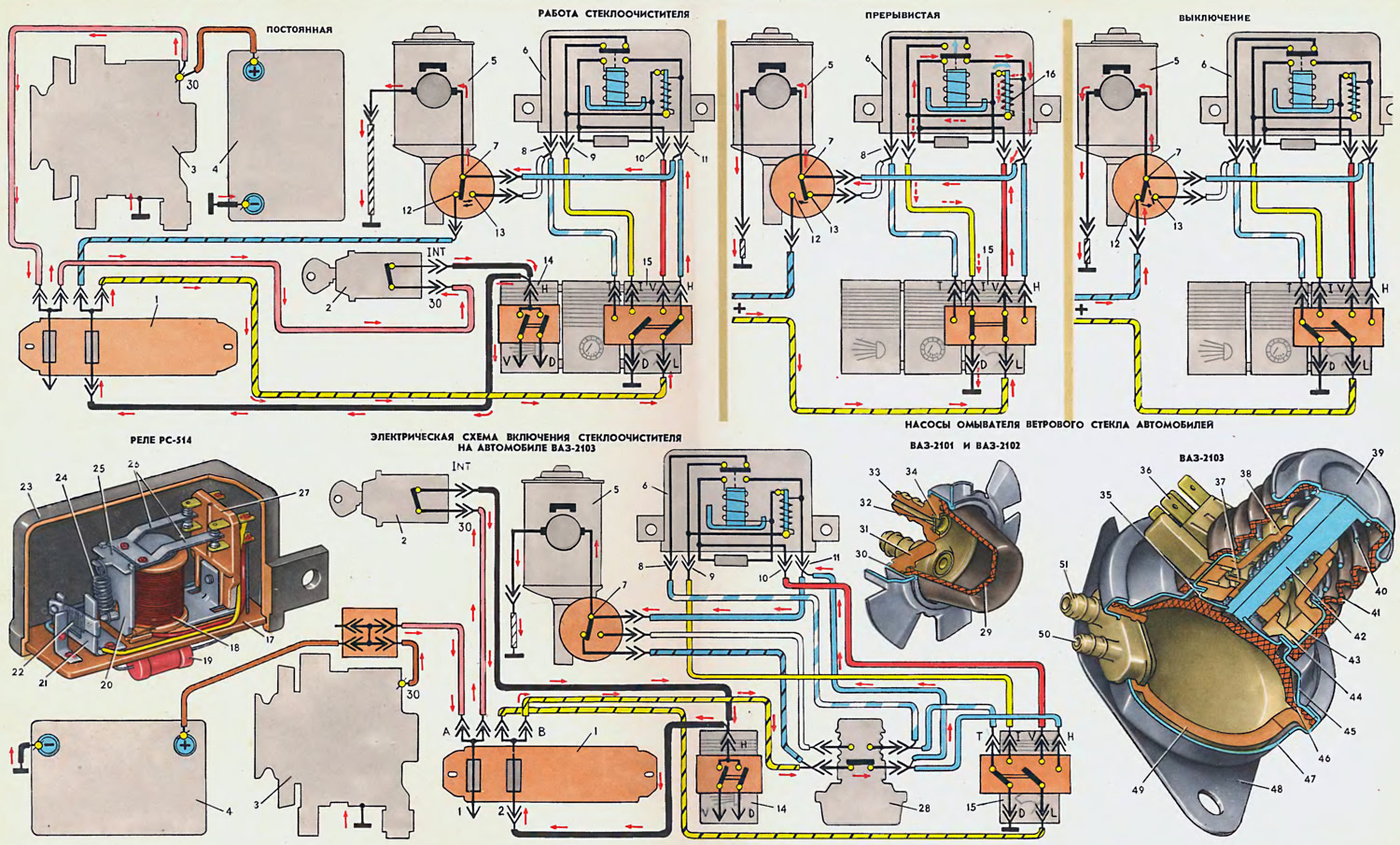
The relay has an elastic plastic casing 23 and a getinax base 17, to which the core with the yoke 20 of the electromagnet is riveted. On the core in a plastic frame is a winding 18. On one side of the yoke a plastic support 27 with two pairs of fixed contacts is attached with a screw, and on the other side an anchor 25 swings on the yoke. A current-carrying plate 26 is riveted to the anchor, closing the upper or lower pair of contacts. When the anchor is attracted to the core, the upper pair of contacts opens and the lower one closes.
Bracket 21 of the breaker with bimetallic plate 22 is also riveted to base 17. Nichrome wire is wound on the plate over an insulating gasket made of asbestos paper. When current passes through it, it heats up, the plate bends and the breaker contacts open. After cooling, the plate returns to its previous position and the breaker contacts close.
When the breaker contacts open, a self-induction EMF arises in the electromagnet winding, which tends to maintain the disappearing current and causes sparking between the open breaker contacts.
To eliminate sparking and, consequently, burning of the breaker contacts, an additional resistor 19 with a resistance value of 100 Ohm is connected in parallel to the winding, through which the self-induction current is closed.
Windshield wiper operation
Open large image in new tab »
1. Fuse box. 2. Ignition switch. 3. Generator. 4. Battery. 5. Windscreen wiper motor. 6. Windscreen wiper relay. 7. Windscreen wiper motor switch contact. 8-11. Windscreen wiper relay plugs. 12, 13. Windscreen wiper motor switch contacts. 14. Outside lighting switch. 15. Windscreen wiper switch. 16. Breaker. 17. Base. 18. Electromagnet winding. 19. Resistor. 20. Yoke. 21. Breaker bracket. 22. Bimetallic strip. 23. Casing. 24. Armature spring. 25. Anchor. 26. Conductor plate. 27. Contact support. 28. Windscreen washer pump. 29. Cap. 30. Sleeve. 31. Housing. 32. Inlet valve. 33. Inlet fitting. 34. Valve sleeve. 35. Plate. 36. Switch plugs. 37. Holder of moving contacts. 38. Rod guide. 39. Button. 40. Return spring. 41. Cover. 42. Rod. 43. Block with contacts. 44. Holder guide. 45. Cover. 46. Diaphragm. 47. Casing. 48. Pump mounting plate. 49. Housing. 50. Outlet fitting. 51. Inlet fitting.
The diagram shows the operation of the windshield wiper of VAZ-2101 and VAZ-2102 cars in different positions of the switch key.
Continuous operation of the windshield wiper is achieved when the button is fully pressed. Current comes from the "+" terminal of the battery or terminal "30" of the generator and closes along the following path: terminal "30" of the generator - plugs "A" of the fuse box - contacts "30" and "INT" of the ignition switch - plug "H" of the exterior lighting switch - plugs "2" and "B" of the fuse box - plugs "L" and "H" of the windshield wiper switch - plug 11 of the windshield wiper relay - contact 7 of the electric motor switch - armature winding of the electric motor - ground.
The electric motor runs at a constant speed and the brushes swing at a frequency of 50-60 cycles per minute.
Intermittent operation of the windshield wiper is achieved by means of the RS-514 relay, which is switched on when the switch 15 key is in the middle position. As in the previous case, the current comes from the generator terminal "30" and flows along the same path to the "L" plug of the switch 15. Then the current path is as follows: plug "V" of the switch 15 - plug 10 of the relay - the electromagnet winding and in parallel through the additional resistor - the contacts of the breaker 16 - the bimetallic plate of the breaker - plug 9 of the relay - plugs "I" and "D" of the switch 15 - ground.
The current flowing through the relay electromagnet winding causes the anchor to be attracted to the core and the lower relay contacts close. Current begins to flow through them, feeding the electric motor anchor winding.
At the same time, current flows through the winding of breaker 16. This current heats up the winding of the breaker. The bimetallic plate bends from heating and the breaker contacts open, disconnecting the power supply to the electromagnet winding. The relay anchor returns to its original position. The lower relay contacts open, and the upper ones close, connecting contact 13 of the electric motor switch to ground. The electric motor stops.
Since the current no longer flows through the breaker winding, it cools down together with the bimetallic plate. The plate takes its previous shape and the breaker contacts close, turning on the power supply to the electromagnet winding. The described cycle is repeated again with a frequency of 9-17 times per minute.
During one cycle, the brushes make one double stroke and stop in the lower position. At the initial moment of switching on the windshield wiper for intermittent operation (while the bimetallic plate of the breaker has not yet heated up) the brushes can make up to four continuous double strokes.
The windshield wiper is switched off after the switch key 15 is moved to its initial position. In this case, the current is supplied to the armature winding of the electric motor from the plug "B" of the fuse block through the closed contacts 12 and 7 of the electric motor switch. At the moment when the windshield wiper blades reach the lower position, the projection of the cam of the worm gear of the reducer will open contacts 7 and 12 and switch off the power supply to the armature winding. The armature of the electric motor will stop and the windshield wiper blades will remain in the lower position.
On the VAZ-2103 car, the windshield wiper can be switched on by pressing the windshield washer pump pedal. In this case, the current flows along the following path: clamp "30" of the generator - plugs "A" of the fuse box - contacts "30" and "INT" of the ignition switch - plug "H" of the switch 14 of the external lighting - plugs "2" and "B" of the fuse box - lower closed contacts of the switch in the windshield washer pump 28 - plug 11 of the relay - contact 7, armature winding of the electric motor 5 - ground. The windshield wiper electric motor operates while the pump pedal is pressed. After releasing the pedal, the lower contacts of the pump switch open, disconnecting the power supply to the armature winding, and the armature of the electric motor stops.
Windscreen Washer Pumps
On VAZ-2101 and VAZ-2102 vehicles, the washer pump is installed on the left side of the instrument panel and is held on it by the flange of the 30 clamp.
The pump has a plastic housing 31 with two connections for supplying and draining liquid and two valves - inlet and outlet. The outlet connection protrudes from the housing further than the inlet (33). The pump valves are plate rubber. They are held in their seats by brass bushings 34 pressed into the housing. The housing together with the rubber cap 29 is rolled in a steel collar 30. Liquid is pumped in by pressing on the cap, and suction occurs by straightening the cap.
On the VAZ-2103 car, the pump is installed on the left side of the front shield. It has a built-in windshield wiper switch. The dimensions of the pump drive parts are calculated so that the windshield wiper is turned on after the liquid from the nozzles splashes onto the glass.
The pump is a foot-operated diaphragm type. The pump body 49 is plastic and has two nipples of different diameters. The nipple 51 of the larger diameter is the inlet. The tube from the washer reservoir is put on it. The valves have the same design as those of the VAZ-2101 car pump. The diaphragm 46 is a cup-shaped rubber one. The body 49 together with the diaphragm and cover 45 is rolled into a steel casing 47, to which the pump mounting plate 48 is welded.
A switch and a pump drive are mounted on cover 45. The drive consists of button 39 with rod 42 welded to it and return spring 40. Plate 35 is riveted to the lower end of the rod, which presses on the diaphragm when button 39 is pressed.
The switch consists of a plastic block 43 with two pairs of contacts. One pair is riveted to the upper part of the block, and the other to the lower part.
The contacts are closed by jumpers riveted to the plastic holder 37. In the normal position of button 39, the upper pair of contacts is closed, and when the button is pressed, the lower pair is closed.