




Open large image in new tab »
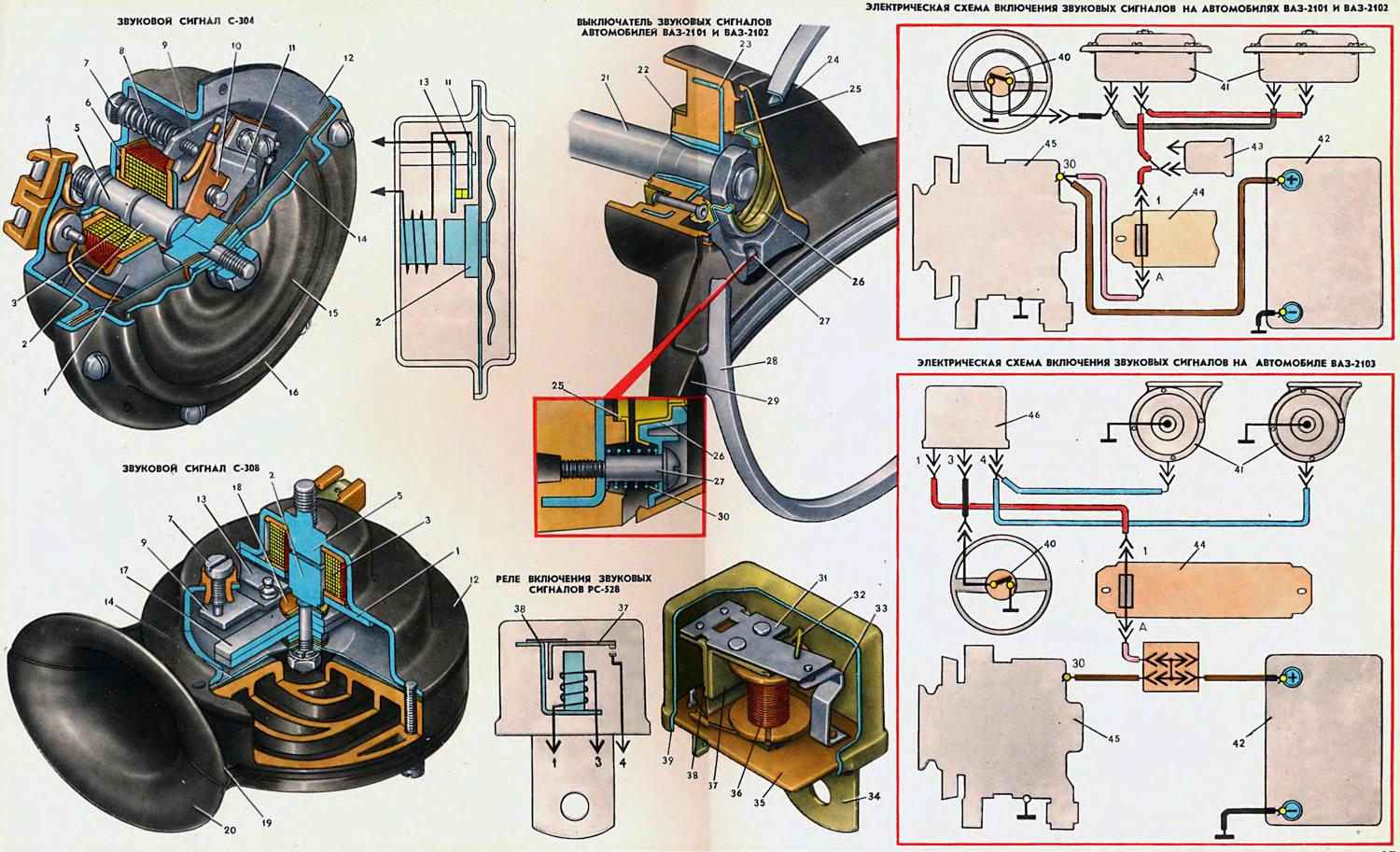
1. Yoke. 2. Anchor. 3. Winding. 4. Contact shoe. 5. Core. 6. Cork gaskets. 7. Adjusting screw. 8. Adjusting screw spring. 9. Bridge. 10. Textolite plate. 11. Fixed contact holder. 12. Housing. 13. Moving contact plate. 14. Membrane. 15. Diffuser. 16. Ring. 17. Weight. 18. Textolite washer. 19. Diffuser housing. 20. Diffuser cover. 21. Steering shaft. 22. Lower contact ring. 23. Steering wheel hub frame. 24. Switch ring cover. 25. Upper contact ring. 26. Switch ring hub. 27. Screws for installing the switch ring. 28. Switch ring. 29. Steering wheel rib. 30. Screw spring. 31. Spring plate. 32. Limiter. 33. Fixed contact post. 34. Relay mounting bracket. 35. Base. 36. Winding. 37. Anchor. 38. Yoke. 39. Cover. 40. Horn switch. 41. Horns. 42. Storage battery. 43. Portable lamp socket. 44. Fuse box. 45. Generator. 46. Horn switching relay.
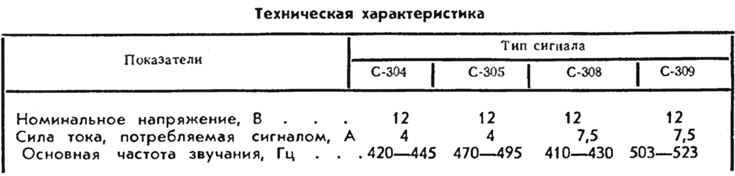
On Zhiguli cars, two sound signals are installed: one high-pitched and the other low-pitched, and on the VAZ-2101 and VAZ-2102, the signals are of the C-304 and C-305 type, and on the VAZ-2103, the C-308 and C-309 type. The sound signals are located in the engine compartment and are attached to brackets on the front panel.
The low-tone C-304 and high-tone C-305 signals are noise-type electromagnetic signals that create sound over a relatively wide frequency range. They differ only in the thickness of the membrane 14: the C-304 signal has a thickness thicker than the C-305. The signals have a steel body 12, to which the core 5 and yoke 1 are welded by contact electric welding, forming the magnetic system of the electromagnet. Under the yoke is a winding 3, insulated from the body by cork gaskets 6 and a nylon bushing. Between the body and ring 16, a membrane 14 made of alloyed hardened steel is clamped. Anchor 2 and steel diffuser 15 are fixed in the center of the membrane. The diffuser serves to create sound of the required frequency and timbre. For normal operation of the signal, there should be a gap of 0.4±0.05 mm between anchor 2 and core 5. This gap is ensured by selecting a gasket between the membrane 14 and the housing 12
Inside the signal housing there is a bridge 9 with a breaker having tungsten contacts. One end of the bridge is attached to the housing, and the other can be moved by screw 7. On the bridge there are fixed a holder 11 with a fixed breaker contact and a spring plate 13 with a movable contact, both insulated with getinax gaskets. A textolite or getinax plate 10 is installed between them. Plate 13 presses the movable contact to the fixed one and therefore the breaker contacts are closed when the signal is switched off.
When the signal is switched on, the current passes through the closed contacts of the interrupter and through the winding 3, creating a magnetic force that attracts the anchor 2. The anchor is attracted, presses the flange of a larger diameter on the plate 10 and opens the contacts of the interrupter, disconnecting the power supply to the winding. The core 5 is demagnetized and the anchor 2 is pulled back by the elastic forces of the membrane. The contacts of the interrupter close and the cycle is repeated. With a frequency of 420-495 Hz, the vibrations of the membrane and the diffuser create air vibrations and provide sound. The strength and timbre of the sound can be adjusted by moving the edge of the bridge 9 together with the contact plates with the screw 7. This changes the moment of opening and closing of the contacts of the interrupter.
Signals C-304 and C-305 are intended for switching on via a two-wire circuit. The output of winding 3 and the wire of plate 13 are soldered to the plugs, which are located in a plastic block 4, attached to the body. One of the plugs is connected to the current source, and the other - through the sound signal switch to ground.
Signals C-308 (low tone) and C-309 (high pitched) are tonal type signals, as they create a sound of a narrow frequency range. Their operating principle is the same as that of the C-304 and C-305 signals, but the design has a number of features. First of all, this is the presence of a diffuser with a snail-shaped channel that amplifies the sound. The dimensions of the channel are selected so as to obtain a sound of the required timbre and strength. The C-308 signal has a longer channel than the C-309. The diffuser has a plastic body 19 and a steel cover 20. The tone of the signal is determined by the mass of the load 17 attached to the anchor. The load is a rectangular steel plate. The C-308 signal has two such plates, and the C-309 signal has only one and it is smaller.
Signals C-308 and C-309 are intended for switching on using a single-wire circuit, i.e. the second conductor for them is the ground. Therefore, the fixed contact of the interrupter is attached directly to the bridge 9 and, therefore, is connected to the ground. The contacts of the interrupter are opened by the textolite washer 18, which presses the elastic plate 13 with the movable contact. For normal operation of the signal, the gap between the anchor and the core should be 1.15±0.05 mm.
Sound signal switch
The switch is located on the steering wheel and has a different design for the VAZ-2101 and VAZ-2103 cars. However, the principle of its operation is the same for both cars and therefore only the switch for the VAZ-2101 and VAZ-2102 cars is described below.
Two contact rings are riveted to the steering wheel hub: the lower 22 and the upper 25, which are electrically connected to each other through rivets. The lower ring 22 is pressed by a spring 73 (see sheet 41) contact 49, through which current from the horn is supplied. In the upper part of the steering wheel hub, the hub 26 of the switch ring 28 is mounted on three screws 27 with springs 30. The ring 28 is cast integrally with the hub 26 and is connected to it by two ribs. The ring hub can move downwards on the screws 27, but the springs 30 press it against the screw heads, providing a gap between the hub and the upper ring within the range of 0.9-1.5 mm. The screws 27 are screwed into the steel frame 23 of the steering wheel hub. Therefore, the hub 26 of the ring is connected to ground through the screws 27, the frame 23 and the steering shaft. When any part of the ring 28 is pressed, the corresponding edge of the hub 26 is pressed against the upper contact ring 25, closing it with ground. The horn is turned on.
Relay for turning on sound signals
(The original can be viewed on the portal VAZBOOK)
Relay type — RS-528. It is used on VAZ-2103 cars. The relay is installed in the engine compartment on the upper part of the left wheel mudguard below the headlight relay.
The relay has a getinax base 35, on which a steel yoke 38 with a core and a post 33 of a fixed contact are fixed. On the core in a plastic frame there is a winding 36. A steel elastic plate 31 with an anchor 37 and a movable contact is riveted to the yoke shelf. A copper plate is placed under it to improve the electrical connection between the yoke and the movable contact. The relay contacts are normally open and close when current passes through the relay winding. The degree of bending of the plate 31 is regulated by a limiter 32, fixed on the relay core.