




Contents: Cylinder block ↓ Piston ↓
Disassembly, assembly and repair of the 21011 engine are similar to disassembly, assembly and repair of the 2101 engine. There are some differences in the repair of cylinder blocks (other cylinder sizes) and in the selection of pistons.
Cylinder block
Cylinder diameter, mm:
- class A: 79,000–79,010;
- class B: 79,010–79,020;
- class C: 79,020–79,030;
- class D: 79,030–79,040;
- class E: 79.040–79.050.
When repairing a cylinder block, it is necessary to hone the cylinders to fit the increased diameters of the pistons of the repair sizes (by 0.4 and 0.8 mm) and taking into account the provision of a gap of 0.05–0.07 mm between the piston and the cylinder, which is measured in the same way as on the 2101 engine.
Piston
Scheme of metal removal from the piston of the 21011 engine to adjust its mass
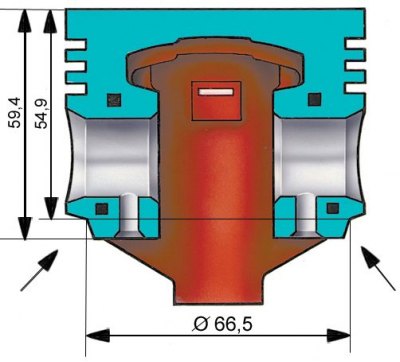
The diameter of pistons of different classes, measured at a distance of 52.4 mm from the piston bottom, mm:
- class A: 78,940–78,950;
- class B: 78,950–78,960;
- class C: 78,960–78,970;
- class D: 78,970–78,980;
- class E: 78.980–78.990.
Until 1988, piston diameters were 0.01 mm smaller than specified.
The increase for piston repair sizes is 0.4 and 0.8 mm. Until 1986, pistons of repair sizes were produced with a diameter increase of 0.4 and 0.7 mm.
Just like on the 2101 engine, the pistons of one engine should not differ in weight by more than 2.5 g. When adjusting the weight, the metal removal should not exceed 4.5 mm in depth relative to the nominal piston height (59.4 mm), and in width it should be limited to a diameter of 70.5 mm.
(The original source is published on the website: VazBook)
On the bottom of the piston there is a recess with a diameter of 55 mm and a depth of 1.9 mm.
When pressing the piston pin into the connecting rod, it is necessary to use the 02.7853.9500 tool instead of the A.60325.
When installing pistons into cylinders, use a set of bushings 02.7854.9500, similar to the set of bushings A.60604 (see Fig p. 9 of subsection 3.5).
Set 02. 7854.9500 includes three bushings: one for normal size pistons, two for oversize pistons (increased by 0.4 and 0.8 mm).