




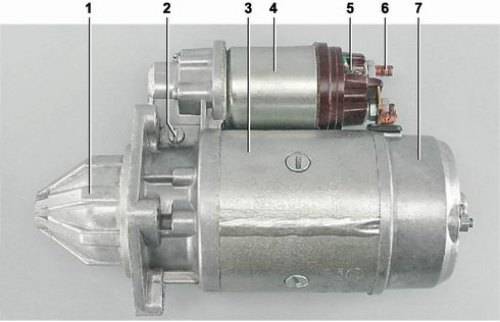
Starter 4216.3708-02: 1 - front cover; 2 - drive lever axis; 3 - body; 4 - starter traction relay; 5 - terminal "50" of the traction relay; 6 - contact bolt; 7 - rear cover of the starter
The starter consists of a housing with excitation windings, an anchor with a drive gear and an overrunning clutch, two covers and a traction electromagnetic relay. The covers and the starter housing are pulled together into a single unit by two studs running inside. The studs are insulated from the stator windings by plastic tubes. A partition with a rubber sealing ring is installed between the front cover and the housing.
Technical characteristics of starter 4216.3708-02:
| Nominal voltage, V | 12 |
| Nominal power, kW | 1,65 |
| Starting power not less than, kW | 1,05 |
| Starting current in the braked state, A | 600 |
| No-load current, A | 85 |
| Weight, kg | 7,2 |
| Direction of rotation | right |
| Working hours | short-term, lasting no more than 10 s |
Four poles with excitation windings (coils) installed on them are secured with screws inside the housing. The main current consumed by the starter and depending on the load flows through two coils connected in series with the armature winding. The other two coils are connected in series and connected in a circuit parallel to the armature. Such a connection of coils provides an optimal shaft rotation frequency at idle speed without loads. The armature shaft rotates in two bronze-graphite bushings pressed into the starter covers. The armature consists of a shaft, a core with a winding and a collector. A drive gear is installed on the front end of the shaft, rigidly connected to the hub of the roller overrunning clutch and a drive ring. The movement of the gear on the shaft is limited by the ring. On the inner surface of the hub there are screw splines that engage with the screw splines of the shaft. The bushings installed on the ends of the drive lever fork enter the groove of the drive ring. The other end of the lever rests on the rod of the electromagnetic traction relay, secured to the front cover with three screws.
The back cover contains a brush holder with two brushes isolated from the body (positive) and two shorted to the body (negative) brushes. The positive brushes are connected to the terminals of the coils, which are connected in series with the anchor. The negative brushes are connected to the "ground", and one of the brushes is connected to the terminal of the coils, which are parallel to the anchor. The brushes are pressed to the anchor collector by springs.
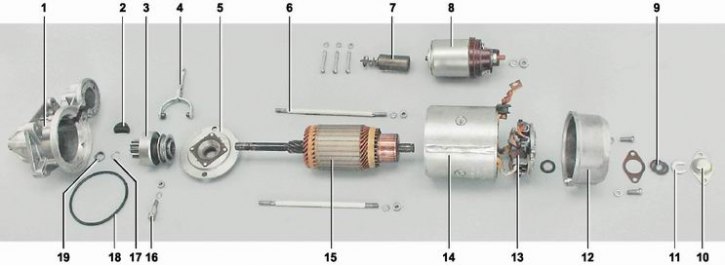
Starter parts 4216.3708-02: 1 - front cover; 2 - seal; 3 - overrunning clutch with drive gear; 4 - drive lever; 5 - partition; 6 - tie rod; 7 - rod; 8 - starter traction relay; 9 - adjusting washers; 10 - armature shaft casing; 11 - lock washer; 12 - rear cover of the starter; 13 - brush holder; 14 - housing with stator; 15 - starter anchor; 16 - drive lever axis; 17 - retaining ring; 18 - sealing ring; 19 - gear travel limiting ring
Traction relay the starter is connected via a relay located in the engine compartment on the right mudguard (in the variant version of the car the starter relay may be absent).
The traction relay is used to engage the starter drive pinion with the flywheel ring gear and to close the power supply circuit of the armature and stator windings. Contact bolts are installed in the relay cover. One bolt is connected by a wire to the positive terminal of the storage battery, and the other is connected to the stator and relay windings. When the ignition key is turned to position II ("starter"), voltage is supplied to terminal "50" of the traction relay cover. The resulting magnetic field pulls in the armature. The contact plate closes the contact bolts, and the rod acts on the drive lever. The lever, moving the drive pinion, engages it with the toothed ring of the engine flywheel. The supply current of the stator and armature flows through the closed contacts of the relay. As a result of the interaction of the magnetic fields, the starter armature begins to rotate together with the hub and the outer ring of the overrunning clutch. In this case, the rollers of the overrunning clutch are wedged between the outer and inner rings of the clutch. The torque from the armature shaft is transmitted through the clutch and the drive pinion to the flywheel ring gear. After the engine starts, the rotation speed of the pinion begins to exceed the rotation speed of the starter armature shaft. The clutch rollers are wedged and the torque from the flywheel is not transmitted to the starter armature shaft. When the key is returned to position I ("ignition"), the power supply circuit of the traction relay windings is opened and, under the action of the relay return spring, the armature returns to its original position, opening the contacts and disengaging the drive pinion.
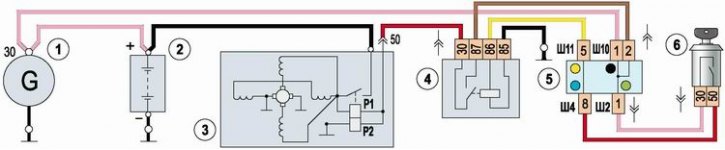
Starter electrical connection diagram: 1 - generator; 2 - battery; 3 - starter; 4 - relay; 5 - mounting block; 6 - ignition switch
Some vehicles are equipped with a 5722.3708 starter. The starter designs are similar, but unlike the 4216.3708-02 starter, the 5722.3708 starter has a planetary gearbox to transmit torque from the anchor to the drive pinion.