




Open large image in new tab »
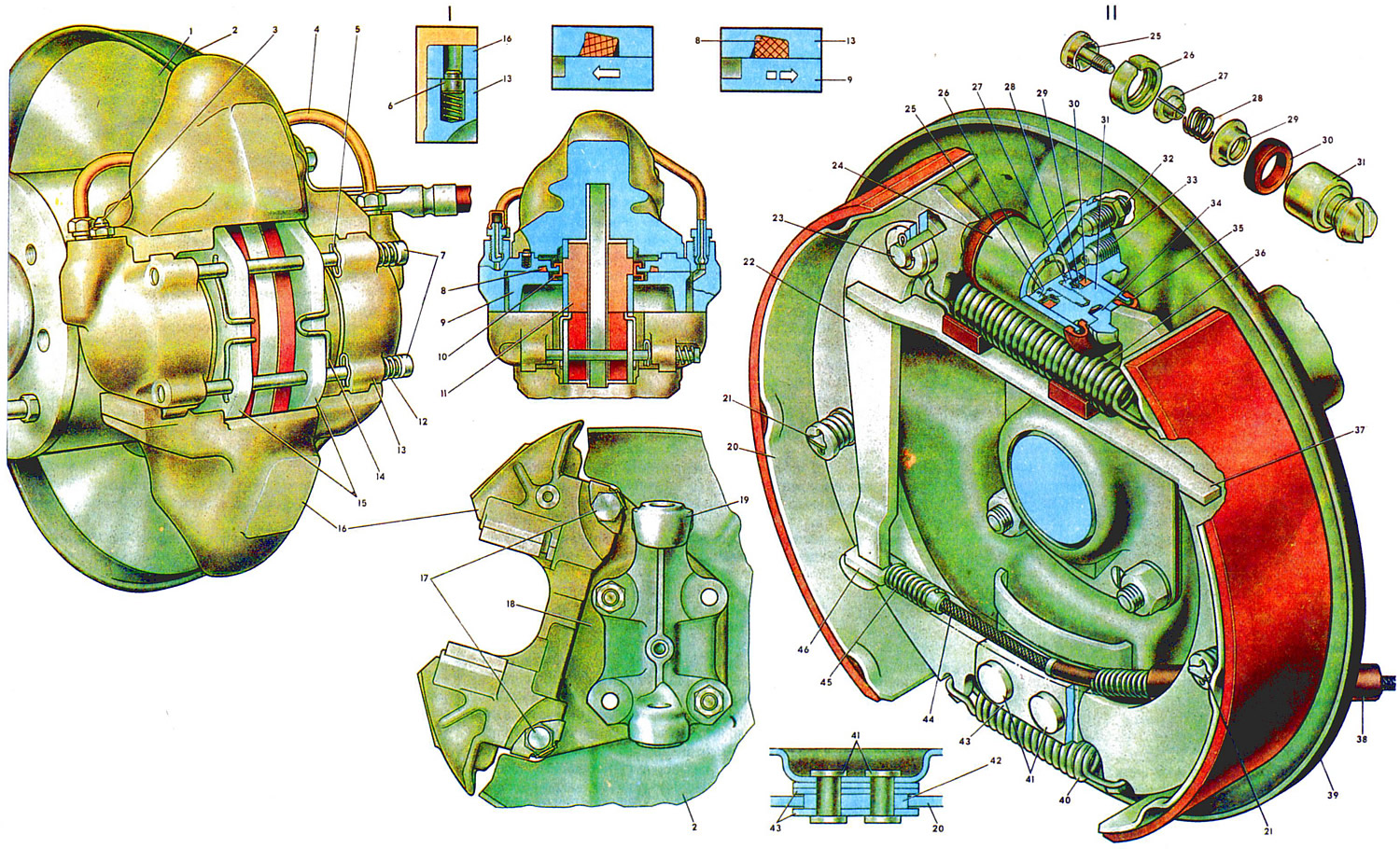
Fig. 26. Wheel brake mechanisms: 1. Front brake disc. 2. Protective cover. 3. Front brake bleed nipple. 4. Cylinder connecting pipe. 5. Cotter pin. 6. Wheel cylinder retainer. 7. Brake shoe fastening pins. 8. Sealing ring. 9. Wheel cylinder piston. 10. Protective cap. 11. Brake shoe linings*. 12. Shoe fastening pin spring. 13. Front brake wheel cylinder. 14. Shoe pressure spring. 15. Brake shoe. 16. Brake caliper. 17. Caliper fastening bolts. 18. Caliper fastening bracket. 19. Steering knuckle. 20. Rear brake shoe. 21. Brake shoe support post. 22. Manual brake shoe drive lever. 23. Lever pin. 24. Wheel cylinder. 25. Thrust screw. 26. Thrust ring. 27. Crackers. 28. Spring. 29. Support cup. 30. Seal. 31. Wheel cylinder piston. 32. Rear brake drive bleed nipple. 33. Brake fluid supply pipe nipple. 34. Brake shoe stop. 35. Wheel cylinder protective cap. 36. Upper brake shoe tension spring. 37. Brake shoe spacer plate. 38. Rear cable casing. 39. Brake shoe support shield. 40. Lower brake shoe tension spring. 41. Rivet for fastening support and guide plates. 42. Support plate of shoes. 43. Guide plate of shoes. 44. Rear cable of parking brake drive. 45. Rear cable spring. 46. End of rear cable. I - Front wheel brake mechanism. II - Rear wheel brake mechanism.
Wheel brakes are mounted directly into the vehicle's wheels. They are designed to create resistance to the vehicle's movement.
The front wheel brake mechanism is disc and open, which ensures good cooling and, as a result, more effective braking during frequent use of the brakes, when the heating of the pads can reduce the friction coefficient of their linings.
The brake mechanism consists of a support 16 assembled with working cylinders, a disc 1, two brake pads 15, pins 7 for fastening the pads and pipelines.
The caliper is cast from high-strength cast iron. It is attached to the bracket 18 with two bolts 17, which are fixed with bent locking plates on the edge of the bolts. The bracket 18 is attached to the flange of the steering knuckle 19 together with the protective casing 2 and the steering lever. The caliper has a radius groove for placing the brake disc and two transverse grooves in which the brake shoes are located. In the caliper lugs there are two windows with guide grooves in which two opposite wheel cylinders 13 are installed. The exact positioning of the cylinders relative to the caliper is ensured by spring clamps 6. When installing the cylinder in the caliper groove, the clamp, under the action of the spring, enters a special side groove of the caliper.
The body of the working cylinder is cast from an aluminum alloy. The cylinder contains a hollow steel piston 9, which is sealed with an elastic rubber ring 8. It is located in the groove of the cylinder and serves not only to seal the gap, but also to return the piston to its original position when releasing the brakes. The cavity of the cylinder is protected from contamination by a rubber cap 10, the outer edge of which is held on the flange of the cylinder, and the inner edge covers the piston seating belt.
The working cavities of the cylinders are connected to each other by a tube 4. A nipple 3 for bleeding the front brake drive is screwed into the outer cylinder, and a nipple for supplying fluid is screwed into the inner cylinder. Pistons 9 rest against brake shoes 15, to which friction linings 11 are glued. The shoes are mounted on guide pins 7, which are held from axial displacement by cotter pins 5, and to prevent vibrations of the shoes on the pins, springs 14 are used, pressing the shoes to the pins. Springs 12 are installed under the heads of the pins.
The brake disc is connected to the wheel hub by two mounting pins. Part of its working surface is located between the brake shoe linings. The friction surface of the disc is machined with great precision, which increases the service life of the brake mechanism.
When braking, the pistons under fluid pressure move out of the wheel cylinders and press the pads against the brake disc. A braking torque is created on the front wheels. When moving, the pistons drag the sealing rings 8 along with them, which twist. When releasing the brakes, when the pressure in the front wheel drive drops, the pistons, due to the elastic deformation of the rings 8, move back into the cylinders. In this case, the linings 11 of the brake pads will be in light contact with the brake disc.
When the linings wear out and the gap in the brake mechanism increases, more fluid pressure is created in the drive to create a braking torque. Under the action of the fluid pressure, the pistons 9 slide relative to the rings 8 and take a new position in the cylinders, which ensures an optimal gap between the disk and the pads. When replacing the pads, when the thickness of the linings decreases to 1.5 mm, the pistons are manually pressed into the cylinders to install new pads.
The rear wheel brake mechanism is a drum brake, mounted on a support shield 39, which is bolted to the flange of the rear axle beam. A pack of plates is attached to the lower part of the shield with two rivets 41, of which plate 42 is a support for brake shoes 20, and plates 43 limit the axial movement of the lower part of the shoes. The inner curved plate limits the movement of cable 44 towards the shield. In the upper part of shield 39, wheel cylinder 24 is attached with two bolts. From the outside, nipple 32 for bleeding the rear brake drive and nipple 33 of the tube for supplying fluid to the cylinder are screwed into the threaded hole of the cylinder.
On both sides of the cylinder, pistons 31 are installed in an assembly with seals and parts of the automatic device. The main element of the automatic device is a split thrust ring 26, located in this subassembly between the flange of the thrust screw 25 and two crackers 27 with a gap of 1.4; 1.6 mm. The thrust rings are installed in the cylinder with tension, providing a force of shifting the ring along the cylinder mirror of at least 35 kgf, which exceeds the force from the tension springs of the brake shoes. A slot is made in the thrust ring for air to escape when bleeding the brake system.
The seal 30 is pressed against the end surface of the piston through the support plate 29 by the spring 28. From the outside, stops 34 are pressed into the pistons, into the grooves of which the upper ends of the brake shoes enter. The cavity of the wheel cylinder is sealed by a rubber cap 35, which is put on the piston with its inner edge, and on the cylinder body with its outer edge.
With an optimal gap between the pads and the drum, the pistons 31 in the wheel cylinder move by the amount of the gap between the flange of the thrust screw 25 and the flange of the thrust ring (1.4-1.6 mm). In this case, the pads are pressed against the brake drum, creating the necessary braking torque, and the thrust rings 26 remain in place.
When the linings wear out, the gap of 1.4-1.6 mm is completely selected and the flange of the stop screw rests against the flange of the stop ring, as a result of which the stop ring shifts after the piston by the amount of wear of the linings. When braking stops, the pistons are shifted by the force of the tension springs until the crackers 27 stop against the flange of the stop screw 25. In this way, the optimum gap between the shoes and the drum is automatically maintained.
To prevent axial displacement of the middle part of the shoes, springs are installed on the posts 21, pressing the middle part of the shoes to the brake shield 39. Due to the non-rigid connection of the shoes with the brake shield, they self-adjust at the moment of contact with the brake drum, which improves braking efficiency and leads to more uniform wear of the linings glued to the shoes.
Brake drum 4 (see fig. 21) is cast from an aluminum alloy, has stiffening ribs on the outer surface and through holes for communicating the inner cavity of the drum with the atmosphere. Inside the drum there is a cast-iron ring 5, with which the brake shoes are in contact. The drum is attached to the flange of the axle shaft with two pins 2 and additionally together with the wheel with bolts 1. Two threaded holes are made in the drum, into which the mounting pins 2 are screwed when removing the drum. Such removal is possible only if the drum is not "stuck" to the flange of the axle shaft, otherwise the thread in the drum holes may be stripped. To prevent such "stuck" during assembly, it is necessary to apply graphite grease to the contacting surfaces of the drum and axle shaft.
When using the parking brake, the brake shoes 20 (see fig. 26) are pressed against the drum by moving the lever 22 and the expansion bar 37. The lever 22 is seated on the pin 23 and, together with the rib of the brake shoe, rests against the groove of the expansion bar. The tip 46 of the rear cable 44 is put on the lower end of the lever. The second end of the cable is connected to the brake mechanism of the other wheel. For protection and support against the brake shield, both knees of the cable are enclosed in a multilayer casing 38 made of plastic tubes and wire braiding. Return springs 45 are put on the ends of the cable, which return the rear cable to its original position when it is released from force.