




Brake drive
The service brake drive is hydraulic, foot-operated. The main brake cylinder is double-cavity, has two coaxial pistons.
The hydraulic drive of the rear wheels includes a pressure regulator in series, which reduces the pressure in the hydraulic drive when the load on the rear axle decreases, which prevents the "skidding" of the rear wheels and thereby increases the stability of the vehicle. The brake drive of the VAZ-2103 is additionally equipped with a vacuum booster and an alarm about an insufficient level of brake fluid in the reservoir of the main cylinder.
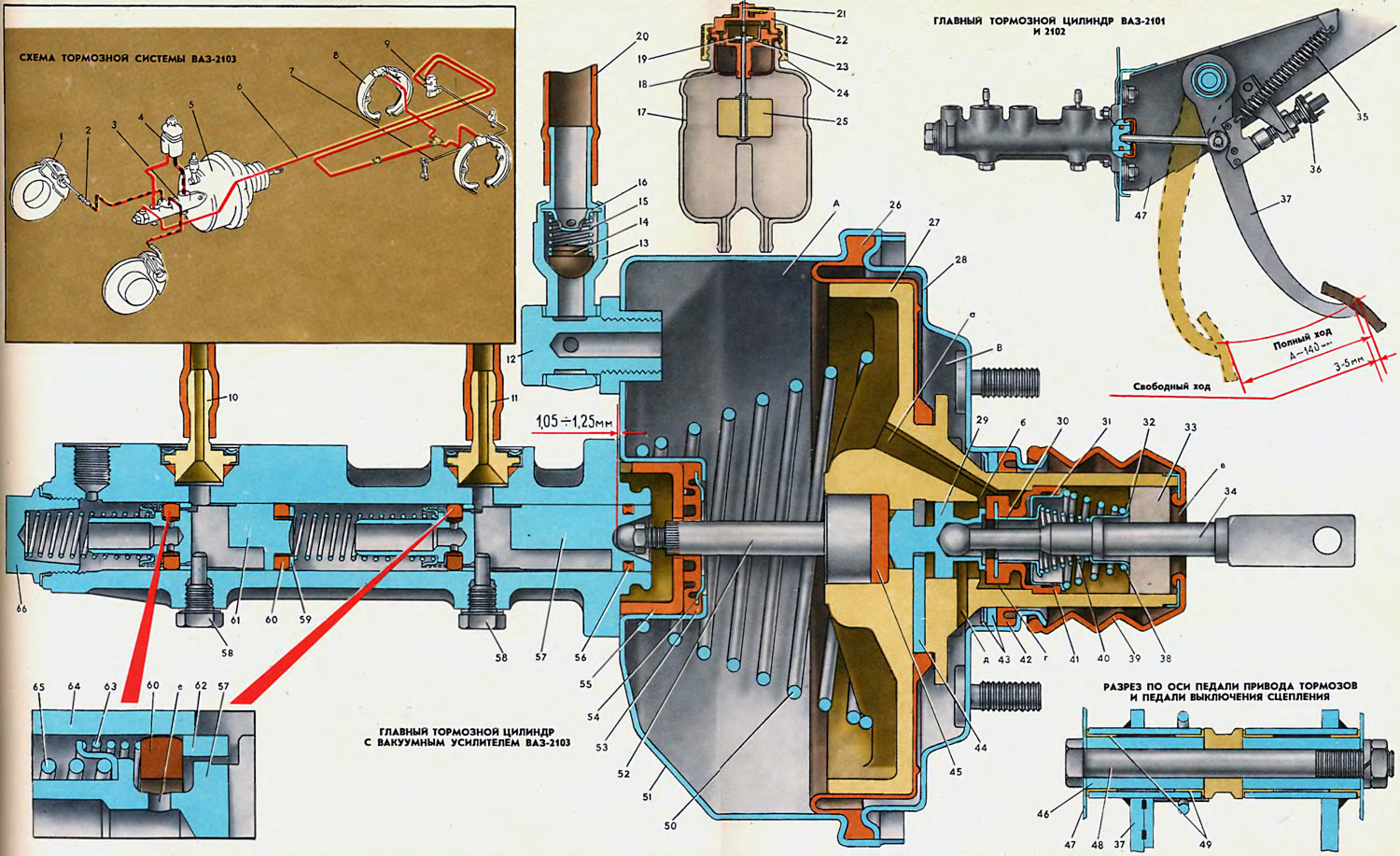
Open large image in new tab »
1. Front wheel brake. 2. Front circuit line. 3. Brake master cylinder. 4. Brake fluid reservoir. 5. Vacuum booster (2103). 6. Rear circuit line. 7. Regulator drive lever. 8. Rear wheel brake. 9. Pressure regulator. 10. Rear brake circuit nipple. 11. Front brake circuit nipples (two). 12. Vacuum hose nipple. 13. Tip. 14. Tip valve. 15. Valve spring. 16. Spring thrust cup. 17. Feed tank. 18. Plug deflector. 19. Movable contact. 20. Hose. 21. Pusher. 22. Terminal cover. 23. Fixed contacts (two). 24. Filler tank cap. 25. Float. 26. Diaphragm. 27. Valve body 28. Booster body cover. 29. Piston. 30. Valve support sleeve. 31. Front support cup. 32. Rear support cup. 33. Air filter. 34. Valve tappet. 35. Return spring. 36. Brake light switch. 37. Brake pedal. 38. Return spring. 39. Protective cap. 40. Valve spring. 41. Valve. 47. Self-tightening oil seal. 43. Pressure and retaining rings. 44. Thrust plate. 45. Rod base buffer 46. Axle bushing. 47. Pedal bracket. 48. Pedal axle. 49. Pedal bushing. 50. Return spring. 51. Booster housing. 52. Piston drive rod. 53. Self-tightening oil seal. 54. Sleeve. 55. Distance cup. 56. Sealing ring. 57. Front brake piston. 58. Lock screw. 59. Thrust washer. 60. Seal. 61. Rear brake piston. 62. Spacer ring. 63. Pressure spring. 64. Master cylinder housing. 65. Return spring. 66. Plug. a — communicating channel; b - annular gap; in — air intake window; g - annular gap; d — channel; e — hole; A - vacuum cavity; B is an atmospheric cavity.
The main components of the hydraulic brake drive are: the brake pedal, the vacuum booster 5 (only for VAZ-2103), master brake cylinder 3, feed tank 4 for brake fluid, pipelines, pressure regulator 9 and wheel cylinders of the front and rear brakes.
The brake pedal is mounted on the same axis 48 as the clutch pedal. The axis 48 is secured in the holes of the bracket cheeks 47 and rotates in two polyamide bushings 49. The brake pedal is constantly pulled back to its original position by the spring 35 and in the free state rests against the tip of the brake light switch 36.
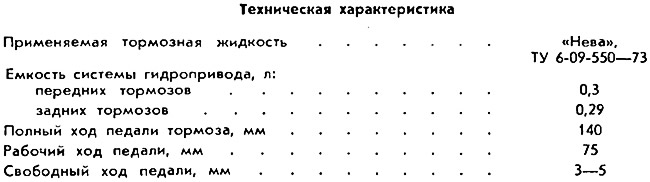
Free travel of the brake pedal is adjusted only on the VAZ-2101 and VAZ-2102 by changing the position of the brake light switch.
The free travel of the brake pedal on the VAZ-2103 is not adjusted during operation, but is provided during assembly.
The master brake cylinder piston pusher is connected to the brake pedal (for VAZ-2101 and 2102) or pusher 34 of the brake booster valve (for VAZ-2103).
The main brake cylinder is attached to the vertical shelf of bracket 47 (VAZ-2101 and 2102) or a vacuum brake booster together with the main brake cylinder (VAZ-2103). When fastening, a rubber gasket is installed between the housing cover and the mating surface of the front shield.
The vacuum brake booster consists of three main units: the booster body 51, the cover 28 and the valve body 27 with the diaphragm 26, which divides the booster into two cavities - vacuum A and atmospheric B. The valve body 27 acts as a piston moving in the booster body 51. The seal between the valve body and the booster body is the diaphragm 26.
The valve body hub opening contains: the stem base, the rubber buffer 45, the valve 41 and the foam air filter 33. The rubber valve 41 is assembled on the pusher 34. The stationary flange of the valve, constantly pressed by the return spring 38 through the support cup 31, creates a reliable seal with the body wall. The movable flange of the valve 41, reinforced with a steel washer, is put on the sleeve 30 with the support crown and is constantly pressed by the internal conical spring 40.
The spherical head of the pusher 34 enters the piston seat 29 and is fixed there by stamping the piston neck at three points.
The assembled valve is inserted into the housing 27 and fixed in it by the stop plate 44. The plate 44 is held from falling out during the operation of the amplifier by the diaphragm 26.
The valve body together with the return spring 50 is inserted into the body 51 of the amplifier and closed by the cover 28, which is locked by turning the cover until its edges are inserted under the locking projections of the amplifier body. The joint between the body and the cover is sealed by the diaphragm flange clamped between them.
The outlet of the valve body hub from the hole in cover 28 is sealed with a self-tightening gland 42. The part of the valve body hub that extends during operation is protected by a rubber corrugated cap 39.
The outlet of rod 52 from the amplifier body is sealed by a self-tightening gland 53, reinforced by a steel collar 54. The gland is evenly pressed against the wall of the socket by a spacer cup 55, creating the necessary tightness of the amplifier body.
Before connecting the main brake cylinder to the booster, the head of the rod 52 is adjusted to the amount of protrusion beyond the plane of the body 51, equal to 1.05-1.25 mm. The amount of protrusion determines the free travel of the brake pedal
A bushing for attaching a vacuum hose is welded into the front wall of the booster housing. A rubber valve 14 with a pressure spring 15 is mounted in the tip 13, which prevents the combustible mixture from entering the booster vacuum cavity. A flexible hose connects the vacuum booster to the engine intake pipe.
The main brake cylinder has a through cylindrical hole, machined with great precision and high surface purity of the mirror. Five holes are made in the top of the cylinder for communication of the cavity of the front brake hydraulic drive with the feed tank 17, the wheel cylinders of the front brakes and the pressure regulator of the rear brakes.
Locking screws 58 are screwed into the threaded holes of the housing from below, limiting the movement of pistons 57 and 61. Copper sealing gaskets are installed under the heads of the locking screws.
The main brake cylinder contains: piston 57 of the front brake hydraulic drive with sealing ring 56, piston head seal 60 and spacer ring 62, piston 61 of the rear brake hydraulic drive with seals 60, thrust washer 59 and spacer ring 62. Piston head seal 60 is constantly pressed by spring 63, the front end of which rests through the cup against return spring 65. In the lower part of piston 57, a longitudinal groove is made for a locking screw. The length of the groove determines the maximum piston stroke. In the piston head, there is a through radial hole for the passage of brake fluid.
The central drilling of the piston tail, two opposite holes in the neck of the annular groove and the labyrinth formed by the surfaces of the seal, spacer ring 62 and piston are intended for the passage of brake fluid under various braking modes.
The seal 60 of the piston head 61 is pressed by the spring 63. The piston itself is constantly pressed in a free state to the extreme rear position by the return spring 65.
The design of piston 61 is similar to the design of piston 57, except for the rear part, in which, instead of sealing ring 56, a seal 60 with a toroidal sealing surface is installed, due to which the seal can withstand high specific pressures of the brake fluid.
The lower groove of piston 61 is shorter than the similar groove of piston 57, since a smaller volume of brake fluid is required to operate the rear brakes.
Both cavities of the main brake cylinder are connected by hoses to the cavities of the feed tank 17 (VAZ-2103) or two separate tanks (VAZ-2101 and 2102).
Feed tank of the VAZ-2103 car (and other car models) made of translucent polyethylene, which facilitates visual control of the brake fluid level. The volume of the tank is divided by a partition into two cavities: the right cavity (in the direction of the car) — for backup power supply of the front brake hydraulic drive, the left cavity — for backup power supply of the rear brake hydraulic drive.
The filler neck of the tank is closed by a plug 24, which has a device for monitoring the level of brake fluid in the tank, which includes a float 25 and a movable contact 19, installed on its rod. The foam propylene float, floating in the brake fluid, goes down when its level decreases and at a certain moment closes the circuit of the control lamp with a movable contact, which lights up with a constant light. Fixed contacts 23 are riveted to the bottom of the plastic housing. Electric power is supplied to them through the terminals of the plastic cover 22.
A pusher 21 is inserted into the central hole of the terminal cover, which is used to check the operation of the control lamp circuit (with a full tank, pressing the pusher, press the rod with the float until the control lamp circuit is closed by the movable contact - the lamp should light). When assembled, the housing is held in the plug 24 by two latches.
The VAZ-2101 and VAZ-2102 models do not have devices for monitoring the brake fluid level.