




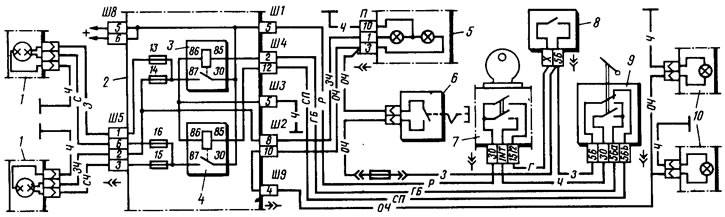
Figure 144. Headlight and fog light connection diagram: 1 - headlights (fragment); 2 - mounting block (fragment); 3 - high beam headlight relay; 4 - low beam headlight relay; 5 - instrument cluster with high beam indicator lamps - on the left - and fog light - on the right (fragment); 6 - fog light switch in rear lights; 7 ignition switch (fragment); 8 - outdoor lighting switch; 9 - headlight switch; 10 - fog lamps in the rear lights (fragment)
Regardless of the position of switch key 8, you can briefly turn on the high beam headlights by pulling the headlight switch lever towards you. In this case, voltage is supplied to contact "30" of switch 9 from contact "1NT" of the ignition switch.
Some cars are equipped with a headlight corrector. It serves to correct the angle of the headlight beam depending on the load on the car. The corrector consists of a master cylinder mounted on the instrument panel, actuator cylinders mounted on the headlights, and connecting tubes. The cylinders and tubes contain a special liquid that does not freeze at low temperatures.
Outdoor lighting
The connection diagram is shown in Figure 145. The side light is switched on by switch 10 of the external lighting. The parking light is switched on by switch 8 if the key of ignition switch 6 is in position III (parking). In this case, the side light lamps of the left or right side of the car light up depending on the position of switch 8.
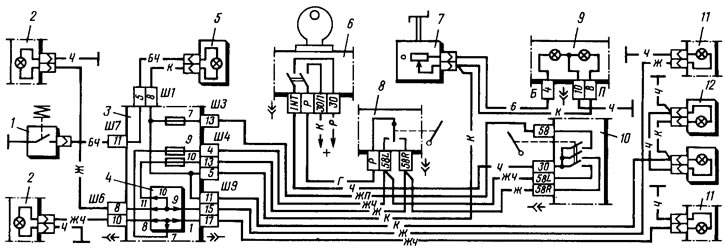
Figure 145. External lighting connection diagram: 1 - underhood lamp switch; 2 - side light bulbs in headlights; 3 - mounting block (fragment); 4 - contact jumpers at the installation site of the lamp control relay; 5 - underhood lamp; 6 - ignition switch (fragment); 7 - Instrument lighting switch; 8 - Parking light switch; 9 - instrument cluster with instrument lighting lamps (left) and external lighting indicator lamp (right); 10 - Outdoor lighting switch; 11 - side light bulbs in the rear lights; 12 - License plate lights
Direction indicators and hazard warning lights
The connection diagram is shown in Figure 146. The right or left side direction indicators are switched on by switch 6. In the emergency signaling mode, all direction indicators are switched on by switch 8. Flashing of the lamps is provided by flasher relay 4.
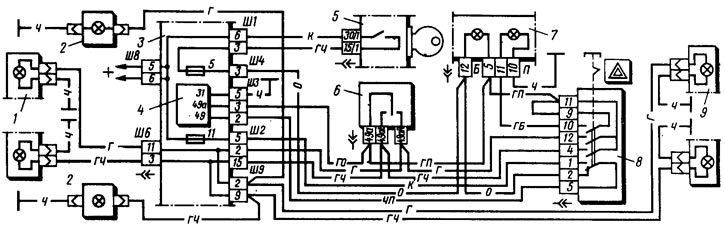
Figure 146. Wiring diagram for direction indicators and hazard warning lights: 1 - direction indicator lamps in headlights; 2 - side direction indicators; 3 - mounting block (fragment); 4 - relay-interrupter of direction indicators and hazard warning lights; 5 - ignition switch; 6 - direction indicator switch; 7 - instrument cluster with indicator lamps for direction indicators (left) and hazard warning lights (right); 8 - hazard warning switch; 9 - direction indicator lamps in the rear lights
Sound signal
The car is equipped with a C309 or C308 horn. If the signal volume decreases or a wheezing sound appears, adjust the signal by turning the screw on its body in one direction or another until a loud and clear sound is obtained. If the adjustment does not eliminate the wheezing or the signal works intermittently, disassemble the signal and clean the breaker contacts. When assembling the signal, install the previous gasket between the membrane and the signal body so as not to disturb the gap (1.15±0.05) mm between the core and the anchor. If the signal does not turn on, check the reliability of the wire connection, the condition of the switch and relay contacts in the mounting block. Clean the contacts if necessary.
Possible malfunctions of lighting and light signaling are listed in table 23.