




The lubrication system consists of an oil pump, an oil filter, a crankcase, an oil filler neck on the cylinder head cover, an oil level indicator in the crankcase, and channels in the block and cylinder head. The oil pressure is monitored by the oil pressure indicator on the instrument panel. The indicator sensor is screwed into the hole of the oil line in the cylinder head, connected to the main oil line in the cylinder block. The oil pressure should be at least 4.5 kgf/cm² at a crankshaft speed of 5600 rpm. The minimum oil pressure should be at least 0.8 kgf/cm² at 750-800 rpm. If the oil pressure drops below the permissible level, one of the control lamps and the "STOP" light panel on the instrument cluster light up red.
Oil pump
Gear, with internal gears, is located on the front end of the crankshaft. The pump consists of a cover 9 (figure 10), housing 1 with suction and discharge cavities and oil receiver 11. The driving 3 and driven 2 gears are installed in the housing. To ensure the necessary clearances between the gears and the housing when the temperature changes, the housing is cast from cast iron, the gears are made of metal ceramics. In the housing, the suction cavity is separated from the discharge cavity by a sickle-shaped protrusion 3 (figure 11).
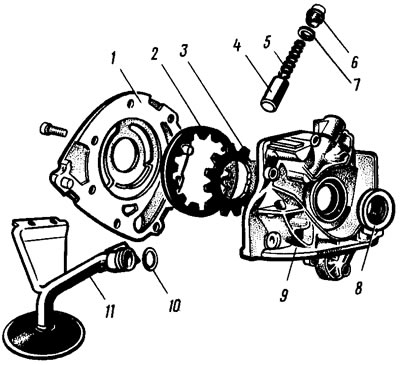
Figure 10. Oil pump |
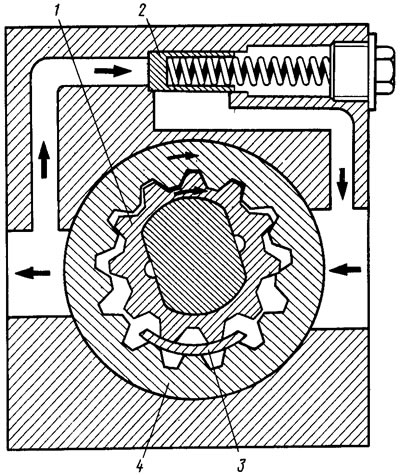
Figure 11. Oil pump operation diagram |
Host 1 (with external teeth) and driven 4 gears of the pump suck in oil and feed it into the pump discharge cavity with the tooth cavities. At a pressure above 4.5 kgf/cm², the pressure reducing valve 2 opens and part of the oil is bypassed into the pump suction cavity.
Under the cork 6 (see figure 10) an aluminum ring 7 is installed on the pressure reducing valve. The crankshaft in the cover 9 is sealed with a seal 8. The oil receiver 11 is sealed with a rubber ring 10.
Oil filter
Interchangeable with the oil filter of the VAZ-2105 engine. The filter is full-flow, non-separable. A filter element made of special cardboard is installed in the steel housing.
It is not allowed to install large;a-barite oil filter type 2101, as it can touch the right wheel drive shaft.
Crankcase ventilation
Forced, closed, preventing the release of crankcase gases into the atmosphere. When the engine is running, gases through the exhaust hose 9 (figure 12) are sucked into the oil separator housing 8, the mesh 6 separates the oil. Then the crankcase gases are sucked through the upper exhaust hose 5 and the crankcase gas outlet tube 2 and enter the engine combustion chambers with the combustible mixture.
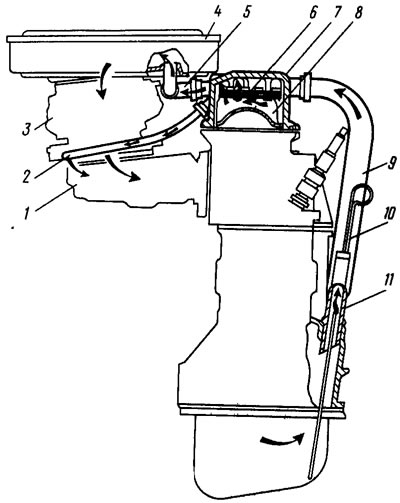
Figure 12. Crankcase ventilation diagram: 1 - inlet manifold; 2 - tube for removing crankcase gases into the carburetor's throttle space; 3 - carburetor; 4 - air filter; 5 - Upper crankcase ventilation tension hose; 6 - oil separator mesh; 7 - cylinder head cover; 8 - oil separator housing; 9 - lower exhaust hose; 10 - oil level indicator; 11 - nipple